
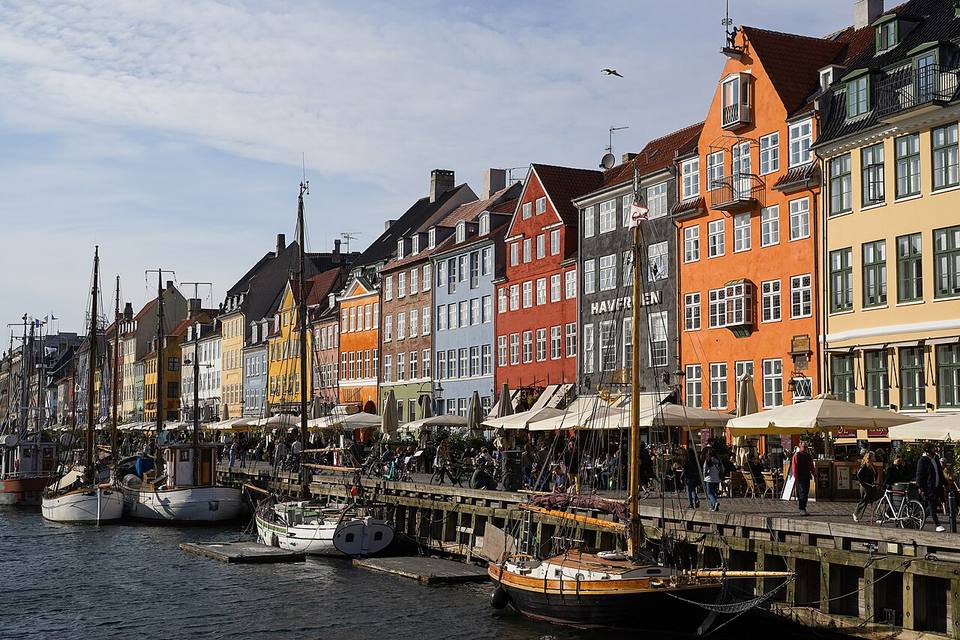
Nyhavn, Copenhagen

Country guide · dk

Denmark

In Copenhagen's Nyhavn, a former trading port, Andersen's homes and today's quayside life share the same waterfront. Walk the canal first; notice how cycling, food and public space shape the day, then carry those observations into the wider culture of Denmark and the Nordic region.

Photo: OleNeitzel · CC BY 4.0
CurrencyDKK Danish kroneEurope ↗
GoTerraVoya · 2026

Denmark

01

Getting Around

Intercity travel is mainly by DSB trains, linking Copenhagen with Aarhus and Odense, and crossing the Great Belt Bridge and the Øresund Bridge to Malmö in Sweden; islands such as Bornholm are reached by domestic flights and ferries. In cities, Copenhagen's driverless metro runs around the clock, alongside S-trains, buses and harbour buses; Aarhus has light rail. Rural areas are known for a national cycle-route network, with cycling popular on Bornholm and in North Jutland. Tickets: the old blue physical Rejsekort was withdrawn in June 2026; visitors should instead use the DSB App / Rejsebillet App, the Rejsekort App for tap-in/tap-out settlement, or the new Basiskort physical card, as officially published. Fares are charged by zone; a ticket for central Copenhagen does not cover the airport, which lies in another zone, and a wrong-zone ticket counts as no ticket. Buses and the metro have no gates and work on trust plus frequent inspections; fare evasion fines are on the order of hundreds of Danish kroner, as officially published.

02

Etiquette & Taboos

  • 🔴 Red Line: travelling without a ticket is heavily fined; cycling through red lights or at night without lights can be fined; there is no fixed blood alcohol limit for cyclists, but riding while too intoxicated to cycle safely can be fined.
  • 🟡 Taboo: walking, photographing or stopping on cycle lanes; changing lanes suddenly without hand signals; dawdling on Copenhagen cycle lanes at rush hour and blocking commuter flow.
  • 🟢 Good Manners: cycle on the right, look back before overtaking, and signal by hand before turning or stopping; turn left in two stages (ride straight to the far corner, then cross on the next green) rather than turning directly; as a pedestrian, check the cycle lane before crossing; queue to board and alight, and offer seats to older and pregnant passengers.
  • Common pitfalls for visitors: ① following old guides and buying the withdrawn Rejsekort card; ② walking or photographing on cycle lanes, where fast traffic makes collisions likely and locals react strongly; ③ turning left directly, which is both illegal and dangerous; ④ buying the wrong-zone ticket to the airport and being treated as travelling without a ticket.

Source leads are being checked individually; confirm travel details with local official notices.

Regional deep dives

Read deeper into each place

Nyhavn, Copenhagen

The Nordics · Harbour district / city character

Nyhavn, Copenhagen

Rows of coloured gables along a hand-dug 17th-century canal; Hans Christian Andersen lived at Nos. 18, 20 and 67 — every beer at Nyhavn is drunk beneath the windows of the fairy-tale writer.

Read more
Location

Copenhagen, Denmark

Stories and legends

There is no myth or legend; Andersen's residence here belongs to documented history.

History and context

Nyhavn was dug out as a harbour canal between 1660 and 1673, and the terraced houses on both sides were mostly built in the 17th–18th centuries; it was originally a noisy port quarter of sailors and merchants (with a past of taverns and red-light colour alike). Andersen lived at several Nyhavn addresses on and off between 1834 and 1875 (No. 20 was his first home here; he lived longest at No. 67). In the 20th century the district declined and was then revived as a dining and walking quarter, and it is now a Copenhagen landmark; canal tour boats departing from Nyhavn are the classic itinerary.

Local life

Nyhavn's character is the shopfront of hygge (Danish cosiness): on sunny days the whole city sits along the quay with legs dangling, beer and ice cream in hand, against a backdrop of historic wooden ships (museum vessels in the harbour). But the locals also know its tourist prices — they prefer the street-food market on the Refshaleøen side of the water and their own neighbourhood bars, and for them Nyhavn is a walking backdrop rather than the stage for their spending.

Customs

A summer culture of sitting and drinking on the quay; canal tours and winter swimming (the harbour water is clean enough to swim in, and harbour bathing is a civic tradition).

Beliefs

No particular religious association; its main cultural identity is harbour-trade history and the Andersen literary landscape.

Local etiquette

The quay edge has no railings — after drinking, do not lean out over the water; swim in the canals only in the designated harbour baths; pedestrians must never occupy the cycle lanes for photographs (in Copenhagen cycling reigns supreme).

Visiting notes

Best from May to September; walk Nyhavn together with the Little Mermaid and Kongens Nytorv in half a day; take the first canal boat to avoid the groups; stay within the walking circle of the city centre.

What to eat nearby

Danish open sandwiches (Smørrebrød, on a rye-bread base, with herring / prawns / roast beef); Danish pastry (Wienerbrød); hot-dog cart snacks (Pølsevogn); New Nordic cuisine (at the expensive end, to be booked ahead); herring platters

The Nyhavn restaurant belt (priced for the view); the Torvehallerne food market; the street-food district on Refshaleøen

Open sandwiches are eaten with a knife and fork — do not fold them up in your hand; a lunch beer (frokost) is part of ordinary culture, so accept it at ease (unless you are driving)

A sit-down meal 200–350 Danish kroner (approx. RMB 210–368, for reference only); the view seats at Nyhavn carry a clear premium. Costs are reckoned in kroner — Denmark uses the Danish krone, not the euro

Work out whether the Copenhagen Card (with canal boats and transport) fits your itinerary; the Nyhavn photo position is on the bridge at the north end of the canal, unobstructed in the early morning.

Source leads: Copenhagen city tourism (Visit Copenhagen, official); historical materials on Nyhavn.

Image source · OleNeitzel · CC BY 4.0

Source leads are being checked individually; confirm travel details with local official notices.