
The Nordics · Hot spring / natural wonder
The Blue Lagoon (Iceland)
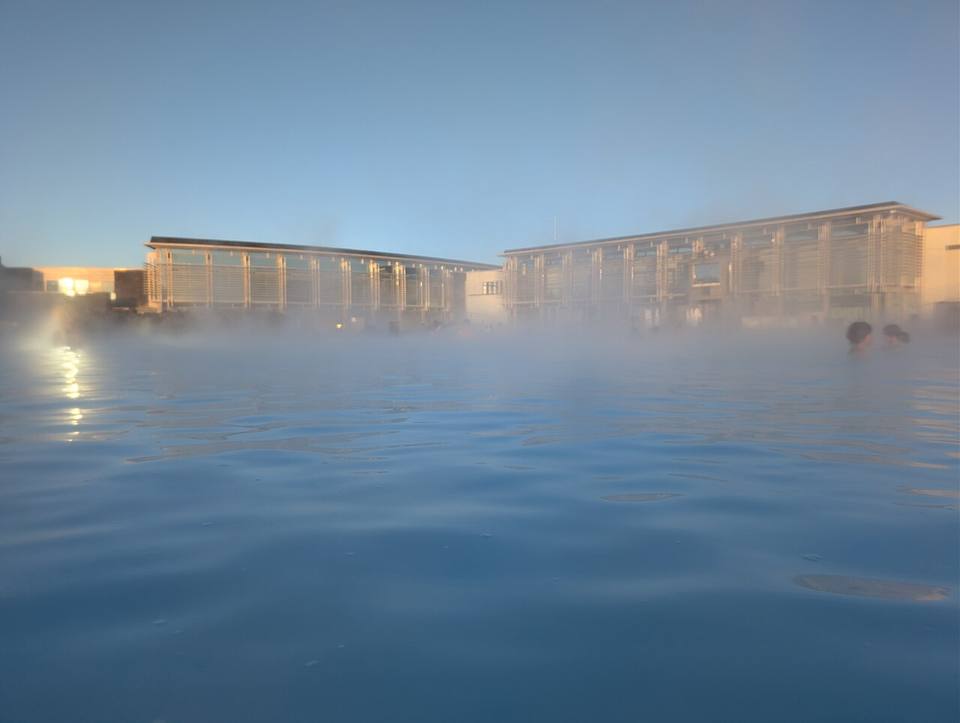
Nine million litres of milky-blue seawater pooled from the Svartsengi geothermal field on a black lava plain, steam rising all around — one of the world's best-known geothermal baths, holding 37–40 °C all year round.
Location
Near Grindavík, Reykjanes Peninsula, south-west Iceland
Stories and legends
There is no myth or legend; the spread of the claim that "the Blue Lagoon heals psoriasis" grew out of the real bathing experiences of patients in the 1980s, and therapeutic claims should be viewed rationally.
History and context
The Blue Lagoon is a man-made lagoon formed where the discharge water of the Svartsengi geothermal power station pooled on the lava field (it took shape after the station started operating in 1976; people began bathing in the 1980s, and an operating company was founded in 1992 to develop it as an attraction). By official figures, it holds about 9 million litres of water over an area of about 10,000 square metres, with an average depth of 1.2 metres and a maximum of 1.6 metres, fully renewed roughly every 40 hours; its milky blue comes from silica and algae. In recent years, volcanic activity on the Reykjanes Peninsula has repeatedly forced temporary closures and the evacuation of the town of Grindavík, so before travelling you must follow the official website's notice for the day.
Local life
The Blue Lagoon's character is Iceland's pragmatism — "an industrial by-product turned into a national calling card": the power station, the silica-mud industry (a skincare line) and luxury hotels (Silica, Retreat) exist in symbiosis. Icelanders' own everyday bathing is the community geothermal pool (sundlaug, where a ticket costs a fraction of the Lagoon's price), and the Lagoon is more "Iceland's first impression for the world" — grasping that distinction between the inside and the outside view is to understand Icelandic bathing culture.
Customs
Before entering the water you must shower naked and wash thoroughly (the rule in all Icelandic geothermal pools, strictly enforced at the Lagoon); scooping your own silica mud mask at the floating stations in the pool is the signature experience.
Beliefs
No particular religious association; its main cultural identity is geothermal use and the bathing-and-wellness industry.
Local etiquette
The silica water damages hair: tie long hair up and use plenty of conditioner (provided in the changing rooms), and take extra care with dyed or permed hair; contact-lens wearers who find the water uncomfortable should take their lenses out; the silica mud on the bottom is slippery — walk slowly; during volcanic alerts, obey closures and evacuations and never enter closed road areas on your own.
Visiting notes
Entry is entirely by timed reservation (the official website, with packages tiered by drink and mask inclusions); it is about 20 minutes from the airport and about 50 minutes from Reykjavík, so scheduling it on your arrival or departure day is the smoothest plan; the first slot of the morning and the pool in winter snow photograph best; for hair care, the official advice is to apply conditioner before entering and go in without rinsing it off.
What to eat nearby
Icelandic langoustine soup (Humar súpa, from the Grindavík fishing harbour); roast lamb (Icelandic lamb); geothermal rye bread (hverabrauð, slow-baked with geothermal heat — more common around the Golden Circle); skyr yoghurt; the hot dog (a national snack across Iceland)
The harbour restaurants of Grindavík; the Lagoon's own restaurant (the Lava restaurant, priced for the view); Reykjavík
Whale meat is a contested food in Iceland — [Note on a contested item: whaling is internationally controversial; it is marked "choose with care"] — and most Icelanders do not eat it regularly; fermented shark (hákarl) is a traditional challenge food with an extremely strong smell — taste a little, knowingly
A sit-down meal 4,500–8,000 Icelandic krónur (approx. RMB 234–416, for reference only); Blue Lagoon tickets from about 11,900 krónur (approx. RMB 619 and up, subject to the dynamic prices on the official website, for reference only)
Lagoon prices float dynamically — book early to lock in a cheaper time band; in the volcanic season, choose refundable ticket types.
Image source · G. Edward Johnson · CC BY 4.0