
Italy · Archaeological site / World Heritage
Pompeii
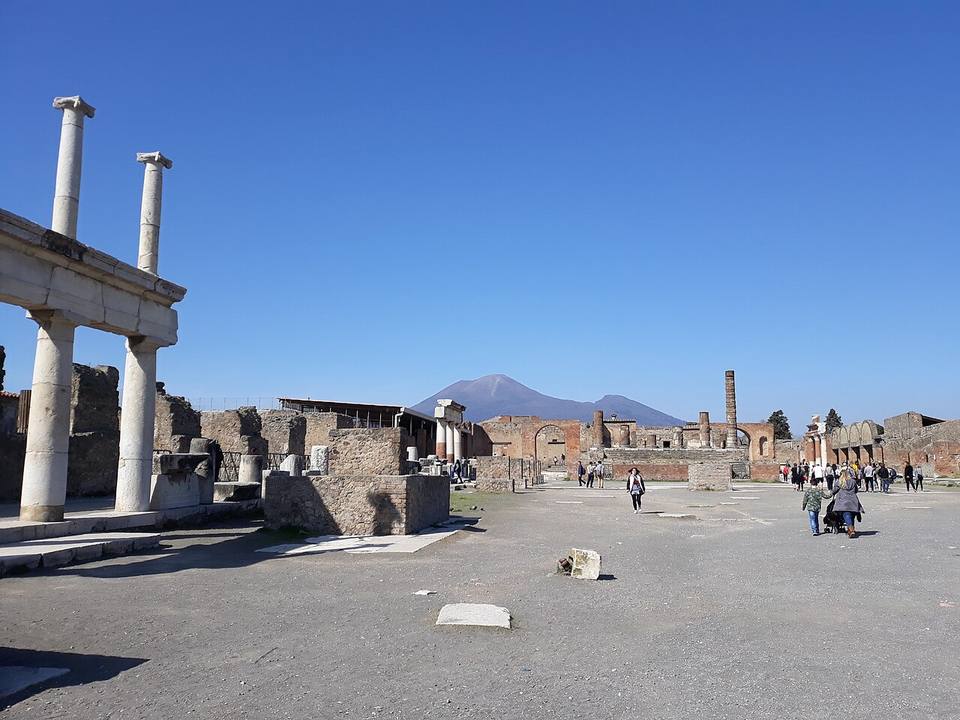
A whole Roman city sealed in a single night by Vesuvius in AD 79: the millstones in its bakeries, price lists painted in its taverns and ruts worn deep in its streets — here time is not past, but paused.
Location
Pompei, Campania, Italy
Stories and legends
There is no myth or legend; the discovery of the plaster casts (poured into the voids left by the victims) is a matter of archaeological history.
History and context
Vesuvius erupted in August AD 79 (traditionally dated 24–25 August; in recent years an autumn dating has been argued in scholarship) and buried Pompeii and Herculaneum; systematic excavation began in 1748, and about 44 hectares — roughly two-thirds of the city — have now been uncovered; the site was listed as World Heritage in 1997. Major remains include the Forum, the Temple of Apollo, the House of the Faun, the Villa of the Mysteries (with its Bacchic frescoes), the theatres and the amphitheatre (among the oldest surviving stone amphitheatres, c. 70 BC); entry now runs on timed reservations with a daily visitor cap (follow the Archaeological Park of Pompeii).
Local life
Pompeii's power lies in the completeness of the everyday: the counter jars of the fast-food shops (thermopolia), the laundries, the brothel signposts, the election graffiti — it is Roman street life, not emperors, that takes the lead here. A guide is worth a great deal (without one, the site easily becomes a walk among rubble); the official and licensed 2–3-hour routes are the threshold to understanding it. The site offers no shade and its paving is uneven, so its physical intensity is widely underestimated.
Customs
There are no festival customs; special evening openings are held from time to time (as announced by the park).
Beliefs
A site of ancient Roman polytheism (temples of Apollo, Isis and others); it is now an archaeological park with no active religious function.
Local etiquette
Never climb the walls or take away any stone or potsherd (a serious offence under heritage law); no flash photography in the fresco rooms; much of the site is a no-eating zone — carry your litter out; keep a respectful quiet before the plaster casts and do not pose or mimic beside them.
Visiting notes
Best in spring and autumn and at first entry (9 a.m.); from Naples, the Circumvesuviana railway runs straight to Pompei Scavi station; allow at least 4 hours and bring water and a hat; between Pompeii and Herculaneum (smaller, finer, with timber superbly preserved), either go deeper into one or give each its own day.
What to eat nearby
Neapolitan pizza (on the way through Naples; the Margherita is the authentic classic); pasta and seafood in the modern town of Pompei; lemon granita (Granita); buffalo mozzarella from Campania (Mozzarella di bufala)
The main street of the modern town of Pompei, and the restaurant strip outside the site exits
Pizza may be eaten with a knife and fork or folded in the hand; the Neapolitan crust is properly thick and soft; do not walk through the site eating hot food
A sit-down meal €22–40 (approx. RMB 172–312, for reference only)
Use the site's luggage storage before you enter; at summer noon the stone reflects fierce heat, so schedule distant points such as the Villa of the Mysteries for the morning.
Source leads: Archaeological Park of Pompeii (official); UNESCO, Pompeii World Heritage site (1997).
Image source · Simon Burchell · CC BY-SA 4.0