
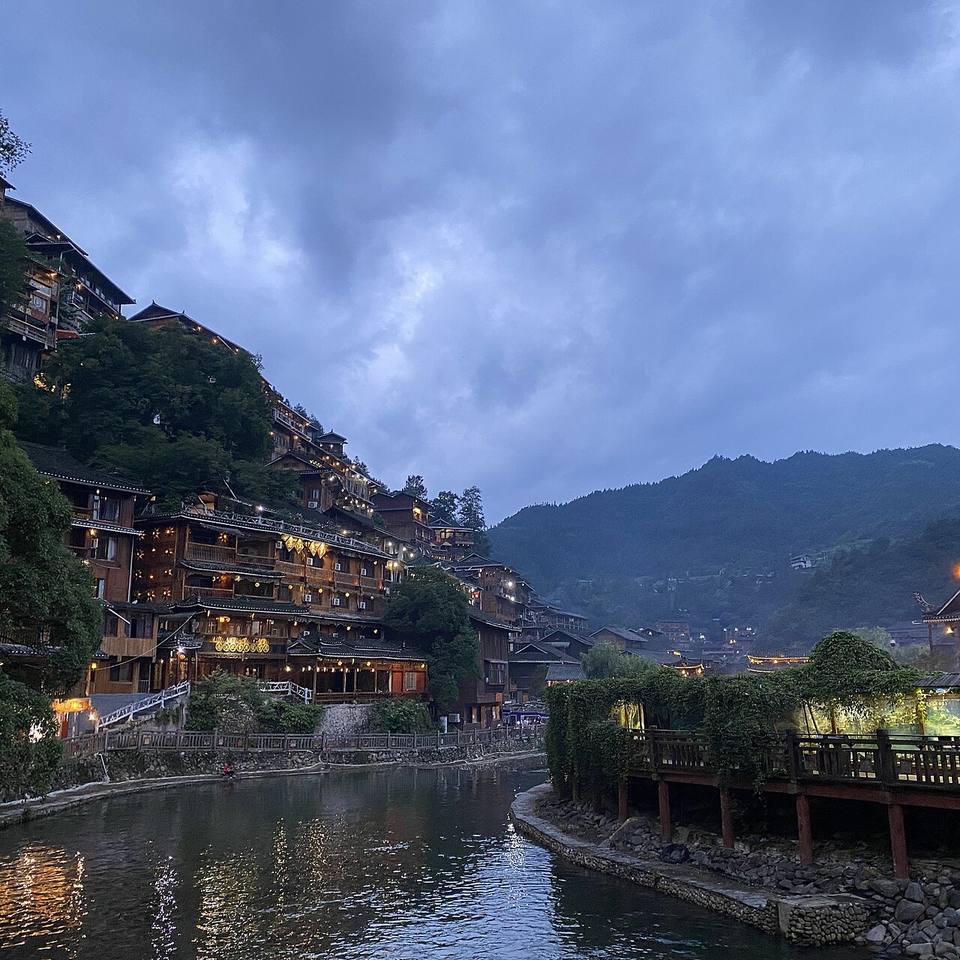
Xijiang Town, Leishan County, Qiandongnan Miao and Dong Autonomous Prefecture, Guizhou Province · Ethnic Village
Xijiang Qianhu Miao Village
More than a thousand Miao stilt houses climb the slopes along both banks of the Baishui River, and after dark ten thousand household lights pour down the mountain like a river of stars — the world's largest Miao village has made "big" its everyday.
Location
Xijiang Town, Leishan County, Qiandongnan Miao and Dong Autonomous Prefecture, Guizhou Province
Stories and legends
In the Miao migration epic, Xijiang is one of the settling places of the migrations; the Guzang festival and the Butterfly Mother creation myth belong to the Miao mythic layer.
History and context
Xijiang is formed of a dozen-odd mountainside villages joined together, with an extremely high Miao proportion — hence "Qianhu" (Thousand Households). The stilt houses are the traditional Miao ganlan architecture (advancing up the slope in tiers, livestock below, people in the middle). The Miao New Year (the Miao-calendar new year, in the Gregorian calendar mostly around November) and the Guzang Festival (a great festival once every thirteen years, its year per the village side) are the highest celebrations. The long-table banquet and the road-blocking wine are Xijiang's hospitality symbols, and the scenic area runs tickets and sightseeing buses (per official rules).
Local life
Xijiang's doubleness is the most typical: by day it is a living great Miao village — silversmiths chasing patterns in their shops, grandmothers selling embroidery at the bridgeheads, rice still in the fields; after dark the commercial street's lights and the travel-photography crowds pour in. Its value lies exactly in its scale: not a specimen village but a real settlement of over ten thousand people, where visitor etiquette (not disturbing residents) matters more than at small scenic spots.
Customs
Road-blocking wine (the village-entry courtesy, guests welcomed with horn wine), the communal joy of the long-table banquet, and Miao embroidery and silver-ornament experiences (paid, clearly priced).
Beliefs
Traditional Miao beliefs (ancestor and nature worship, the drum-society system) are the core, and the silver-ornament patterns are rich in migration and totem narratives.
Local etiquette
Never intrude or photograph without permission during household rites / Guzang and other ceremonies; at the road-blocking wine you may taste a little / touch the cup with your hand to politely decline heavy drinking (explaining your capacity and health suffices); never buy high-priced "old silver" ornaments of unclear origin (mostly alloy imitations — use proper shops).
Visiting notes
Best in the Miao New Year season and in spring and autumn; for the night view you must stay a night, and take your spot at the viewing platform before sunset; Kaili South Station has direct buses, about 1 hour; for travel-photography sessions, agree in advance on the contract for originals and the number of retouched photos.
What to eat nearby
Sour-soup fish (of the Kaili sour-soup line, red sour soup); the long-table banquet (a shared-table experience); Miao cured pork and glutinous rice; Xijiang barbecue and rice tofu; chestnut-rose (cili) products
The Beimen commercial street, and the local restaurant belts of Yedong Village / Yangpai Village (more local than the tourist street)
Sour soup is appetising but sour and spicy — those with weak stomachs should start with a small bowl; the long-table banquet is charged per seat, and on sitting, follow the host's seating arrangements
A full meal 60–120 yuan (for reference only); the long-table banquet runs from tens to over a hundred yuan per person (per the village side's posted prices, for reference only)
The sightseeing buses run in segments, and entering by the north gate is more downhill-friendly for luggage; at 6 a.m. the village is at its most authentic — worth an early rise.
Source leads: Xijiang Qianhu Miao Village scenic area official site; Leishan County Bureau of Culture and Tourism.
Image source · Hhhh2 · CC BY-SA 4.0