
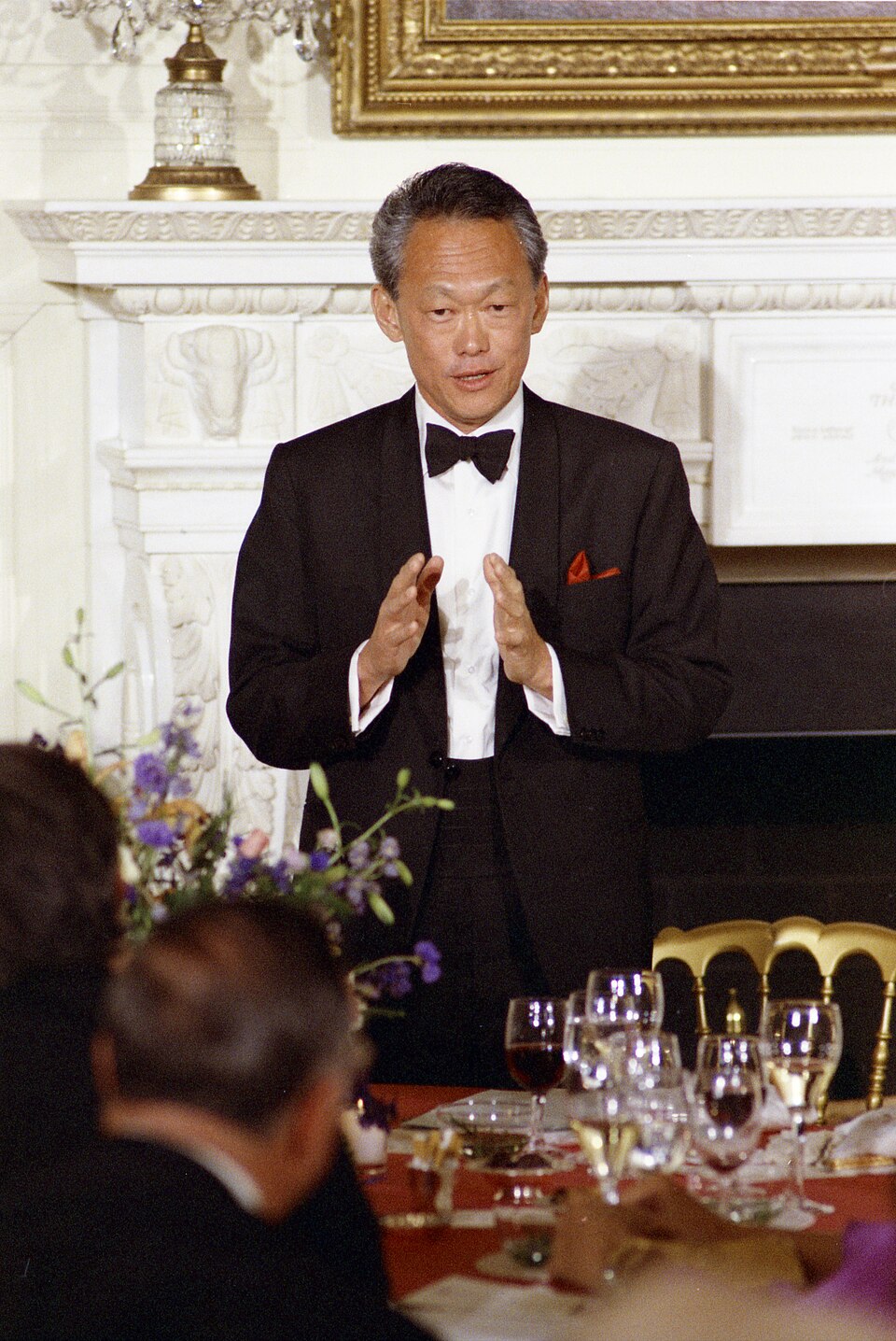
美国白宫摄影办公室(经美国国家档案馆 NARA 发布,1975 年 5 月 8 日国宴照片) + 许可:公有领域(美国联邦政府作品)。 · 公有领域
1959–1990
Lee Kuan Yew, Chinese: 李光耀; originally Harry Lee Kuan Yew
Lee Kuan Yew · 新加坡
Singapore's first prime minister (1959–1990), creator of modern Singapore.
Born on 16 September 1923 in British Singapore into a Peranakan Chinese family, he attended Raffles Institution, and the experience of the Japanese occupation (1942–1945) convinced him that a small city-state must protect itself with discipline and strength. After the war he went to Fitzwilliam College, Cambridge University, to study law, returning to Singapore in 1950 to practise law, taking part in founding the People's Action Party in 1954, and leading the party to election victory in 1959 to become prime minister. In 1963 he pushed Singapore into the Federation of Malaysia, and in 1965, owing to racial and political differences, Singapore was forced out of the federation and became independent. Over the next thirty years he pursued industrialisation, clean government, bilingual education, and public housing (HDB) policies, turning a resource-poor port city into one of the Four Asian Tigers. He stepped down as prime minister in 1990, later serving as Senior Minister and Minister Mentor, and died in Singapore on 23 March 2015.
People & stories
Places in their life
Birthplace, place of activity, and burial memorial all in Singapore.
People
Cultural significance
The symbol of the "Singapore model": known for rule of law, clean government, and developmentalism, while his authoritarian style of governance and restrictions on freedom of speech are also subjects of continuing academic debate; the draft records both sides as they are, without one-sided praise.
