
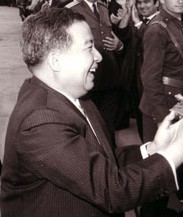
未署名(罗马尼亚国家历史博物馆藏,ComInRo 项目) · 署名后可任意使用
1941–1955
Norodom Sihanouk, Khmer: នរោត្ដម សីហនុ
Norodom Sihanouk · 柬埔寨
King of Cambodia twice over (1941–1955, 1993–2004) and independence movement leader, who also served as prime minister and head of state.
Born on 31 October 1922 in Phnom Penh, son of Prince Norodom Suramarit and Princess Sisowath Kossamak. After his grandfather King Monivong died in 1941, he acceded at only 18, at a time when the French protectorate and Japanese occupation alternated; in March 1945, encouraged by Japan, he proclaimed independence, and after the war negotiated with France, finally achieving Cambodia's independence in November 1953. In 1955 he abdicated in favour of his father, formed the Sangkum (People's Socialist Community) to enter politics and served as prime minister, and after his father's death in 1960 served as head of state, pursuing a neutral foreign policy. In the 1970 Lon Nol coup he was overthrown, fled to Beijing, and formed a government in exile; after the Khmer Rouge victory in 1975 he returned home as nominal head of state, resigned in 1976, and was kept under house arrest until 1979. After the 1991 Paris Peace Agreements he returned home, acceded again in 1993, abdicated in 2004, died in Beijing on 15 October 2012, and was buried in the Silver Pagoda, Phnom Penh.
People & stories
Places in their life
Birthplace Phnom Penh; places of activity the Royal Palace and Silver Pagoda, Phnom Penh; burial place the Silver Pagoda, Phnom Penh.
People
Cultural significance
The longest-reigning and most multifaceted political figure in modern Cambodian history: independence hero, neutralist, film director, and saxophonist; his later relationship with the Khmer Rouge (first allied, then kept under house arrest) is the most controversial page in Cambodian history, and the draft records it as it is, without one-sided praise.