City guide · Salzburg
Salzburg
Between fortress, palaces and old town, understand Salzburg's religious and musical history
We suggest staying 2 days. Mirabell Palace, the fortress, Mozart's Birthplace and the old town can all be linked on foot; Hallstatt and Germany's Königssee are out-of-town round trips only. Other places in the city worth a visit: Hohensalzburg Fortress and Mozart's Birthplace.
History
How the city came to be
Salzburg grew thanks to the salt trade and traffic on the Salzach River, and in 696 Bishop Rupert helped establish a Christian centre here. From then on, prince-archbishops long held both religious and secular power, and churches, squares and palaces gave the old town its distinctive architectural ensemble. Hohensalzburg Fortress, built from 1077 onwards, is the city's high point and a physical record of its history of power. From the sixteenth to the eighteenth century Italian-style and Baroque architecture shaped the old town, with the cathedral, the Residenz and the riverside lanes together forming today's historic centre. In 1756 Mozart was born in Getreidegasse, and musical tradition later became an important part of the city's public life. The ecclesiastical principality came to an end in the early nineteenth century, and after 1816 Salzburg came under Habsburg rule. In 1996 the historic centre was inscribed as a World Heritage Site, the protected area spanning both banks of the Salzach. Looking down from the fortress today, you can still pick out the different layers left by church power, merchant quarters and the city's modern expansion.
- 696Rupert establishes a Christian centre in Salzburg.
- 1077Construction of Hohensalzburg Fortress begins.
- 16th–18th centuriesThe Baroque cityscape gradually takes shape.
- 1756Mozart is born.
- 1803The secular rule of the prince-archbishops ends.
- 1816Salzburg comes under Habsburg rule.
- 1996The historic centre is inscribed as a World Heritage Site.
Stories
Stories of the city
Jedermann opens the festival in front of the cathedral
History · Salzburg Festival
On 22 August 1920 the Salzburg Festival opened with Hofmannsthal's Jedermann, performed on the steps in front of the cathedral and directed by Reinhardt. This morality play about a rich man facing death has been a fixture of the festival ever since and is still staged on Cathedral Square every summer.
A palace for Salome Alt
History · Mirabell Palace
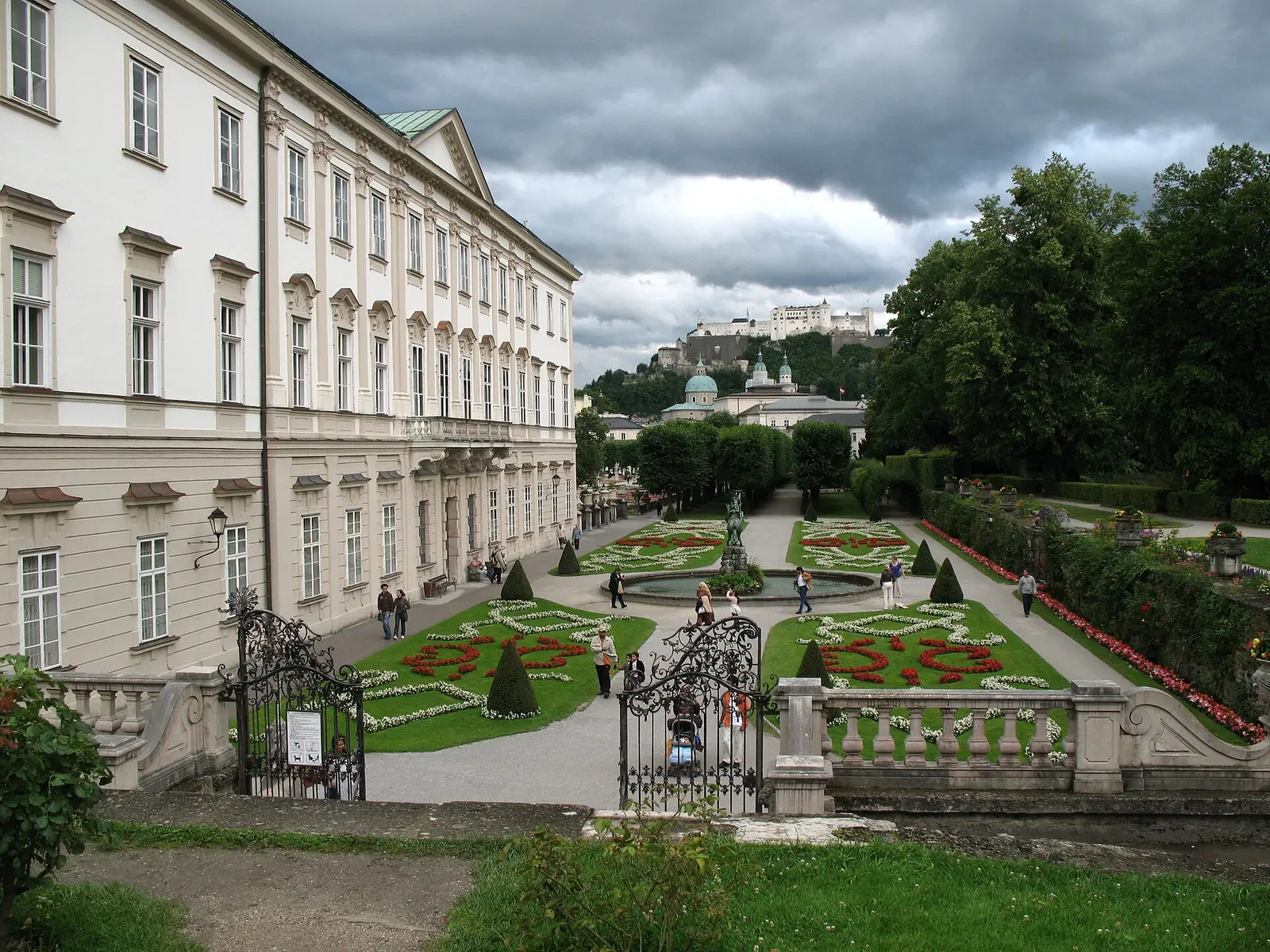
Archbishop Wolf Dietrich von Raitenau built this palace around 1606 for his mistress Salome Alt, who is said to have had 15 children with him. After Raitenau's fall in 1612, his successor Markus Sittikus expelled Salome's family and renamed the palace, reportedly to erase his predecessor's legacy.
The fire of 1818
History · Mirabell Palace
The great Salzburg fire of 1818 struck Mirabell Palace, which was then restored with its present Neoclassical look. The Marble Hall and the palace's marble staircase are said to have survived the fire, and in 1866 the palace, together with the nearby Kapuzinerberg, was reportedly sold to the city for 50,000 florins.
The Mozarts in the Marble Hall
History · Mirabell Palace
The young Mozart and his sister Nannerl are said to have often performed in the Marble Hall, and their father Leopold also played here. Today it remains the venue of the Salzburg Palace Concerts.
Birthplace of King Otto of Greece
History · Mirabell Palace
On 1 June 1815, the future King Otto of Greece was born at Mirabell Palace.
Before you go
Rules to know in Salzburg
Austria: Private photos are allowed in museums, but no flash, tripods or selfie sticks
Do
- Check for no-photo signs as you enter each room
- Stay at least one metre from the exhibits
- Check coats, umbrellas, backpacks and large bags first
- Apply to the press office for academic or journalistic shoots
Don’t
- Don't use flash, tripods, selfie sticks or drones
- Don't photograph other visitors, especially children
- Don't photograph security measures
- Don't make loud phone calls in the galleries
At the Belvedere, for example, the house rules state that anyone breaking them or ignoring staff can be refused entry or asked to leave without a refund. Temporary exhibitions are often stricter because of lenders' conditions.
Verified Oct 19, 2026Source: Official site: Belvedere house rules
Austria: Dress modestly in churches and watch Mass quietly from the back
Do
- Wear neat, modest clothing and carry a shawl to cover your shoulders
- Men should remove hats inside
- Switch your phone to silent and speak softly
- During Mass, watch quietly from the back
Don’t
- Don't wear shorts, miniskirts or sleeveless tops
- Don't walk in front of people praying or give loud commentary
- Don't enter roped-off areas
- Don't take large suitcases into St Stephen's Cathedral
Most Austrian churches do not check clothing strictly at the door and revealing outfits usually just draw a reminder, but they offend worshippers; cathedrals and services are stricter, so follow the notices and staff. Since mid-October 2026, St Stephen's Cathedral in Vienna no longer admits large suitcases or trolleys, and it has no left-luggage room.
Verified Oct 19, 2026Source: Vienna.at: Stephansdom tightens house rules for travelers
Austria: Keep quiet at night and on Sundays, when most shops are closed
Do
- Keep the noise down at night, usually from about 10 pm to 6 am
- In an apartment, read the house rules and rental terms
- Do your Sunday shopping on Friday or Saturday
- For urgent Sunday shopping, try station, airport or petrol-station shops
Don’t
- Don't talk loudly or play music on the balcony late at night
- Don't do noisy jobs like hammering or assembling furniture on Sundays and holidays
Austria has no single national quiet-hours law; quiet times are set locally and by house rules, with 10 pm to 6 am the common norm, and disturbing neighbours can bring complaints or even the police. By law, shops are in principle closed on Sundays and public holidays.
Verified Oct 19, 2026Source: Official site: Austrian Federal Ministry of Economy: Business hours
Austria: Tell the server the total including tip when you pay
Do
- Say the total including the tip as you hand over the money
- In restaurants and cafés, tip around 10% and round to a convenient figure
- Round up taxi fares
- When paying by card, tell the server the total to charge first
- Carry some cash for rural inns and mountain huts
Don’t
- Don't pay, take your change and leave coins on the table
- Don't skip the tip entirely without reason
In Austria, giving no tip to restaurant staff or taxi drivers is read as a sign you were unhappy with the service, and leaving coins on the table is not the local way.
Verified Oct 19, 2026Source: BOKU University: How to tip in Austria
Austria: Say "Grüß Gott" as you enter and use titles with surnames
Do
- Say "Grüß Gott" when entering a shop or mountain hut
- Say "Auf Wiedersehen" when you leave
- Shake hands with eye contact; the older or more senior person usually offers first
- Address people as "Herr" or "Frau" plus their surname
- Include titles such as "Doktor" when the person has one
Don’t
- Don't use first names until you are invited to
- Don't drop a person's title
Austrians value titles more than many neighbours, so dropping a title or using first names too soon can seem rude; first names are usually kept for close friends, family and young people.
Verified Oct 19, 2026Source: Cultural Atlas: Austrian Culture – Greetings
Regional deep dives
Read deeper into each place
Central & Eastern Europe · Historic city / city of music
Salzburg Old Town
A fortress rides the hill above, the wrought-iron signs hang in a row along Getreidegasse, and Mozart was born at No. 9 on that very street in 1756 — the old town, listed as World Heritage in 1996, is a Baroque score in its entirety.
Explore the local guide ↗Source leads: Salzburg city tourism (official); UNESCO, Historic Centre of Salzburg (1996).
Source leads are being checked individually; confirm travel details with local official notices.
How do you like this place?