
Spain · Palace architecture / World Heritage
The Alhambra
The Nasrid dynasty's red palace-city: the sound of water in the Court of the Lions, the reflection in the Court of the Myrtles, and Arabic ornament over every wall — a leading surviving example of Islamic art in Europe, with tickets to fight for a month ahead.
Location
Granada, Andalusia, Spain
Stories and legends
The Moorish treasure and princess legends collected in Washington Irving's Tales of the Alhambra (1832) spread far and wide; they belong to the layer of literary legend.
History and context
The palace-city began as a 9th-century fortress and was built into a palace complex by the Nasrid dynasty in the 13th–14th centuries (from Muhammad I onwards), comprising the Nasrid Palaces, the Generalife (the summer palace), the Alcazaba fortress and the later Palace of Charles V (Renaissance in style, begun in 1526); the capture of Granada by the Catholic Monarchs in 1492 ended the last Muslim kingdom on the Iberian peninsula; the site was listed as World Heritage in 1984; tickets are now named and booked in advance, and the Nasrid Palaces admit strictly at the time printed on the ticket (follow the Patronato; in peak season they sell out 1–3 months ahead).
Local life
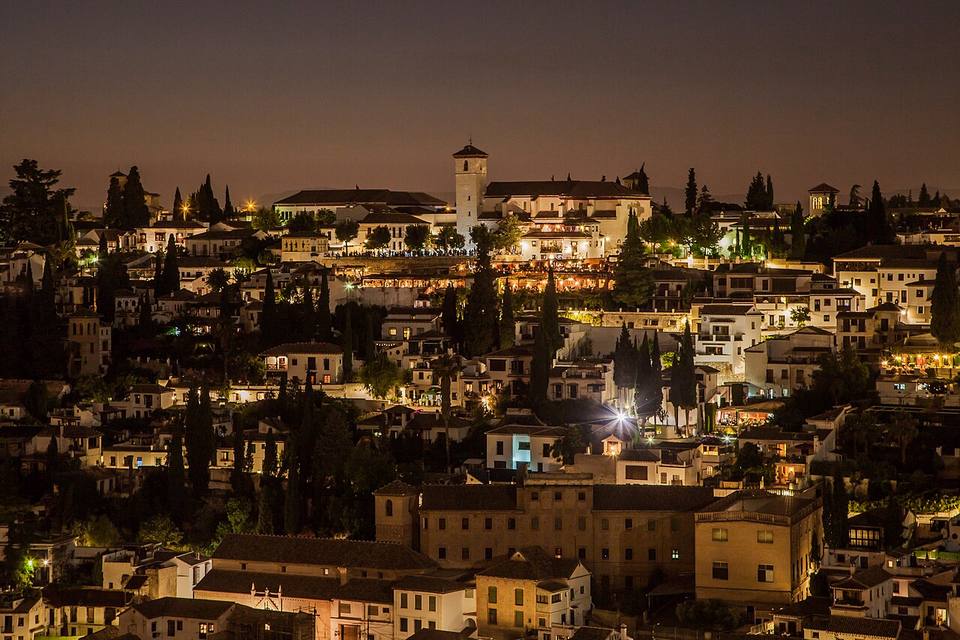
The Alhambra's mood is one of "sorrowful refinement": it was built in a dynasty's twilight and is beautiful almost to the point of elegy; across the valley, the Albaicín (the old Arab quarter of whitewashed lanes) faces it, and from the Mirador de San Nicolás at sunset the whole city watches the palace-city turn from gold to red, with the snows of the Sierra Nevada behind — Granada's collective rite is performed here. The origins of flamenco remain debated, and it is often discussed in connection with this history.
Customs
Crowds gather at the viewpoint at sunset; the city's Arab tea houses (teterías) carry on the Moorish legacy.
Beliefs
Historically an Islamic court complex, today a heritage museum; Granada's cathedral and its other Catholic buildings form the layer added after 1492.
Local etiquette
The Nasrid Palaces are unforgiving about time (arrive at the checkpoint 30 minutes early — a late ticket is void as an iron rule); no tripods or large bags inside, and no flash in some of the halls; never touch the carved plasterwork (it is extremely fragile).
Visiting notes
These are among the hardest tickets in Europe: book through official channels and have your passport details ready for the named ticket; best in spring and autumn; walk up from the Albaicín quarter or take the minibus; allow a full day (the palace-city + the Generalife + sunset in the Albaicín).
What to eat nearby
Tapas (Granada keeps the tradition of "a free tapa with your drink," observed by many bars — as each house decides); saffron paella (a neighbouring region's dish); the pionono (a little cake from Santa Fe, a Granada speciality); mint tea and baklava in the Arab tea houses
The tea-house street of the Albaicín (Calle Calderería) and the tapas-bar belt in the centre (around Calle Navas)
As a rule you cannot choose the complimentary tapa — do not argue the point; in tea houses, follow the house rules in the shoes-off seating areas
A tapas crawl €20–35 per person (approx. RMB 156–273, for reference only)
The museum inside the Palace of Charles V has free hours, as officially announced, and makes an easy add-on; the Nasrid Palaces by night (open on specific dates) have a superb atmosphere, and the tickets are scarcer still.
Source leads: The Alhambra's governing body (Patronato de la Alhambra, official); UNESCO, Alhambra World Heritage site (1984).
Image source · Grand Parc - Bordeaux, France from France · CC BY 2.0