
Spain · Church architecture / plaza
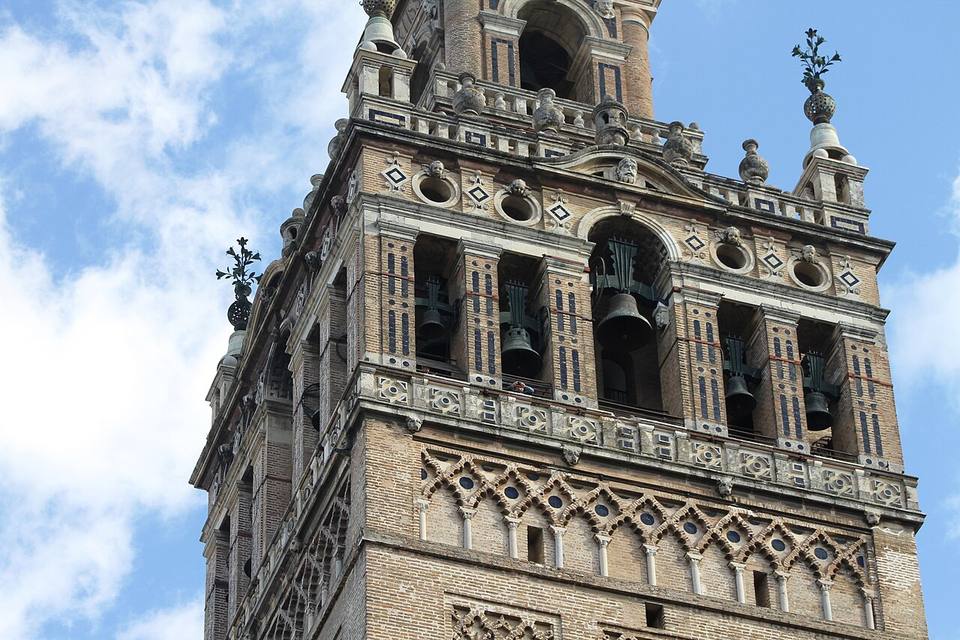
Seville Cathedral and the Plaza de España
The world's largest Gothic cathedral holds the tomb of Columbus, and the Giralda was once a mosque's minaret; turn the corner to the Plaza de España, where a semicircular tiled arcade draws all of Spain's provinces into a three-dimensional book.
Location
Seville, Andalusia, Spain
Stories and legends
The authenticity of Columbus's tomb (disputed with Santo Domingo) is a question of scholarly controversy, not settled legend.
History and context
The cathedral was built in 1401–1506 on the site of the great mosque and is the world's largest Gothic church (World Heritage, 1987); the Giralda rises about 104 metres including its weathervane — it began as a 12th-century minaret, and inside it is a ramp that could be climbed on horseback (by historical design); Columbus's remains rest in the cathedral (DNA studies support the Seville attribution, as the mainstream reporting has it); the Plaza de España was the centrepiece of the 1929 Ibero-American Exposition, designed by Aníbal González — a semicircular square with a canal and tiled alcoves for the 48 provinces.
Local life
Seville's character is Andalusia distilled: at the Feria de Abril (the April Fair, usually in the fortnight after Easter — as announced by the city) the whole city is flamenco dresses, while the Holy Week processions are solemn — grief and joy taken to their extremes alike. Between the cathedral's mass and the plaza's bright tiles lies the palm shade of María Luisa Park, where locals run in the morning and the tourist carriages ply their trade.
Customs
The Holy Week (Semana Santa) processions and the Feria de Abril are the twin annual peaks, when room prices multiply; small boats can be rented to row on the plaza's canal.
Beliefs
The cathedral belongs to the Catholic Archdiocese of Seville and is an active place of worship; the Giralda bears witness to the layering of Islamic and Christian history.
Local etiquette
The cathedral's dress rules are strict and sightseeing stops during Mass; Seville's summer can pass 40 °C — do not queue in the midday sun (heatstroke is a common hazard); do not climb and sit on the tiled provincial benches for photos in ways that block the paths.
Visiting notes
Best in spring and autumn (avoid the extreme summer heat); cathedral tickets include the tower — book through official channels; the free hours (such as Monday afternoons) follow the cathedral's official announcements and are fiercely contested; for flamenco, choose a proper tablao performance.
What to eat nearby
Cold soups (Gazpacho / Salmorejo, the thick Córdoba-style cold soup with ham and egg); fried fish (Pescaíto frito); Iberian ham (Jamón ibérico); spinach with chickpeas (Espinacas con garbanzos, a Holy Week tradition); orange-based desserts
The tapas belt of the Santa Cruz quarter, and Triana across the river (an old quarter of flamenco and pottery)
Tapas come in three sizes — tapa / media / ración — ask about the size before ordering; ham is priced by weight, so confirm first
Tapas €20–35 per person (approx. RMB 156–273, for reference only)
The Plaza de España is almost empty early in the morning and loveliest at sunset, but then it is full — choose according to photography versus experience; the cathedral roof tour (cubiertas) is a separately bookable extra that is well worth adding (follow the official site).
Source leads: Seville Cathedral (official); UNESCO, Seville Cathedral heritage site (1987); Seville city tourism.
Image source · José Luiz · CC BY-SA 3.0