
Western Europe Supplement · Historic city / canal city
Bruges
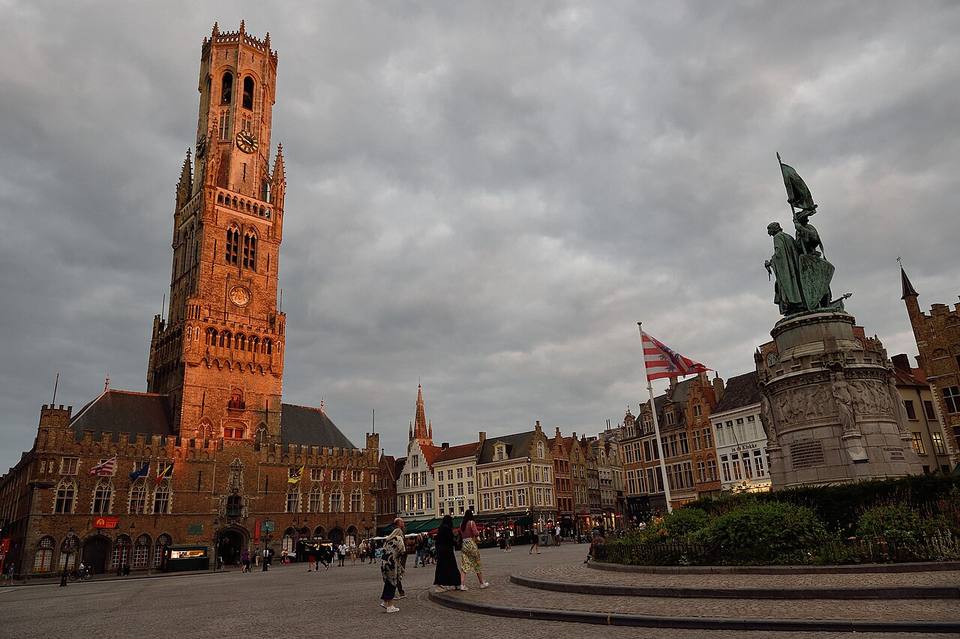
The "Venice of the North": the 83-metre Belfry presses down on the Market Square, and the gabled houses stand with swans along the canals — the wealth of medieval Burgundy, perfectly frozen in the 15th century.
Location
Bruges, West Flanders, Belgium
Stories and legends
The Bruges swan legend: after, in the late 15th century, the citizens executed an attendant of Maximilian of Austria, they were punished by being made to keep swans on the canals for ever — a widely told historical legend.
History and context
From the 12th to the 15th century Bruges was among Northern Europe's greatest trading ports (it declined as the Zwin channel silted up, and Antwerp rose in its place), and the Hanseatic League and Italian banks (including a Medici branch) converged here; the Belfry was built in the 13th century, stands 83 metres tall, and can be climbed by 366 steps; the old town became World Heritage in 2000; the Basilica of the Holy Blood holds a relic of the "Holy Blood," and the Procession of the Holy Blood on Ascension Day is the great ceremony (as announced by the parish); canal boat trips are the standard excursion (tickets follow the operators).
Local life
Bruges' character is "people living inside an exquisite medieval specimen": behind the trio of lace, chocolate and beer, Bruges lies in the Dutch-speaking region of Belgium. In the early morning, with no boats on the canals and the Belfry's reflection complete, Bruges shows the quiet beauty of a port city that decline saved from redevelopment.
Customs
The Procession of the Holy Blood (in spring) and the Christmas market; beer-house culture (against the national background of Belgian beer culture, listed by UNESCO as intangible heritage in 2016).
Beliefs
Catholicism is the historical and present main axis (the Church of Our Lady holds Michelangelo's original Madonna and Child); the whole centres on the heritage of the medieval trading port.
Local etiquette
The signs separating cyclists and pedestrians on the old town's cobbled streets are strict — do not occupy the cycle lanes; keep a reverent quiet inside the churches; for chocolate, choose the handmade shops (industrial tourist products fill the streets; creative houses such as The Chocolate Line are among the city's name brands).
Visiting notes
Best in spring and autumn and on weekdays; stay a night; it is about 1 hour by train from Brussels Central station; buy the timed Belfry tickets first; take the first canal boat to avoid the queue.
What to eat nearby
Belgian beer (the Trappist ales; and Straffe Hendrik from Bruges' own Half Moon brewery); mussels with fries (Moules-frites); Flemish beef stew (Stoofvlees, stewed in beer); waffles and handmade chocolate
Around the Market Square, the beer-house belt behind the Church of Our Lady, and the local Ezelstraat quarter
In Belgium, serving each beer in its own dedicated glass is an iron rule — do not ask for a different glass; mussels arrive by the pot, with mayonnaise fries
A sit-down meal €25–45 (approx. RMB 195–351, for reference only)
Work out the Bruges Card and museum passes against your itinerary; Ghent and Bruges on the same route deserve a day each, rather than a rushed day covering both cities.
Source leads: Bruges city tourism (official); UNESCO, Historic Centre of Bruges (2000).
Image source · Tim Adams · CC BY 3.0