
Cherry-blossom sites · Cherry blossoms / Urban riverside
Chidorigafuchi
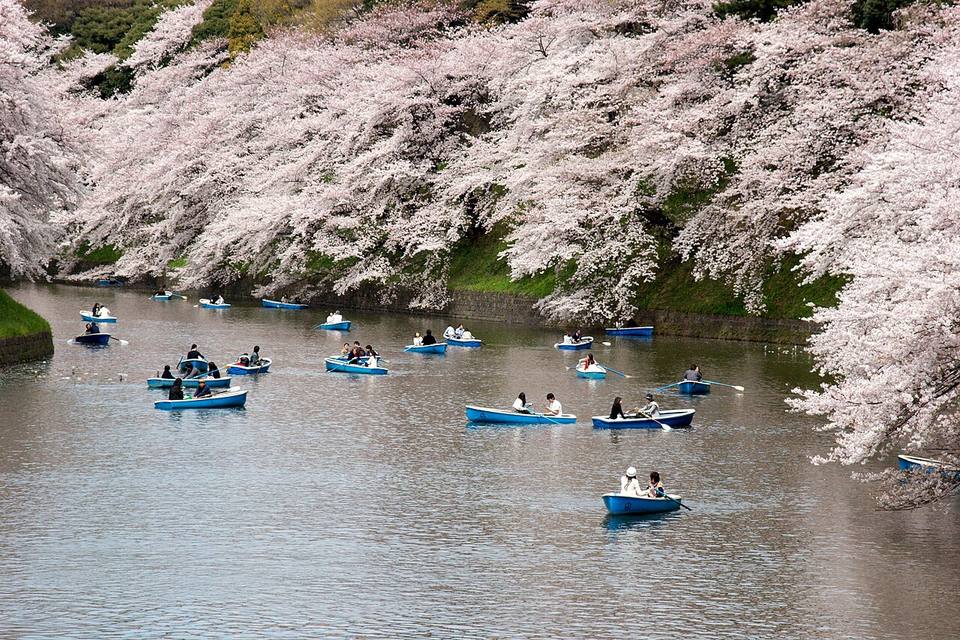
A 700-meter cherry tunnel along the Imperial Palace moat droops down to the water; row a small boat into the pink dome — the most dreamlike way to view flowers in central Tokyo.
Location
Chiyoda Ward, Tokyo, northwest of the Imperial Palace
Stories and legends
The name "Chidorigafuchi" (Plover Abyss) is said to come from the moat's shape, like a plover (千鳥) spreading its wings — a place-name legend.
History and context
Chidorigafuchi was originally part of Edo Castle's moat and became a public recreation ground after the Meiji era; about 260 cherry trees, mainly Somei Yoshino, line its banks, widely planted into scenery after the war. On one side stands the Chidorigafuchi National Cemetery (built in 1959, holding the remains of unidentified war dead), so the cherries here also carry a note of mourning, unlike purely recreational hanami spots. The bloom usually runs from late March to early April; night lighting and the opening of the Imperial Palace's Inui-dori often coincide.
Local life
This is the "quiet" pole of Tokyo hanami: the woods of Kitanomaru Park, the solemnity of the cemetery, and the specimen tree of Yasukuni Shrine (the benchmark tree for Tokyo's official blossom declaration, right nearby) are all within walking distance. Queuing two hours for a boat is a Tokyo rite of spring adulthood, and the view from a boat turns cherry blossoms from something you "look at" into something you "pass through."
Customs
Boat rental during bloom is one of the most sought-after activities in the city — first come, first served, with most years offering no reservations (per that year's announcements).
Beliefs
No specific religious association (nearby Yasukuni Shrine is a Shinto facility, and visiting it requires following its own rules); its main cultural identity is a public space where urban blossom viewing and war-dead memorial coexist.
Local etiquette
Keep quiet in the cemetery and do not picnic boisterously; do not stand up in the boat or reach out to break branches; do not feed the fish and birds in the moat; do not stake out spots overnight under the cherry trees (a general Tokyo park rule).
Visiting notes
Best in the three days around full bloom; to row, queue 30 minutes before opening; for walking only, the vantage point across the Uchibori-dori is less crowded; the night-lighting end time follows Chiyoda Ward announcements (usually around 21:00).
What to eat nearby
Soba at old shops around Kudanshita; wagashi and sakura-mochi (桜餅, cherry-season limited) around Yasukuni Shrine; Jimbocho curry (a fiercely competitive curry district within walking distance); bentos around the Imperial Palace East Gardens
The Jimbocho curry-shop street, around Kudanshita Station, diners in the Kitanomaru / Takebashi area
The salted cherry leaf on a sakura-mochi is edible but quite salty — locals often eat it, and some remove it; either is fine; do not cut in line at famous Jimbocho shops
Soba / curry 1,000–1,500 yen (about 47–70 yuan, for reference only)
Pairing the Jimbocho secondhand-bookstore street with the blossoms in one day best shows Tokyo's cultural layers; Kudanshita Station is extremely crowded on festival weekends, so go via Hanzomon Station instead.
Source leads: Chiyoda Ward official tourism, Chidorigafuchi boat pier (Chiyoda City Tourism Association) announcements, JNTO Tokyo cherry-blossom introduction.
Image source · KimonBerlin · CC BY-SA 2.0