
Western Europe Supplement · Historic city / university city
Heidelberg
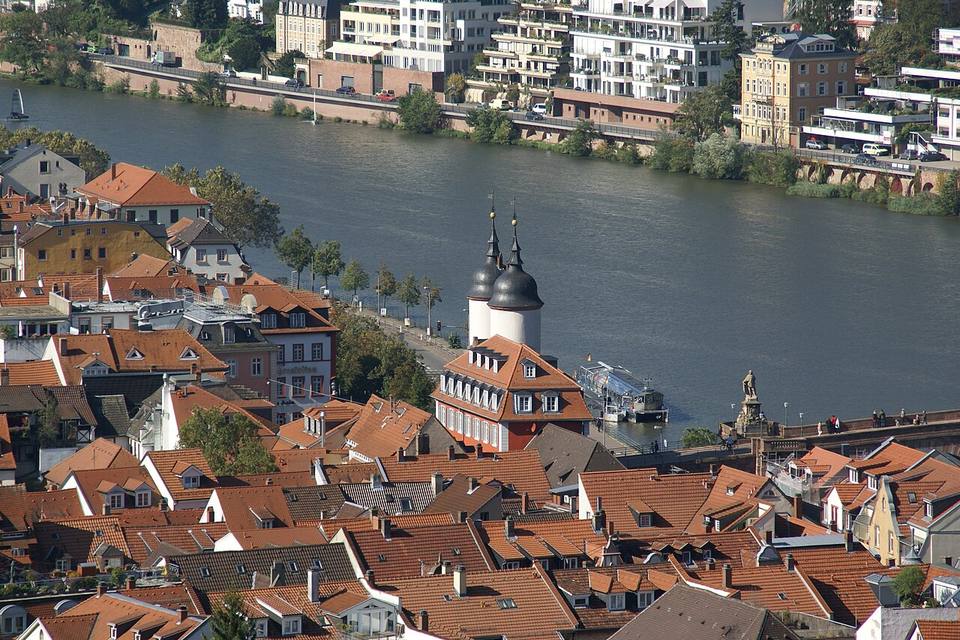
The Old Bridge over the Neckar, the red-sandstone castle ruin on the hillside, and Germany's oldest university (1386) — a romantic old town written about by both Mark Twain and Goethe.
Location
Heidelberg, Baden-Württemberg, Germany
Stories and legends
The castle's Great Tun (with a capacity of about 220,000 litres, 1751) and the court anecdotes of Perkeo, the dwarf who kept the tun, are widely told — they belong to the layer of legend.
History and context
Heidelberg Castle was begun in the 13th century and expanded under the Electors Palatine; in the War of the Palatine Succession (1689/1693) French troops blew it into ruin, and after a lightning strike in the 18th century it was left in ruin, to be enshrined in the Romantic age as a sacred place of ruin aesthetics; the Old Bridge (the Karl Theodor Bridge) was built in 1788; Heidelberg University was founded in 1386 and is Germany's oldest university, and the Students' Prison (Studentenkarzer, the old student detention rooms, their walls covered in graffiti) is a curiosity; the Philosophers' Walk on the north bank of the Neckar is the line from which to view the castle in full.
Local life
Heidelberg's character is "the youthful feeling of students and ruins": undergraduates sing together in the old-town taverns while couples watch the river-valley sunset from the castle ruin — Romanticism here is not scenery but a continuous tradition of two hundred years. The locals both live off the army of visitors (numbering in the millions each year) and guard the old town's quiet; once the main street (Hauptstraße, a 1.6-kilometre pedestrian street) closes for the night, the town returns at once to the stillness of a university city.
Customs
The castle's summer fireworks and illuminations (Schlossbeleuchtung, on specific nights usually in June, July and September, as announced by the city) are a great Neckar festival; there are student tavern traditions (rowing and choral singing).
Beliefs
The Church of the Holy Spirit is the old town's central church (with a history of shared use and division between the confessions); the whole centres on the university and Romantic culture.
Local etiquette
Keep to the hours and keep quiet when visiting the Students' Prison and the old university buildings (they are teaching areas); the castle courtyard's stone is slippery after rain; do not leave litter on the Neckar meadows, the summer sunbathing ground.
Visiting notes
Best in spring and autumn and on the nights of the castle illuminations; it is about 1 hour by train from Frankfurt, so a day trip is possible, but staying a night is worth more; ride the mountain funicular (Bergbahn) up to the castle station; the Philosophers' Walk and the Old Bridge together make a half-day loop.
What to eat nearby
Schnitzel with hunter sauce; Palatinate wines (from the neighbouring region); student-priced lunches (in the places that spill out around the university canteen, the Mensa); gingerbread and Christmas baking (in season); coffee and Black Forest gateau (a flavour of the wider region)
The old town's main street and around University Square, and the Neuenheim district on the north bank
Sharing tables in the taverns is normal; tip about 5–10%, rounded up and stated aloud to the server when paying
A sit-down meal €18–35 (approx. RMB 140–273, for reference only)
The castle ticket includes the Great Tun and the Pharmacy Museum, and the courtyard tickets come in tiers — check carefully before buying; on illumination nights, claim your spot on the riverbank 2 hours ahead.
Source leads: Heidelberg city tourism (official); the castle's managing body (the State Palaces and Gardens of Baden-Württemberg).
Image source · Hermann Luyken · CC0