
Western Europe Supplement · Tidal island / abbey
Mont-Saint-Michel
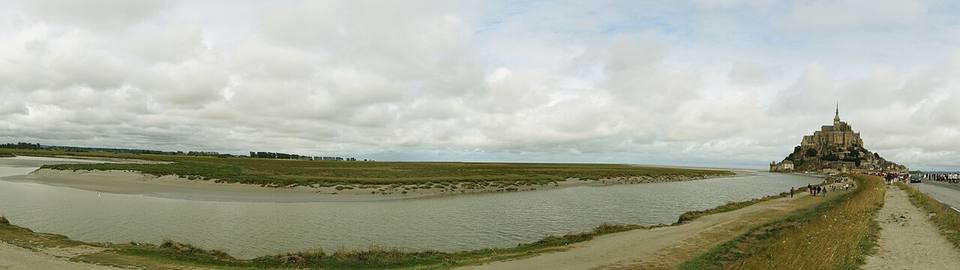
A Gothic abbey spears up into the sky from the top of a granite islet, and some of Europe's strongest tides (a tidal range of up to about 14 metres) turn it into an island and then back into mainland twice a day — known as the "Wonder of the West".
Location
Manche, Normandy, France
Stories and legends
The legend that in 708 Aubert, Bishop of Avranches, dreamed three times that the Archangel Michael ordered him to build a church, and of the relic of the saint's pierced skull, forms the core of the founding myth — it belongs to the layer of legend.
History and context
A Benedictine abbey was established here from 966, its Romanesque and Gothic fabric ("La Merveille," the Marvel, 13th century) layered one over another; through the Hundred Years' War it was among the few Norman strongholds never to fall; after the French Revolution it was turned into a prison, restored in the 19th century, and listed together with its bay as World Heritage in 1979. In 2014 a new causeway-bridge replaced the causeway built in 1879 (which had blocked the tides and caused the bay to silt up) — restoring the mount's tidal-island nature is the point of the modern engineering; access is by parking off the island and then shuttle bus or a walk across the bridge (following the official arrangements).
Local life
Mont-Saint-Michel's character is faith's geography made vertical: inns and restaurants at the foot, the village street in the middle, the abbey at the top — a social hierarchy carved into the slope. At flood tide the sea surrounds the island "at the speed of a galloping horse" (Victor Hugo's much-quoted image), and the local guides' barefoot mudflat walks (with quicksand demonstrations and the bay's ecology) are the bay's proper way of reading it; only a few dozen people live on the island, and the early morning and evening belong to them and to the abbey bells.
Customs
The pilgrimage tradition continues (pilgrim routes that walk the bay); the Archangel's festival (around 29 September, St Michael's Day, as arranged by the parish).
Beliefs
A historic sanctuary of the Catholic Benedictine abbey tradition (a monastic community is resident on the mount today), and a centre of devotion to St Michael the Archangel.
Local etiquette
The quicksand of the bay's mudflats is lethal: never walk the bay or chase the tide on your own without a guide; always check the tide tables and return to the island before the flood; keep silence inside the abbey and stop at the worship areas; the village streets are steep and slippery stone — wear shoes with grip.
Visiting notes
Best on big-tide days (a high tidal coefficient, by the French tide tables) and in spring and autumn; day-trip groups are at their densest at midday — stay a night to enjoy the dawn, the dusk and the floodlit mount; abbey tickets can be bought in advance on the official website; from Paris Montparnasse, the TGV to Rennes or Pontorson with a bus connection takes about 3.5–4 hours.
What to eat nearby
Pré-salé lamb (Agneau de pré-salé, salt-marsh lamb — a seasonal speciality at a high price); the puffy omelette (Omelette de la Mère Poulard, the signature of the 1888 house); buckwheat galettes (Galette, in the style of the Brittany–Normandy border); cider (Cidre) and Calvados (as a side trip)
The old restaurants on the island's main street, and the restaurant belt across at La Caserne (a notch cheaper)
Salt-marsh lamb is supplied by cut and by season — ask for the day's menu first; a savoury galette with cider is the proper form of a main meal
A sit-down meal on the island €30–55 (approx. RMB 234–429, for reference only); across the water, €20–35 (for reference only)
Dining on the island is pricey and its reviews polarised — the locals' ratio is a proper meal across the water and a coffee with a view on the mount; dragging a suitcase over the cobbles is agony, so enter the island lightly packed.
Source leads: Mont-Saint-Michel Abbey (Centre des monuments nationaux, official); UNESCO, Mont-Saint-Michel (1979).
Image source · ines s. · CC BY 2.0