
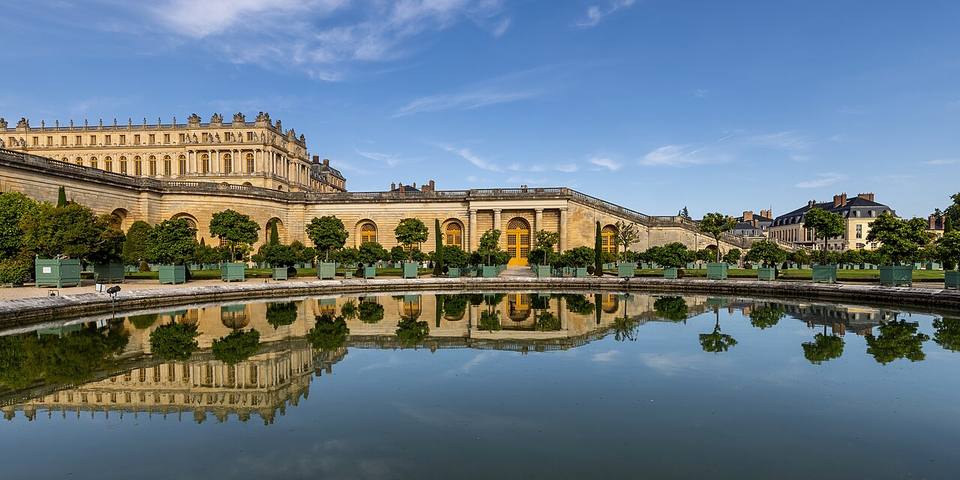
Western Europe Supplement · Palace / gardens
The Palace of Versailles
The 357 mirrors of the Hall of Mirrors face the gardens, and Louis XIV made a palace out of the entire power of France — the garden's axis runs down the Grand Canal all the way to the horizon.
Location
Versailles, Yvelines, Île-de-France, France
Stories and legends
There is no myth or legend; the Sun King's comparison of himself to Apollo belongs to the history of court propaganda.
History and context
It began in 1623 as Louis XIII's hunting lodge; Louis XIV began the great expansion in 1661, and the court moved in officially in 1682; Le Vau, Mansart and Le Nôtre (the gardens) were its three great makers. The Hall of Mirrors is 73 metres long, built in 1678–1684, and the Treaty of Versailles was signed in it in 1919; the estate includes the Queen's Hamlet (Marie Antoinette's pastoral buildings, 1783) and the Grand and Petit Trianon palaces; the gardens cover roughly 800 hectares and the Grand Canal runs for more than 1.6 kilometres. Entry is by timed reservation (the Passport combined-ticket system — follow the palace's official website), with a Musical Fountains season (usually on specific days from April to October, per the official calendar).
Local life
Versailles' character is "the extreme of order, and the reverse of life": court etiquette was once refined to the question of who might hand the king his shirt, yet today the gardens belong to the citizens — locals row on the Grand Canal, picnic on the lawns and feed the sheep at the Hamlet. To understand Versailles you need half a day inside and half outside: the impact of the Hall of Mirrors and the pastoral style of the Queen's Hamlet, taken together, give the full picture of the Ancien Régime.
Customs
The Musical Fountains and the night fountain shows (on specific summer nights, as officially announced) are a midsummer rite for the citizens; morning hours when the gardens are open to residents for running and cycling also exist (following the palace's rules).
Beliefs
The royal chapel inside the palace is a Catholic place of worship (historical); the whole centres on the cultural heritage of royal power.
Local etiquette
No large bags or selfie-stick-like items inside the palace (a cloakroom system applies); in the Hall of Mirrors, do not block the way for long photo sessions; the lawns are zoned (areas where sitting is allowed and areas to keep off, as the signs direct); allow at least 30 minutes for the queues and security checks.
Visiting notes
Best in spring and autumn and on fountain days; take the RER C from Paris to Versailles Château Rive Gauche station, a 10-minute walk away; buy the Passport ticket in one go to avoid queuing twice; route: at opening, go first to the main palace and the Hall of Mirrors, then take the gardens and the Trianons in the afternoon against the flow; you will walk well over 20,000 steps in the day — the little train and electric carts in the gardens can be hired as needed.
What to eat nearby
A proper French set meal (in the old-town restaurants of Versailles); crêpes and coffee; palace-style pastries such as madeleines (souvenir lines); cooked dishes at the market (Marché Notre-Dame)
The Saint-Louis quarter of the town of Versailles and around the market (within walking distance of the palace, and better value than eating inside)
In the French manner, the bread goes on the table rather than on a plate, and during the meal both hands rest at the edge of the table; the palace's own restaurants are priced for the view, so eat your proper meal in town
A sit-down meal in town €25–45 (approx. RMB 195–351, for reference only)
The palace is closed on Mondays (garden opening is counted separately — follow the official website) so do not make a wasted trip; on the way back, the RER has two stations, for the Left Bank and the Right Bank — be sure you want Château Rive Gauche.
Source leads: The Palace of Versailles (official); UNESCO, Palace of Versailles (1979).
Image source · Basile Morin · CC BY-SA 4.0