
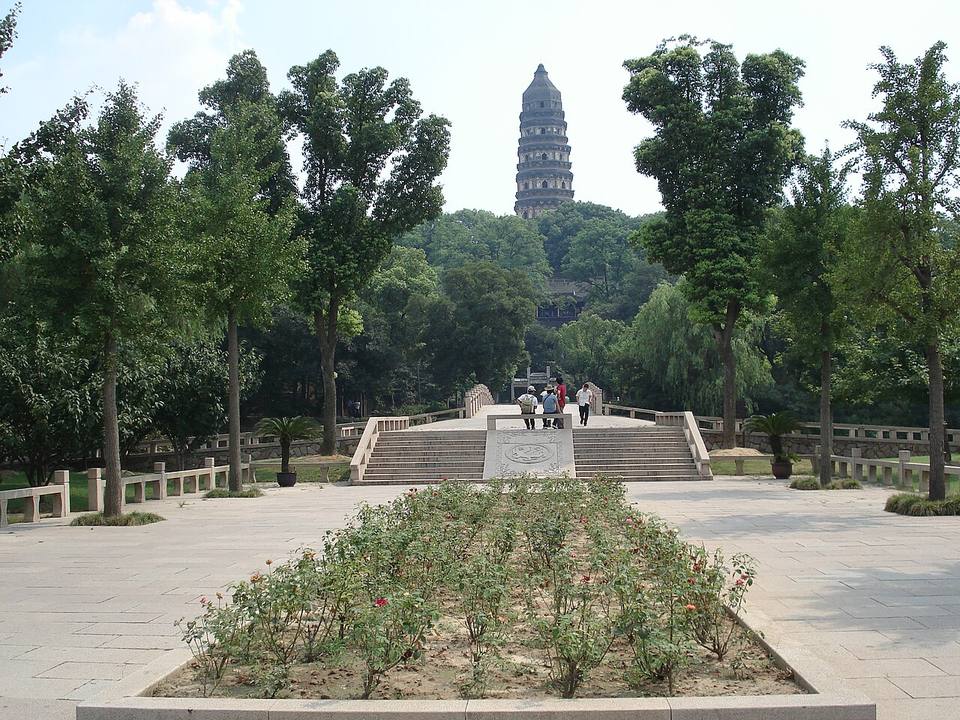
Gusu District, Suzhou, Jiangsu Province · Historic Site / Garden & Hill Scenery
Tiger Hill (Huqiu)
China's most famous leaning pagoda, the Yunyan Temple Pagoda, stands on a Wu royal tomb hill with 2,500 years of history — Su Dongpo said, "To visit Suzhou and not see Tiger Hill is a thing to regret."
Location
Gusu District, Suzhou, Jiangsu Province
Stories and legends
The tales that a white tiger appeared crouching on the tomb three days after King Helü of Wu was buried — hence the name Tiger Hill — and that the Sword Pond hides 3,000 burial swords belong to legend.
History and context
Tiger Hill is the site of the tomb of Helü, King of Wu (buried in 496 BC). The hill is only about 36 metres high yet accumulates remains from Wu and Yue through the Ming and Qing: the Yunyan Temple Pagoda was begun in the Later Zhou of the Five Dynasties (959) and completed in the second year of Jianlong in the Northern Song (961); the seven-storey, eight-sided brick pagoda leans because of uneven foundations (its top is displaced over 2 metres from the central axis), earning the name "China's No. 1 Leaning Pagoda," centuries older than Pisa's. The Sword Pond is the site of a natural rock face and the artificially cut tomb-passage entrance; Su Shi (Su Dongpo), the great Song literary figure, left the famous line in the tradition of his Tiger Hill accounts.
Local life
Tiger Hill holds a double identity for Suzhou people — "ancestral tomb and living room": the founding narrative of Wu culture is here, and so are residents' spring outings and autumn gatherings — the Tiger Hill temple fair and flower fair have run for centuries. It has none of the gardens' refined enclosure; instead tomb, pagoda, springs and rocks are spread out in open country, wild charm and historical weight side by side — the origin point for understanding Suzhou's narrative of "first came Tiger Hill, then the city of Suzhou (Helü's city)."
Customs
The Tiger Hill Flower Fair (spring) and temple fair are traditional Suzhou folk events (subject to the official schedule).
Beliefs
Historically the site of Yunyan Chan Temple (Buddhist); today it is chiefly a heritage scenic area, its religious colour a historical layer.
Local etiquette
Do not climb or carve on ancient remains such as the Sword Pond and the Broken-Beam Hall; the pagoda is closed to climbing — never try to cross the railings; the hill paths are slippery when wet, so go slowly on rainy days.
Visiting notes
Best in spring and autumn; the back-hill entrance is less crowded; combine with the Lingering Garden and Shantang Street in one day (all in the Changmen area); allow 2–3 hours.
What to eat nearby
Suzhou-style noodle soup (Fengzhen noodles, a summer-limited flavour / at time-honoured noodle houses such as Tongdexing); pan-fried buns (shengjian — Yaba Shengjian is of the folk-famous kind); squirrel-shaped mandarin fish; crab-roe soup dumplings (in season); tea snacks around Tiger Hill
Shantang Street, around the Lingering Garden, and the old-city noodle-house area in the opposite direction from Tiger Hill Wedding Dress City
Suzhou noodles are all about "catching the soup" (the broth's freshness is time-sensitive) — eat as soon as the bowl lands and do not leave it sitting for photos; sharing tables in noodle houses is the norm
Noodles 20–40 yuan (for reference only); a full meal 80–150 yuan (for reference only)
Tiger Hill's south gate is the wedding-dress-city crowd; enter by the north gate / main mountain gate for a quieter visit.
Source leads: Suzhou Municipal Bureau of Gardens and Greening materials on Tiger Hill; Tiger Hill Scenic Area official site, Suzhou.
Image source · Alton · Public domain