
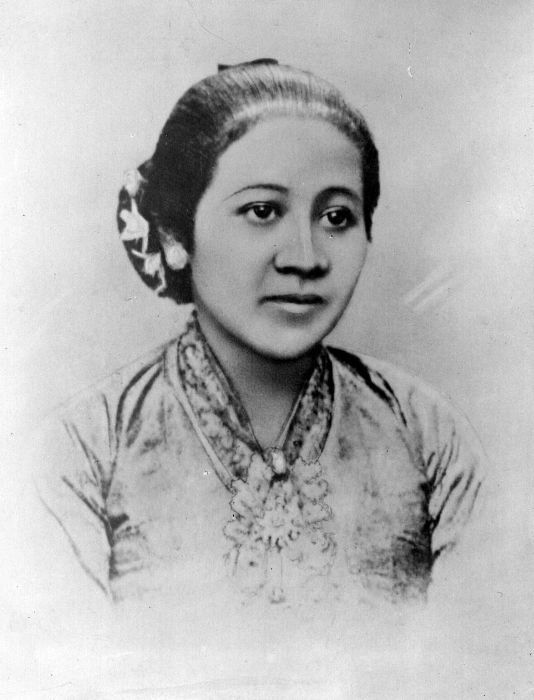
Tropenmuseum(荷兰世界文化国家博物馆藏) · CC BY-SA 3.0。注:该文件页直读曾遇 403,作者与许可据检索结果核验,特此说明。
21 April 1879–17 September 1904
Kartini, full name Raden Adjeng Kartini, also Raden Ayu Kartini
Kartini · 印度尼西亚
Late-19th- to early-20th-century Javanese aristocratic woman and pioneer of women's education, an Indonesian national heroine.
Born on 21 April 1879 in Jepara, Central Java (formerly Japara), her father was the regent of Jepara. She attended a Dutch-language primary school, and after age 12, following the Javanese aristocratic custom for girls, entered seclusion in the inner quarters (pingitan), during which she corresponded in Dutch with Dutch friends, criticising arranged marriage, polygamy, and girls' lack of schooling, and advocating schools for girls. In 1903 she was forced to marry the regent of Rembang, who already had three wives, and after marriage she still ran a school for Javanese girls in the east wing of the official residence. On 17 September 1904 she died four days after giving birth to her only son, aged only 25, and was buried in Bulu, Rembang. Her letters were compiled and published by J. H. Abendanon in 1911 as *Door Duisternis tot Licht* (*Through Darkness to Light*), with the English translation *Letters of a Javanese Princess* following; in 1964 she was posthumously recognised as an Indonesian national hero, and her birthday, 21 April, is Kartini Day.
People & stories
Places in their life
Birthplace Jepara (Central Java); places of activity Jepara and Rembang; burial place Bulu village, Rembang.
People
Cultural significance
A symbol of Indonesian women's emancipation and women's education; her letters were inscribed in 2025 in a UNESCO Memory of the World-related collection (the Leiden University Kartini collection), becoming a representative document of Southeast Asian women's voices in the colonial period.