

City guide · Praha
Prague
City of a hundred spires on the Vltava: the castle, Charles Bridge and the Astronomical Clock
Prague is the capital of Czechia, with the Vltava River running through it: Castle Hill on the left bank, and the Old Town and New Town on the right bank. As you cross Charles Bridge, you look up to the castle and St. Vitus Cathedral and down to the river and the bridge towers. The Astronomical Clock in the Old Town Square, the Old-New Synagogue in the Jewish Quarter, and the Baroque palaces of the Lesser Town together form an old town that was not largely destroyed in the Second World War. Prague is best explored slowly, one bank per day. Also worth visiting in the city: St. Vitus Cathedral, Church of Our Lady before Týn, Church of St. Nicholas, Old-New Synagogue, Jewish Quarter, Strahov Monastery, Petřín Lookout Tower, Vyšehrad, Wenceslas Square, Dancing House and Municipal House.
History
How the city came to be
Prague Castle was founded in the 9th century as the seat of the rulers of Bohemia, and Charles Bridge, begun in 1357 and completed in the early 15th century, connects the two banks. The Hussite Wars of the 15th century and the reign of Rudolf II in the 16th century, which attracted many artists and scientists, both left their mark on the city. In the 20th century, Prague went through the Czech nationalist movement, the suffering of the Second World War, and Communist rule, until the Velvet Revolution of 1989 led it toward democracy and modernity. In 1992 the Historic Centre of Prague was inscribed on the UNESCO World Heritage List, and since 1993 Prague has been the capital of the Czech Republic.
- 9th centuryPrague Castle is founded.
- 1357construction of Charles Bridge begins (completed in the early 15th century).
- 15th centurythe Hussite Wars.
- 16th centurythe reign of Rudolf II, a flourishing period for art and science.
- 20th centurythe Czech nationalist movement, the Second World War, and post-war Communist rule.
- 1989the Velvet Revolution, and Czechoslovakia moves toward democracy.
- 1992the Historic Centre of Prague is inscribed on the World Heritage List.
- 1993the Czech Republic is founded, with Prague as its capital.
Stories
Stories of the city
Stories of Prague Castle and Charles Bridge
Legend · Prague Castle and Charles Bridge
The most-touched spot on Charles Bridge is the statue of St John of Nepomuk (Jan Nepomucký) at the bridge's midpoint. Legend tells that this 14th-century Prague vicar-general refused to reveal the queen's confession to King Wenceslaus IV, and in 1393 the king had him thrown from the bridge into the Vltava to drown; five stars of light rose where he fell, and the queen and the priests found his body by following the light. He thereafter became a patron of "keeping confidences" and one of the patron saints of Bohemia, and in 1693 his bronze statue was raised on the bridge — touch the relief on the pedestal and the bronze cross below, it is said, and you will gain good luck and the promise to "return to Prague". Locals hold another private feeling about the bridge: tradition claims the architect Petr Parler mixed eggs into the bridge's mortar to strengthen it (the tale is told of many bridges, a folk embellishment with no historical confirmation); and the memory of each flood that destroyed the earlier bridge (the Judith Bridge was lost to the flood of 1342) makes Praguers almost protective about it — during the great Vltava flood of 2002, the whole city watched the news to confirm "the bridge is still there". As for the castle, from a 9th-century timber-fenced stronghold to today's presidential residence, it has never been abandoned in more than 1,100 years: it is one of Europe's very few castles that have "never clocked off", with kingship, empire and republic taking turns to work behind the same ridge line.
History of Prague Castle and Charles Bridge
History · Prague Castle and Charles Bridge
Prague Castle was founded around AD 870 in the Přemyslid era, when a church and fortress first rose on the hill, and successive Bohemian kings kept expanding it: in the 14th century Charles IV rebuilt St Vitus Cathedral in the French Gothic style (founded in 1344, the cathedral was only finally completed in 1929, nearly six centuries later) and strengthened the palace complex; under Rudolf II the castle became the seat of the Holy Roman Empire's court, its collections and observatory famous across Europe; today it is the residence of the President of the Czech Republic and a symbol of state power, its grounds covering some 70,000 square metres, listed by Guinness World Records as the largest coherent castle complex in the world. Charles Bridge was ordered by Charles IV in 1357; tradition holds that the court astrologers fixed the start of construction at 5:31 on 9 July 1357 — the palindromic number sequence 1-3-5-7-9-7-5-3-1. The bridge is about 516 metres long and 10 metres wide, its stonework directed by Petr Parler's workshop; the 30 Baroque statues of saints on the bridge were mostly added in the 17th–18th centuries (today mostly replicas, the originals held by the National Museum). The castle and the historic centre of the old town were inscribed on the World Heritage List in 1992.

Local life
Food and local daily life
Prague Castle and Charles Bridge
Must-try
- Czech roast pork knuckle
Czech roast pork knuckle (pečené koleno, with mustard and horseradish); beef in cream sauce with bread dumplings (svíčková na smetaně, the Czech national dish); Pilsner beer (the bottom-fermented golden lager born in Plzeň, Bohemia); roast duck with red cabbage and dumplings; a chimney cake (trdelník) from a bridgehead stall — its origins are disputed, but it has become a Prague street emblem
| Where to eat | The castle district and the Lesser Town (Malá Strana) have the most atmosphere in their century-old beer halls (old establishments of the U Černého vola type); across the bridge, restaurants around the Old Town hall are dense but pricey; for a local canteen, head to the Újezd area of the Lesser Town or the Letná Park beer garden behind the castle (superb views of the city) |
|---|---|
| Dining etiquette | Czech beer-hall culture values order: find a seat before ordering, shared tables are common and welcome, and a greeting is basic politeness; the height of the beer foam comes in grades such as "na dvakrát" (the standard pour), and ordering a Pilsner is the default courtesy; bills are usually settled in cash at the table, and the custom is to tip about 10% by stating a rounded total including the tip |
| Typical price per person | About CZK 300–550 per person (roughly RMB 95–175, reference prices); prices rise sharply in the old town's tourist core, and three minutes' walk toward the outer Lesser Town restores local prices |
| Tips | For the right flavour, prefer beer halls whose menu is just two pages in Czech and English and where locals share tables; svíčková sauce is properly mopped up with the bread dumplings (knedlíky) — when knife and fork fail you, asking the server for a spoon is perfectly common |
Prices are typical rates as of October 2026, not exact quotes; CNY equivalents are approximate where exchange rates fluctuate.
Trips beyond the city
These places can be explored from this city but lie outside it. See each place for transport and visiting guidance.

Karlovy Vary
Five spa colonnades line the valley, where you can sip springs of different temperatures and mineral content from a special spa cup as you strol…

Sedlec Ossuary
Beneath the Cemetery Church of All Saints, the bones of an estimated 40,000 to 70,000 people form a chandelier, bone pyramids, garlands and the …

Český Krumlov
A medieval town wrapped in a bend of the Vltava, with the second-largest castle complex in Czechia after Prague Castle: 40 buildings around 5 co…
Regional deep dives
Read deeper into each place
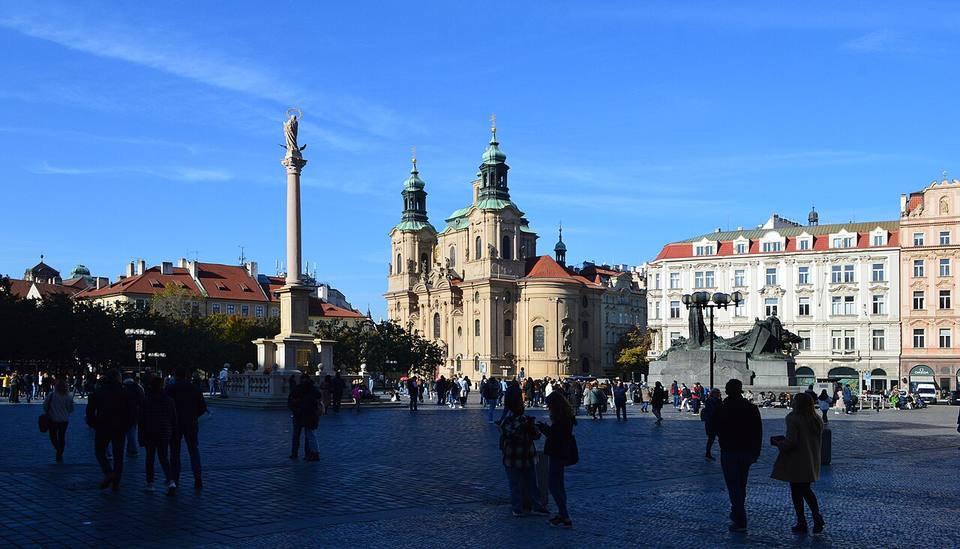
Central & Eastern Europe · Square / historic bridge
Prague Old Town Square and Charles Bridge
On Prague's Old Town Square the town hall's astronomical clock sends out its procession of apostles every hour, while the thirty statues of Charles Bridge have stood in the morning mist for six hundred years — Prague's cover and its soul in a single kilometre.
Explore the local guide ↗Source leads: Prague City Tourism (official); Prague City Hall materials on the astronomical clock.
Image source · Scotch Mist · CC BY-SA 4.0
Source leads are being checked individually; confirm travel details with local official notices.