
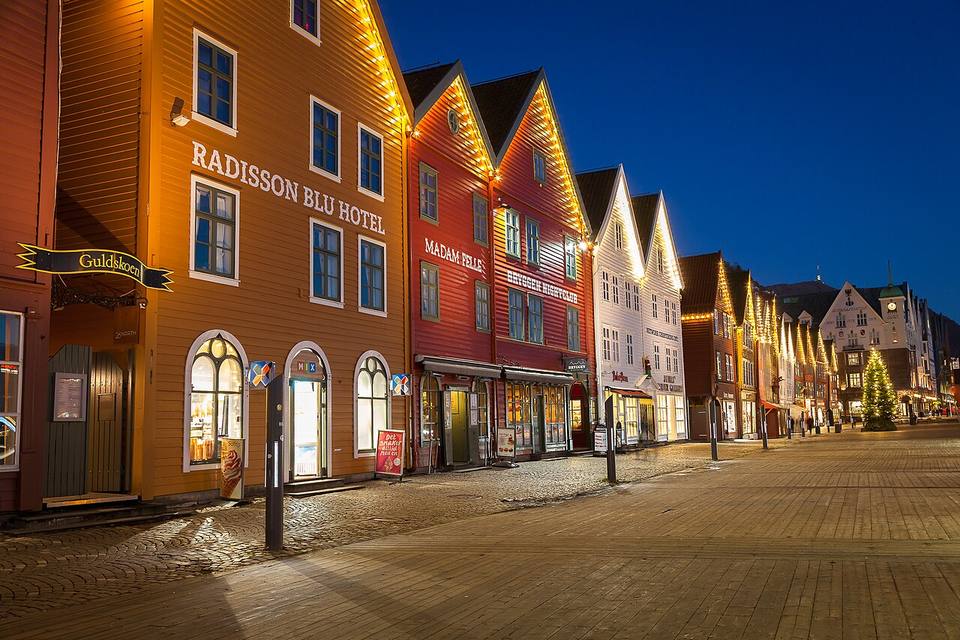
The Nordics · Historic wharf / World Heritage
Bryggen, Bergen
The Hanseatic League's row of painted timber houses lines the harbour, and the stockfish trade was carried on here for four hundred years — a living fossil of North Sea trade, listed as World Heritage in 1979.
Location
Bergen, Norway
Stories and legends
There is no myth or legend; the repeated great fires and rebuildings form the historical layer (an old city saying runs: "Bergen is reborn by rain and by fire").
History and context
Bergen is an old Norwegian capital (traditionally founded in 1070); in the 14th century the Hanseatic League established a trading post (a Kontor) here, and the Bryggen houses are the long joined rows where the German merchants lived and traded, rebuilt in the traditional layout after fires including that of 1702 — about 60 timber buildings survive today; the wharf was listed as World Heritage in 1979. Bergen's rainy days are famous (the claim of more than 200 days of rain a year is widely repeated), and "Bergen rain" is a daily fact of life.
Local life
Bryggen's character is timber and sea: the ladders creak in the narrow lanes (smau), the air smells of gulls and the fish market, and the Hanseatic Museum's stockfish stores stand face to face with modern design shops. It is also a gateway to the Norwegian fjords (one of the starting points of the Norway in a Nutshell route), where the visitors' hurry contrasts with the locals' ease, watching the rain from the cafés.
Customs
At the fish market you buy and eat on the spot (open-air stalls in summer); on 17 May, Constitution Day, the whole city parades in national costume (bunad) — a great Norwegian festival.
Beliefs
Historically, the Lutheran church (the Norwegian national-church tradition) and the church of the German Hanseatic community (St Mary's Church was the Hanseatic church) form a layer; overall the site centres on its trading heritage.
Local etiquette
Most of the wooden houses are shops and workshops — do not wander into courtyards and stairways to take photographs; fire prevention is the city's iron rule (open flames are strictly controlled in the timber district); stone paving and boardwalks are slippery in the rain.
Visiting notes
Best from May to September (for the long daylight); combine Bryggen, the fish market and the Fløibanen in half a day on foot; rain gear is Bergen's number-one piece of equipment (a waterproof shell beats an umbrella in the wind); book fjord-season boats in advance.
What to eat nearby
Bergen fish soup (Bergensk fiskesuppe, a creamy fish soup); cod and salmon; whale meat — [Note on a contested item: Norwegian whaling is controversial; it is marked "choose with care"]; brown cheese (Brunost); cinnamon buns (Skillingsbolle, said to originate in Bergen)
The fish market, the small restaurants in the back streets behind Bryggen, and the harbour area
At the fish-market stalls you can agree on the cooking and the accompaniments — settle the total price first; Norwegian prices are high, and the lunch set (dagens) is the money-saving course
A sit-down meal 280–450 Norwegian kroner (approx. RMB 185–297, for reference only)
The Norwegian krone rules here, and cards are accepted everywhere — cash is barely needed; the airport light rail into town is the most economical arrival.
Source leads: Bergen city tourism / the Bryggen Foundation; UNESCO, Bryggen (1979).
Image source · Smtunli · CC BY-SA 4.0