
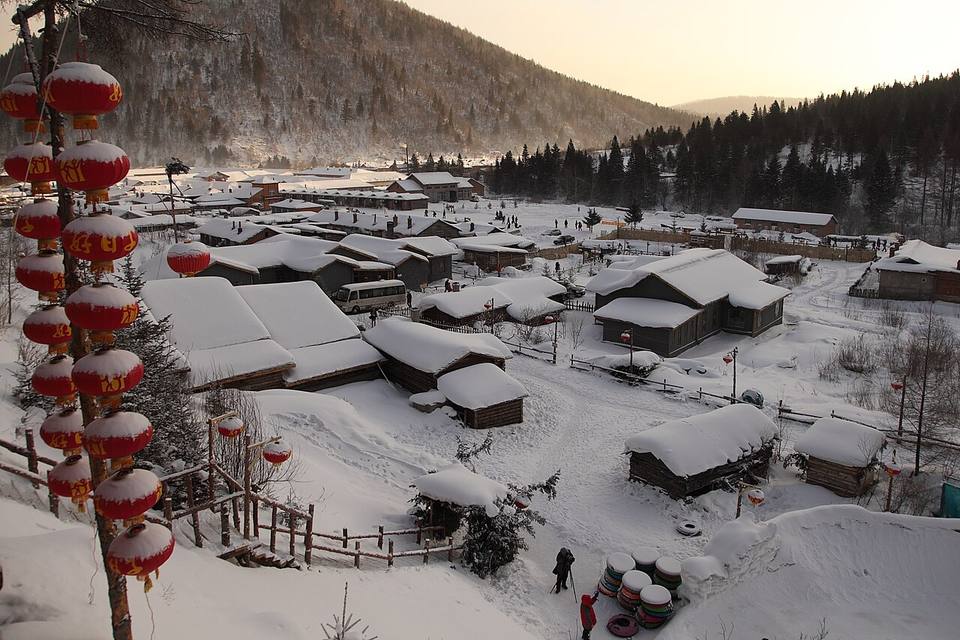
Shuangfeng Forest Farm, Hailin City, Mudanjiang, Heilongjiang Province · Snow Scenery / Village
China Snow Town
Moisture from the Sea of Japan is caught here by the mountain terrain, and the annual snowpack can reach about 2 metres; snow piles up on the roofs into "snow mushrooms" — the stickiest, thickest, most fairy-tale snow in China.
Location
Shuangfeng Forest Farm, Hailin City, Mudanjiang, Heilongjiang Province
Stories and legends
There is no myth or legend; the forest-farm anecdote that "Snow Town's heavy snow is thanks to the old logging boss's choice of site" is oral tradition.
History and context
Snow Town's core is Shuangfeng Forest Farm, a forestry farm established in the 1950s. Lying where the Zhangguangcai Range meets the Laoye Range at about 1,100 metres above sea level, it is where warm, moist air from the Sea of Japan converges with Siberian cold air; average annual snow depth can reach about 2 metres and the snow season lasts about 7 months. It became famous through film, television and photography (its association with the filming of Dad, Where Are We Going? and The Taking of Tiger Mountain is widely told), and it now runs unified management of tickets and shuttle buses with posted prices (each season subject to official announcement).
Local life
Snow Town's base colour is the life of forest-farm workers: wooden houses, heated brick beds (kang), and strings of corn and chillies in the storehouses, with red lanterns hanging under snowy eaves. The controversies and rectifications that followed its tourism boom also shaped it — clearly marked prices and unified transfers have become its keywords in recent years. Beyond the noise, smoke rising from snow-covered roofs at dawn and horse-drawn sledges passing through the street remain the most complete sample of a Northeastern snow village.
Customs
Sleeping on a heated kang — and "firing the kang" before bed — is the core of the experience; Xueyun Street has Northeastern yangko dance parades at night (subject to the scenic area's schedule).
Beliefs
No specific religious association; its main cultural attributes are forest-farm life and snow-country folkways.
Local etiquette
Never accept unlicensed touts or low-price tours on your own (a lesson from history — always book rooms and tickets through official channels); the snow on roofs is landscape and insulation — never climb onto roofs or break off the snow mushrooms; drone flights must follow scenic-area rules.
Visiting notes
Best from December to February, when the snow is thickest; staying one night to see both the night view and the morning is the best value; direct buses from Harbin take about 5–6 hours, and on snowy days official schedules rule; dress to the Mohe standard, and warming patches on the soles of your feet are the most practical trick.
What to eat nearby
Iron-pot stews (ribs with green beans / goose); chicken stewed with mushrooms (hazel mushrooms); pork stewed with vermicelli; sticky bean buns (niandoubao) and frozen pears; forest-farm wild mountain vegetables (in season)
Farmhouse restaurants along both sides of Xueyun Street (look for the posted clearly-marked-price boards) and canteen-style eateries run by forest-farm staff families
Eating cross-legged on the kang is the norm — take off your shoes and follow local custom; before ordering, ask clearly how dishes are priced (per pot / per portion) and the total
Full meals 80–150 yuan (for reference only)
Confirming the price of everything first and keeping receipts is Snow Town's rule number one; in peak season, book rooms through the scenic area's official platform.
Source leads: Official releases from Hailin City / Snow Town scenic area; China Weather Network climate data for Snow Town.
Image source · Chen Wu · CC BY 2.0