
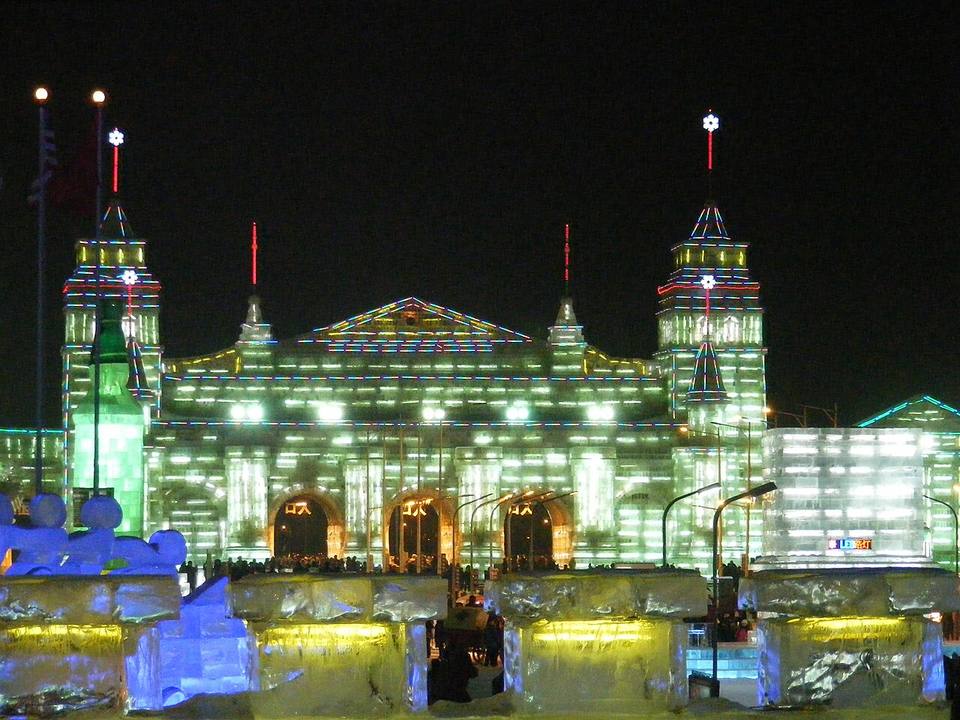
Songbei District, Harbin, Heilongjiang Province · Festival / Ice-and-Snow Park
Harbin Ice and Snow World
Usually open from late December to the following February (subject to official announcement each year), it builds a glowing city you can walk into out of Songhua River ice — and people happily queue two hours for the giant ice slide.
Location
Songbei District, Harbin, Heilongjiang Province
Stories and legends
There is no myth or legend; the claim that "the ice-lantern fair is the forerunner of Ice and Snow World" is verifiable history.
History and context
Harbin's ice lanterns began in 1963 with the first Ice Lantern Garden Party at Zhaolin Park; Ice and Snow World was founded in 1999 (to welcome the millennium) on the north bank of the Songhua River, west of Sun Island. Each edition covers several hundred thousand square metres and uses ice and snow on the order of several hundred thousand cubic metres (per edition, subject to official release). After the Songhua River freezes over, ice harvesters cut blocks with chainsaws and haul them to build the park — a winter trade carried on for decades.
Local life
What moves people most about Ice and Snow World is the swagger of "Harbiners treating winter as their home field": ice is the building material, cold is the selling point, and night is the stage. Locals may not go every year, but they all speak of it with pride — it is their calling card proving to the whole country that "cold can be festive too." Inside the park, Northeastern-accented hawking, steaming stalls of candied hawthorns (bingtanghulu) and the cold glow of the ice sculptures together create a one-of-a-kind, bustling polar feel.
Customs
Opening day and the Spring Festival bring the largest crowds; the giant slide and the Ferris wheel (Snowflake Ferris Wheel) are must-queue attractions, and locals make a habit of grabbing reservations first / rushing the slide first.
Beliefs
No specific religious association; its main cultural attributes are the ice-and-snow festival and the city's ice-and-snow industry.
Local etiquette
Every surface in the park is ice and snow, so ordinary soles will slip — wear ice cleats / anti-slip snow boots; phones shut down in the cold, so keep them warm against your body; never climb the ice sculptures and never touch ice with your tongue or wet hands (they will stick and cause frostbite); do not cut queues or push in line areas.
Visiting notes
The usual season runs from late December to mid-to-late February (subject to the official website / official WeChat account); entering at 15:00 lets you enjoy both the clear daylight views and the illuminated night scene; rush the giant ice slide right at opening or use the official reservation channel; Metro Line 2 runs directly to Ice and Snow World Station — the most reliable option, avoiding the difficulty of hailing taxis on snowy days.
What to eat nearby
Guobaorou (crispy sweet-and-sour pork; the claim that Lao Chu Jia is one of its founding restaurants is widely circulated); Harbin smoked red sausage; Madieer ice pops (in the park / on Central Street — eating an ice pop outdoors in winter is a Harbin ritual); iron-pot stews; kvass (fresh kvass)
The Sunac / Shimao dining areas in Songbei District, or back downtown around Central Street and the Daoli food market
An ice pop eaten outdoors at twenty below does not melt — eating it as you walk is the local picture, no need to find a warm room; iron-pot stews are cooked to order and take 30–40 minutes, so order first and then look around the area
Full meals outside the park 60–120 yuan (for reference only); hot drinks and snacks inside the park 30–60 yuan (for reference only)
Food inside the park is pricey with long queues; eating your fill downtown before entering is the smartest move.
Source leads: Official releases of Harbin Ice and Snow World (each edition's scale and dates subject to official announcement); Harbin Municipal Bureau of Culture, Radio, Television and Tourism.
Image source · Rincewind42 from China · CC BY 2.0