
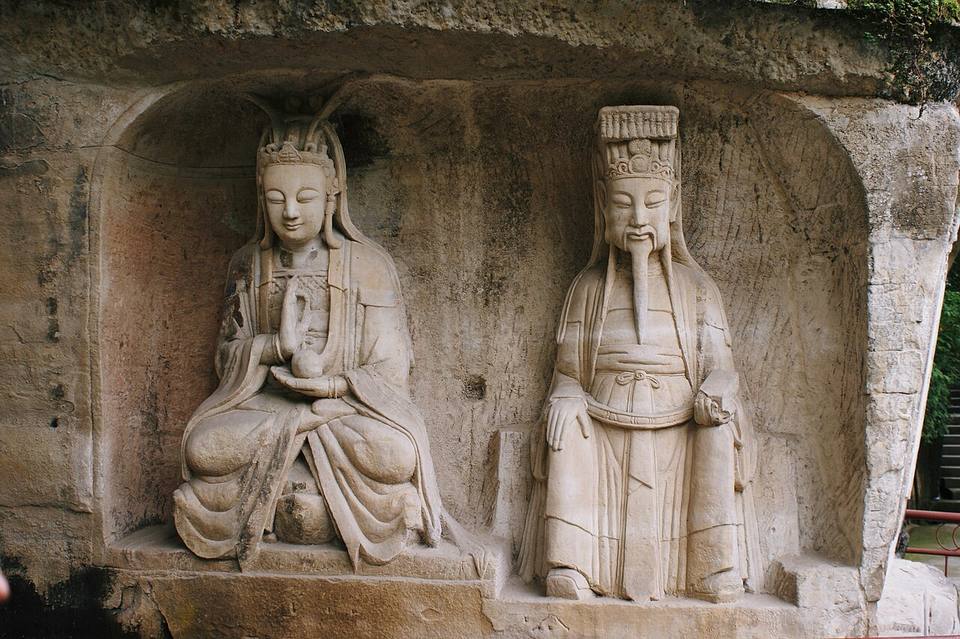
Dazu District, Chongqing · Stone-Carving Art / World Heritage
Dazu Rock Carvings
Inscribed as World Heritage in 1999: the Thousand-Armed Guanyin of Baodingshan spreads 800-plus hands across the cliff face, while the Beishan carvings turned Tang-Song secular life into a comic strip carved in stone — the "second half" of Chinese grotto art concludes here.
Location
Dazu District, Chongqing
Stories and legends
Baodingshan's founding vow tale of Zhao Zhifeng's mission and the narrative of Liu Benzun's practice are interwoven — the faith-history layer.
History and context
The Dazu carvings began in the Yonghui years of the Tang (650) and flourished in the Song, comprising five mountains including Baodingshan and Beishan with more than 50,000 statues. Baodingshan is an esoteric Buddhist sanctuary system built under Zhao Zhifeng in the Southern Song (between 1174 and 1252), famous for its secular style of linked serial sculptures telling sutra stories (such as the Sutra on the Profound Kindness of Parents transformation tableau). The Thousand-Armed Guanyin actually has 800-plus hands (commonly called a thousand) and regained its golden body through a major restoration from 2008 to 2015. It was listed as World Cultural Heritage in 1999.
Local life
Dazu's temperament is "stone carvings that tell stories": unlike Yungang's grandeur or Longmen's imperial manner, Baodingshan's Ox-Herding Picture and Chicken-Raising Woman tell the sutras as Sichuan-Chongqing daily life, and the guides' dialect commentary matches the carvings' humour perfectly. Dazu town itself is quiet, and Longshui Lake and the hardware industry (Dazu is a hometown of hardware) add an earthly footnote to the carving tour.
Customs
The Baodingshan incense fair (such as the Guanyin fair on the 19th day of the second lunar month, per temple arrangements); the Rock Carvings Museum is an essential preliminary lesson.
Beliefs
A Buddhist grotto group (esoteric Buddhism foremost, with fused Confucian-Buddhist-Taoist imagery including the Three Teachings), and Baodingshan still has a functioning religious site (Shengshou Temple).
Local etiquette
Never touch the niche statues or photograph them close with flash (per on-site signage); keep quiet in the temple area; do not fall for unlicensed "wild guides'" incense-oil sales routines.
Visiting notes
Best in spring and autumn; the order "museum first, then Baodingshan" gives the smoothest understanding; from central Chongqing by bus / high-speed rail (Dazu South Station) is about an hour; Baodingshan + Beishan fit in one day (combined tickets per official rules).
What to eat nearby
Dazu Youting crucian carp (a Dazu signature — spicy, numbing and fresh); Dingjiapo potatoes; Dazu winter vegetables; Baoding vegetarian food / farmhouse dishes around Shengshou Temple
Baoding Town, and the dining belt along Tangxiang Street in Dazu urban area
Youting crucian carp has many bones — eat slowly, and state your spice level first; for vegetarian food in the scenic area, use the temple's windows
A full meal 60–110 yuan (for reference only)
A guide is a must (seeing Baoding without commentary is like reading a comic strip without the captions) — use the official guide service points.
Source leads: UNESCO World Heritage Dazu Rock Carvings (1999); Dazu Rock Carvings Research Institute official site.
Image source · Hugh Llewelyn from Keynsham, UK · CC BY-SA 2.0