
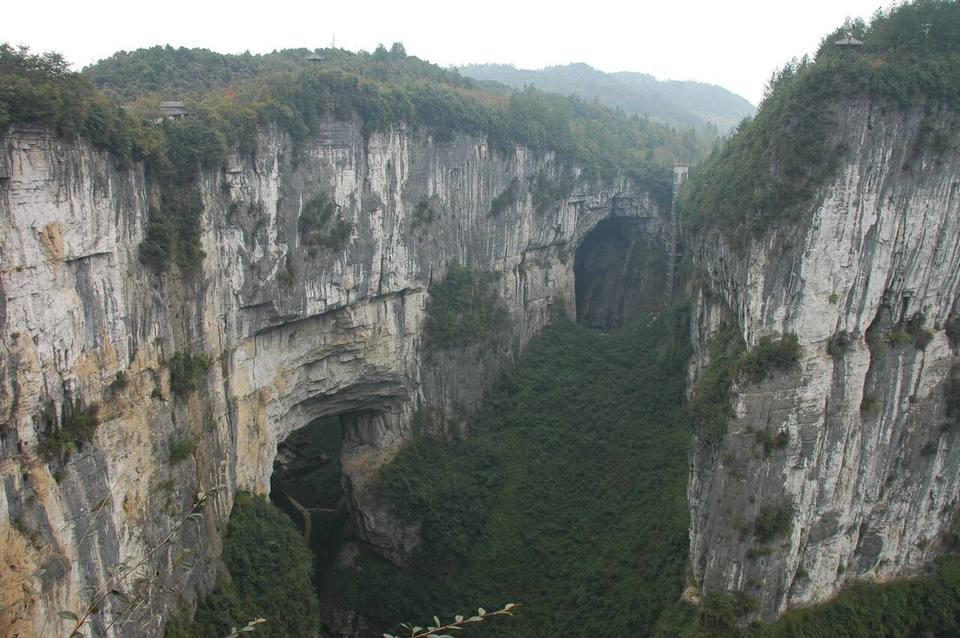
Wulong District, Chongqing · Karst / World Natural Heritage
Wulong Three Natural Bridges
The three stone arch bridges — Tianlong, Qinglong and Heilong — span a giant sinkhole at heights of the 200-metre class: Curse of the Golden Flower and Transformers 4 both filmed in this great hall of nature.
Location
Wulong District, Chongqing
Stories and legends
The three bridges carry a series of "dragon" names with attached dragon legends — the legendary layer.
History and context
The Three Natural Bridges belong to the karst system of the Yangshui River gorge, a tributary of the Wu River; Tianlong Bridge, Qinglong Bridge and Heilong Bridge average over 200 metres in height with spans in the hundreds of metres, forming one of the world's largest natural-bridge groups. Together with Furong Cave and Xiannüshan (Fairy Mountain), they form the Wulong Karst of Phase II of the "South China Karst," inscribed as World Natural Heritage in 2007. At the bottom of the Qinglong Tiankeng stands the Tianfu Official Post, a Qing-dynasty courier-station remain (displayed in combination with film set-dressing). The scenic route goes down into the pit by sightseeing elevator and walks through the bridges (per official rules).
Local life
Wulong's temperament is "the epic face of Chongqing's backyard": beyond the city centre's hotpot jianghu, two hours' drive brings the geological grandeur of sinkholes and ground fissures. The contrast between the people at the pit bottom (the post station, tea stalls) and the thread of sky overhead lets visitors viscerally understand the karst residents' daily life of "living in the cracks of the earth." Xiannüshan grassland's summer-retreat culture (Chongqing people going up the mountain at summer nights to sleep in tents) is its other face.
Customs
A one-way walking route through the sinkhole; grassland camping and music-season activities at Xiannüshan (per the scenic schedule).
Beliefs
No specific religious association; its main cultural attribute is karst geological heritage.
Local etiquette
The pit-bottom paths are wet and slippery — never leave the path to climb the cliffs or the bridge bodies; drone no-fly zones in the scenic area follow announcements; do not push in the peak elevator queues.
Visiting notes
Best on clear days in spring, summer and autumn; from Chongqing North Station the train to Wulong Station takes about 2 hours, then transfer to a scenic bus; packaging with Xiannüshan over two days and one night is most leisurely; entering on the first slot, when the light slants into the bridge caves, gives the best shots.
What to eat nearby
Wulong mutton (the mutton tradition of the Jiangkou / Yangjiao area); wanwan yangrou (bowl mutton); Xiannüshan whole roast lamb (for groups); suanlafen and Wulong shaofen (sweet-potato noodles); Tujia cured flavours
The dining street in Xiannüshan Town, Wulong urban area
Whole roast lamb is ordered by the animal — small groups should not order impulsively; mutton's gaminess is a local feature, cut with mint / dipping water
A full meal 60–120 yuan (for reference only)
The Three Bridges and Furong Cave / the Ground Fissure lie in different directions — in one day take the Three Bridges + Xiannüshan; in the rainy season check the scenic area's opening announcements (rockfall controls).
Source leads: UNESCO "South China Karst" Wulong entry; Wulong District Bureau of Culture and Tourism / Three Natural Bridges scenic area official site.
Image source · Brookqi · Public domain