
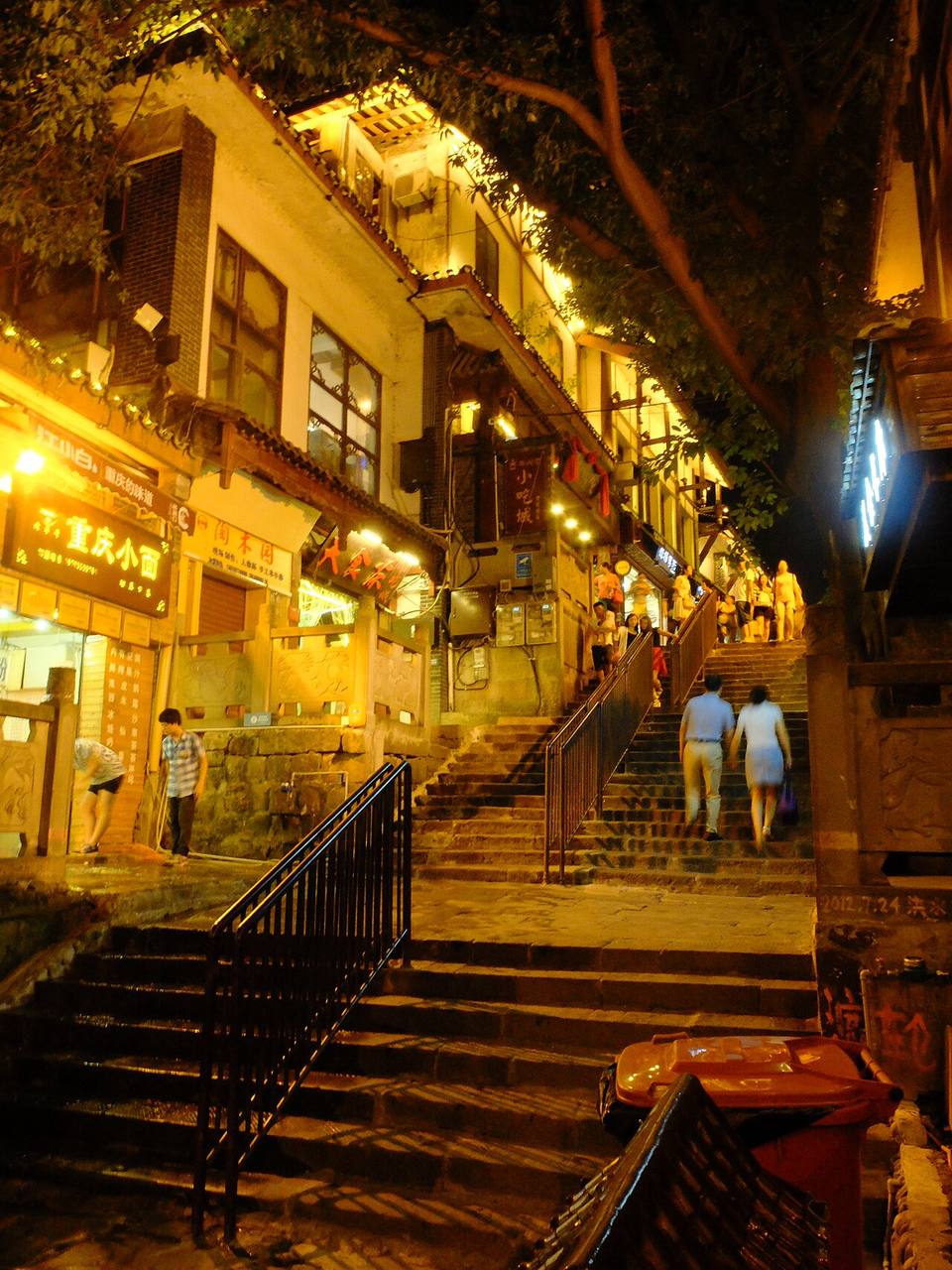
Shapingba District, Chongqing · Old Town / Bayu Folk Customs
Ciqikou Old Town
A thousand-year-old wharf town on the Jialing River, its bluestone main street sliding down from the mountain shadows toward the riverbank on the Baigongguan side — the length of the Chen Mahua queue is the gauge of its popularity.
Location
Shapingba District, Chongqing
Stories and legends
The town was originally called Baiyan Town and was renamed Longyin Town after the legend of the Ming Jianwen Emperor's refuge — the legendary layer (the Jianwen exile theory is unproven).
History and context
Ciqikou was founded in the Xianping years of Emperor Zhenzong of Song (said to have become a town around 998); in the Qing it took the name Ciqikou from porcelain production and transshipment, serving as an important water wharf and goods-distribution centre on the Jialing River. The Baolun Temple (transmitted as founded in the Song system) and the Zhong Family Courtyard are among its historic buildings. It is now one of the national-grade historic and cultural districts and the most accessible old town in central Chongqing (Ciqikou Station on Rail Transit Line 1).
Local life
Ciqikou's temperament is "the city centre's backyard": locals come on weekends to eat maoxuewang, listen to longmenzhen (idle chat), and watch the Jialing River from the riverside teahouses. The tourist main street is crowded, to be sure, but turn into the old lanes of Jinrong Street and Heng Street and the shoe-repair stalls and old teahouses pull the pace straight back to the wharf era. This "scenic area pressed against community" state is why it rewards wandering longer than purely commercial old towns.
Customs
Blessings at Baolun Temple, riverside teahouse culture, and temple-fair activities at festivals such as the Spring Festival (per street announcements).
Beliefs
Baolun Temple is a Buddhist site; overall, Bayu wharf folk culture dominates.
Local etiquette
At peak one-way-flow hours on the main street, do not go against the flow or stop for photos and block the way; when the river rises, never go down to the banks to play in the water; at old-town restaurants ask prices first, and for snacks sold by weight confirm the total.
Visiting notes
Best on weekdays and early mornings; rail transit goes straight there and avoids the jams; the back-street / Heng Street route has half the people; combine with Zhazidong and Baigongguan in half a day (the red-history sites need reservations, per the venues).
What to eat nearby
Chen Mahua (Ciqikou's famous product); old-town maoxuewang; chicken offal (jiza); suanlafen (hot-and-sour noodles); ciba and bingfen (ice jelly)
Ciqikou's main street and Heng Street, and the dining area at Shapingba's Sanxia Square (on the way)
Maoxuewang is fiery, spicy and oily — the local method is to cut the heat with rice and drinks like Weiyi soy milk; mahua is priced by weight / by bag — confirm first
Snacks 30–60 yuan per person (for reference only); a full meal 60–100 yuan (for reference only)
Mahua keeps for a short time — buy souvenirs in moderation; on holidays the old town runs flow limits and reservations per official announcements.
Source leads: Shapingba District Bureau of Culture and Tourism / Ciqikou Old Town official introduction.
Image source · Franco Pecchio from Milano, Italy · CC BY 2.0