
Western Europe Supplement · Old bridge / lake city
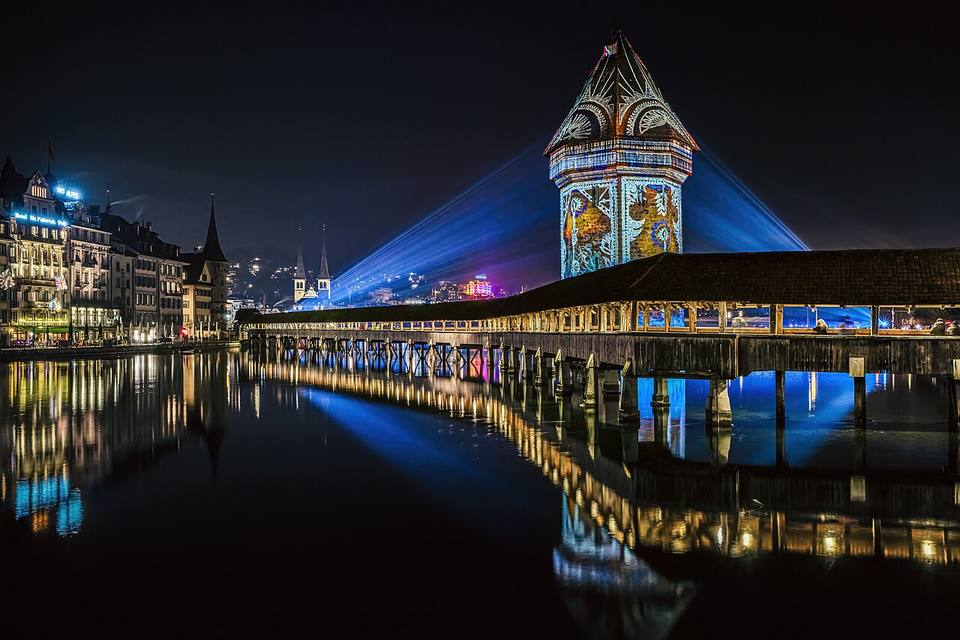
The Chapel Bridge, Lucerne
One of Europe's oldest covered timber bridges, built in 1333, with a hundred-odd triangular paintings ranged inside its roof and the octagonal Water Tower standing in the middle of the Reuss — after the fire of 1993, the people of Lucerne joined it back together exactly as it was.
Location
Lucerne, Switzerland
Stories and legends
There is no core myth or legend; the Water Tower's service as a treasury and a prison belongs to documented history.
History and context
The Chapel Bridge is about 204 metres long (it was originally longer, and was shortened as the banks were rebuilt); it was built in 1333 for defence and as a crossing, and inside its roof are kept the 17th-century painted panels of Swiss and Lucerne history (about 110 panels by the counts of those surviving and restored). The fire of August 1993 destroyed most of the bridge and many of the panels; in 1994 it was rebuilt true to its original appearance and reopened, and some of the charred panels are displayed on the bridge in their original state as a warning. Nearby landmarks include the Dying Lion monument (1821, commemorating the Swiss Guards who fell in 1792), the old town's painted houses and the Reuss weir.
Local life
Lucerne's character is Switzerland's front parlour: the lake (the Lake of the Four Cantons, Lake Lucerne), the two mountains Pilatus and Rigi, the painted houses of the old town and the Swan Square — exquisite as a model, yet still in working order: the locals commute across the bridge in the early morning, and on market days the market opens on the riverbank below the bridge (with a Tuesday/Saturday morning-market tradition). The fire and the rebuilding are this city's collective memory, and in the hearts of Lucerne's people the bridge carries far more weight than a bridge.
Customs
Markets on the bridge and the riverside morning market; Carnival (Fasnacht, usually in February, as announced by the city) is Lucerne's great festival, among the largest in Switzerland.
Beliefs
The bridge takes its name from St Peter's Chapel (the Kapelle); the whole centres on the citizens' defensive history and the city's symbol.
Local etiquette
No cycling or smoking on the bridge (fire safety for the timber structure); do not lean on the railings of the paintings; keep a respectful quiet at the Lion's pond (it is a memorial); do not feed the swans on the lake.
Visiting notes
Best in spring and autumn and in the early morning; the bridge is a 5-minute walk from Lucerne station; give the Museum of Transport (among Switzerland's most popular museums) and the Pilatus Golden Round Trip (a combination of rack railway and boat, following the operator) a separate day; the old town is entirely walkable — stay there.
What to eat nearby
Lucerne-style veal (Luzerner Chügelipastete, veal stewed in a puff-pastry shell — the local signature dish); cheese fondue (in proper restaurants); lake fish (whitefish and the like, in season); Swiss chocolate and cheese tasting at the markets
The riverside restaurant belt in the old town, and around the railway station
The "punishment" jokes for dropping your bread in the fondue (buying a round, doing the washing-up) are a table custom — follow the mood of the table; the locals say fondue goes with white wine or hot tea to help digestion
A sit-down meal CHF 35–60 (approx. RMB 308–528, for reference only)
Swiss prices are among the highest in Europe — the lunch menu (Tagesmenü) and supermarket delicatessens are the money-saving methods; for the Lucerne visitor card (covering city transport), the policy of a card given with your accommodation depends on the hotel.
Source leads: Lucerne city tourism (official); materials on the Chapel Bridge and the Lucerne old town.
Image source · Roy Egloff · CC BY-SA 4.0