
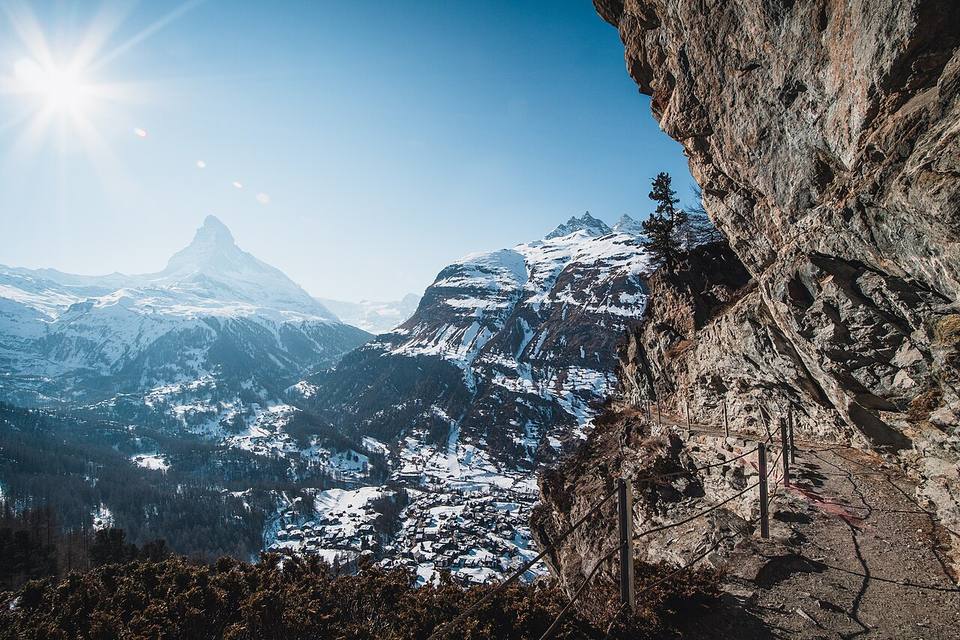
Western Europe Supplement · Alpine peak / resort town
Zermatt and the Matterhorn
The pyramidal peak rises alone against the sky at 4,478 metres, and the town at its foot bans petrol cars altogether — the terminus of the Gornergrat rack railway is a pilgrimage rite that humankind built for the sake of a single mountain.
Location
Zermatt, Valais, Switzerland
Stories and legends
In local tradition the Matterhorn is a giant, a fragment of a city wall and the like — a layer of Alpine folk legend.
History and context
The Matterhorn was first climbed on 14 July 1865 by Edward Whymper's party, and the disaster on the descent, when the rope broke and four men fell to their deaths, is the originating event of mountaineering history; Zermatt is a car-free town (only electric vehicles and horse-drawn carriages; petrol cars stop at Täsch and change to the train); the Gornergrat Railway opened in 1898 to its viewing platform at 3,089 metres, taking in the Gorner gorge glacier and the Monte Rosa group; the Klein Matterhorn "Glacier Paradise" cable car rises to 3,883 metres, among the highest cable-car stations in Europe (operation follows the weather and the official notices); on the Italian side the mountain is called Cervino.
Local life
Zermatt's character is "a temple of alpinism fused with a luxury ski town": the old village's black Valais timber houses (their granaries standing on rat-guard stone discs) stand face to face with the luxury shops of Bahnhofstrasse, and the genealogies of the guiding families share a street with Michelin restaurants. The locals hold the mountain in professional awe — weather windows and avalanche bulletins are everyday conversation, and the visitor's "sunrise photo run" is, to them, knowledge for survival.
Customs
Special Gornergrat sunrise trains (on specific days in summer, following the railway); the Matterhorn Museum tells the story of the broken rope of 1865, with the original rope on display.
Beliefs
No single religion dominates; Alpine mountain belief and the Catholic traditions of Valais form the cultural layer (the town church and the mountaineers' cemetery are spaces of memorial — visit them quietly).
Local etiquette
Alpine weather changes in a breath — keep your viewing-platform plans flexible, and do not force your way into bad weather because the ticket was expensive; never leave the marked routes in glacier areas without a guide (the crevasses are lethal); driving a petrol car into the town is forbidden (fines and towing); off-piste risk is borne strictly at your own responsibility.
Visiting notes
Best from July to September (hiking) and from December to March (skiing); to hedge against the cloud, stay 2–3 nights to raise your chance of seeing the peak; by train from Zurich or Geneva to Visp and then the mountain railway takes about 3.5–4 hours; the Swiss Travel Pass covers the leg to Zermatt, and the Gornergrat discounts follow the pass rules; for the sunrise reflection, hike to the Riffelsee or ride the train to Rotenboden station.
What to eat nearby
Cheese fondue and raclette (Raclette, the scraped grilled cheese that originates in Valais); Valais rye bread and dried apricots; lamb and platters of air-dried meat (Viande séchée); Valais white wine (Fendant)
The restaurant belt along Bahnhofstrasse, the small places in the old village, and the restaurants at the viewing platforms (priced for the view)
Raclette is scraped fresh and served with potatoes and pickles, at a slow pace — do not hurry it; for the wines to accompany fondue, see the Lucerne entry
A sit-down meal CHF 40–70 (approx. RMB 352–616, for reference only)
The summit restaurants and the cable-car fares are expensive, and self-catering from the town supermarket is the skiers' usual method; the Matterhorn's "golden sunrise" (the summit dyed gold) can be seen from within the town itself — at about 8 a.m. in winter and about 6 a.m. in summer, following the sunrise time.
Source leads: Zermatt tourist office (official); the Gornergrat Railway (official); the Matterhorn Museum materials.
Image source · Deralpinbergsteiger · CC BY-SA 4.0