

City guide · 成都 · 古称锦官城
Chengdu
The slow life of the Land of Abundance: two thousand years of everyday warmth steeped in a lidded bowl of tea
Chengdu lies in the heart of the Chengdu Plain, on the alluvial fan of the Min River — the central city of Southwest China. Since Li Bing and his son built Dujiangyan more than two thousand years ago, this land has been free of flood and drought and rich in produce, praised as the "Land of Abundance". The Sanxingdui and Jinsha sites prove the antiquity of ancient Shu civilisation; Du Fu's Thatched Cottage, the Wuhou Shrine, Kuanzhai Alley and the lidded-bowl tea of the People's Park sketch the Chengdu philosophy of a "comfortable" (basuo) life. The city expands in rings, with Longquan Mountain and the Xiling Snow Mountain as its backdrop — a city that lives its days as poetry.
History
How the city came to be
Chengdu's city history runs over two thousand three hundred years. The Kaiming dynasty of ancient Shu moved its capital here, naming it Chengdu from the saying "in one year a settlement, in two years a town, in three years a capital (chengdu)". After the Qin conquered Shu it set up Shu Commandery, and Li Bing, as governor, built Dujiangyan, making the Chengdu Plain the "Land of Abundance". In the Han, Chengdu's brocade (Shu jin) ranked it among the five great metropolises; in the Tang it shared the glory of "Yang first, Yi second". In the Five Dynasties, Meng Chang of Later Shu planted hibiscus all along the city walls, giving Chengdu its alias "City of Hibiscus". In the Northern Song, Chengdu's jiaozi was born — one of the world's earliest paper currencies. In modern times Chengdu has been the capital of Sichuan and a key city of the southwest; more than three million Sichuan soldiers went out to fight in the War of Resistance. Today Chengdu is known for its park-city programme and leisure culture, and has hosted the Universiade and the World Games in succession.
- c. 5th century BCThe Kaiming dynasty of ancient Shu moved its capital to Chengdu; the name "Chengdu" arose
- 256 BCLi Bing and his son presided over the building of Dujiangyan
- Han dynastyChengdu ranked with Luoyang, Handan and others as one of the "five capitals"; Shu brocade was famous across the realm
- 1023The Northern Song set up the Yizhou Jiaozi Office in Chengdu, issuing the world's earliest official jiaozi paper money
- 759Du Fu arrived in Shu and built his thatched cottage beside Huanhua Stream
- Ming–QingAfter the great migrations into Sichuan, Chengdu became the commercial and cultural centre of the southwest
- 1949Chengdu was liberated on 27 December
- 2007Chengdu was approved as a National Comprehensive Reform Pilot Zone for coordinated urban–rural development; rural tourism such as the "Three Saints Flower Village" rose
Must see
Places you shouldn’t miss

Local life
Food and local daily life
Kuanzhai Alley, Chengdu
Must-try
- Hotpot
- Chuan chuan xiang (skewer hotpot)
- Zhong dumplings / Long wontons
Hotpot (beef-tallow hotpot), chuanchuan xiang (skewers cooked in broth), Zhong dumplings / Long wontons (old Chengdu snacks), dandan noodles, rabbit heads (spicy rabbit heads — try with caution)
| Where to eat | Snacks inside Kuanzhai Alley, Kuixinglou Street (the locals' food street), the area around the original Long Chaoshou restaurant |
|---|---|
| Typical price per person | CNY 60–120 |
| Tips | Inside the alleys it's mainly about the experience, so eat main meals on Kuixinglou Street; 'mild' is already very spicy for visitors — have yoghurt or Weiyi soy drink on hand. |
Prices are typical rates as of October 2026, not exact quotes; CNY equivalents are approximate where exchange rates fluctuate.

Breaknet2025 · CC BY 4.0
Trips beyond the city
These places can be explored from this city but lie outside it. See each place for transport and visiting guidance.

Regional deep dives
Read deeper into each place
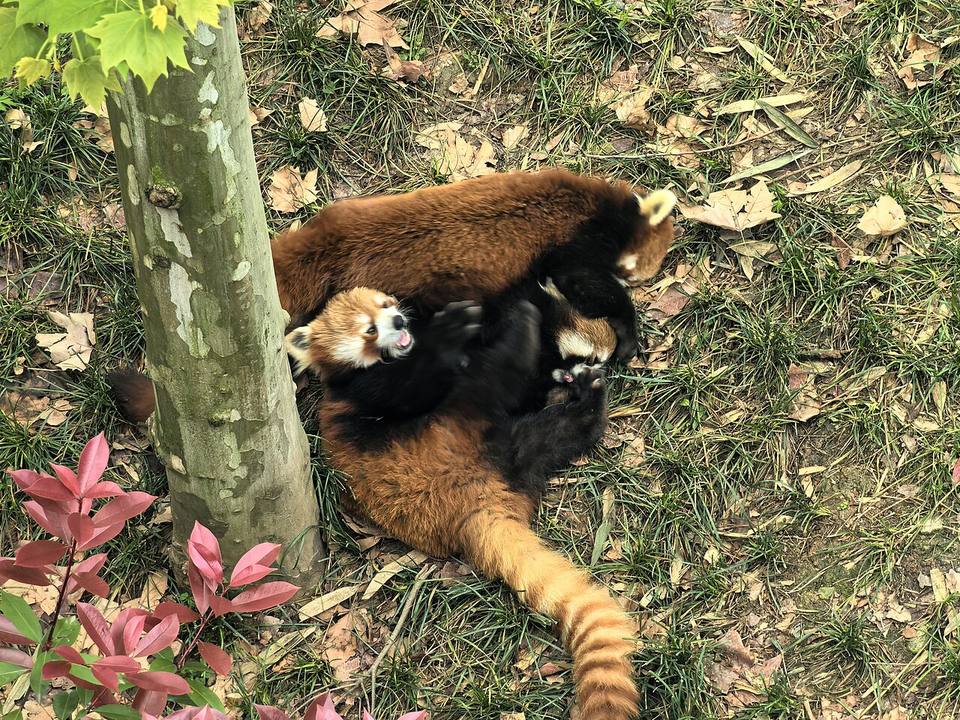
Chenghua District, Chengdu, Sichuan Province · Animal Conservation / Family Science Education
Chengdu Research Base of Giant Panda Breeding
One of the world's most important institutions for captive giant panda breeding — in the early morning the young pandas roll on the lawns and eat bamboo; seeing pandas means arriving early, and that is Chengdu's lesson number one.
Explore the local guide ↗Source leads: Chengdu Research Base of Giant Panda Breeding official site; Chengdu Municipal Bureau of Culture and Tourism.
Image source · MSK · CC BY-SA 3.0
Source leads are being checked individually; confirm travel details with local official notices.