
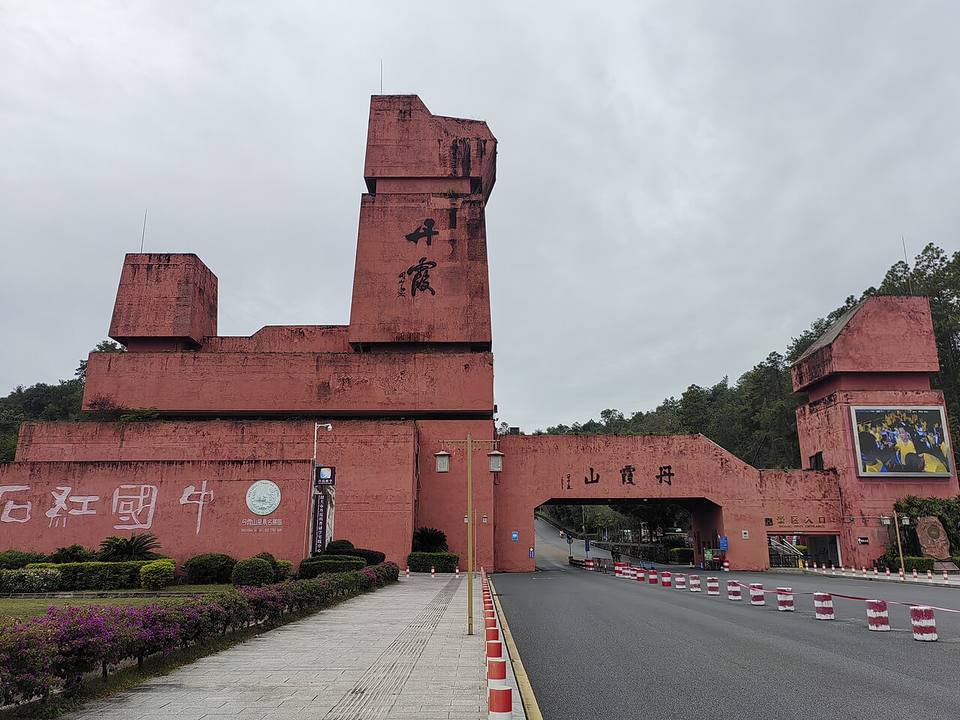
Renhua County, Shaoguan, Guangdong Province · Natural Wonder / Naming Site of the Danxia Landform
Danxia Mountain (Danxiashan)
The geomorphological term "Danxia" was born here: red cliffs line up along the Jin River, while the earth's joke of Yangyuan Stone and Yinyuan Stone hides outside the main scenic area.
Location
Renhua County, Shaoguan, Guangdong Province
Stories and legends
Legends of the sage-king Shun playing music and of Nüwa's sky-mending leftover stones are attached to sights such as Elder Peak (Zhanglao Peak) — the legendary layer.
History and context
In 1928 the geologist Feng Jinglan and others discovered the red sandstone-conglomerate strata in northern Guangdong and named them the "Danxia Beds"; in 1939 Chen Guoda proposed the concept of "Danxia landform," making Danxiashan the landform's naming site. The landform was formed from fluvial-lacustrine red sandstone conglomerate of about 70 million years ago, uplifted and eroded; Elder Peak, Xianglong Lake and Yangyuan Mountain are the core touring areas. In 2010 it was inscribed on the World Natural Heritage list as part of the serial "China Danxia" nomination, and in 2004 it became a Global Geopark.
Local life
Danxiashan's temperament is rugged yet humorous: the geological-textbook seriousness (Jinshi Rock Temple embedded in the cliff face, the incense of Biechuan Chan Temple) coexists with a knowing smile at the Yangyuan Stone area. Shaoguan, gateway to northern Guangdong and a cultural junction of Hakka and Yao (the Guoshan Yao of neighbouring Ruyuan), adds farmhouse Hakka dishes and leicha (pounded tea) at the mountain's foot to give the red rocks a touch of hearth-smoke.
Customs
Visits to cliff temples such as Jinshi Rock Temple; watching the sunrise from Elder Peak in the early morning (the Danxia sunrise) is a photography set piece.
Beliefs
Buddhist temples (Biechuan Chan Temple, Jinshi Rock Temple) form the historical layer; geological heritage dominates overall.
Local etiquette
Cliffside trails such as Yangyuan Mountain are slippery when wet — never climb over the railings and lean out; the scenic cable car and boats may be suspended in flood season, so obey arrangements; never carve on the red rock walls (the rock is soft and the scars are permanent).
Visiting notes
Best on clear spring and autumn days; for the Elder Peak sunrise you must stay inside the scenic area / halfway up the mountain the night before (per ticket and lodging policies); the main scenic area and Yangyuan Mountain are ticketed and toured separately — plan a day and a half; Shaoguan Station / Shaoguan East Station have dedicated bus lines.
What to eat nearby
Hakka stuffed tofu; Renhua white-hair tea and Danxia black tea; Jin River fish (in season); Yao bamboo-tube rice (Ruyuan, on the way); Shaoguan stir-fried river snails
The dining street outside Danxiashan's mountain gate, Renhua county town, and Bainian Dongjie in Shaoguan city
Hakka food is saltier and more savoury to go with rice — balance it with green vegetables; for river snails, ask first whether they have been purged of sand
A full meal 60–120 yuan (for reference only)
Sunrise spots (along the Shaoyin Terrace line) need to be taken early in peak season; summer sun is fierce with no shade, so schedule climbing for the early morning.
Source leads: UNESCO "China Danxia" (2010); Danxiashan Management Committee / Global Geopark official site.
Image source · Yumeto · CC BY-SA 4.0