
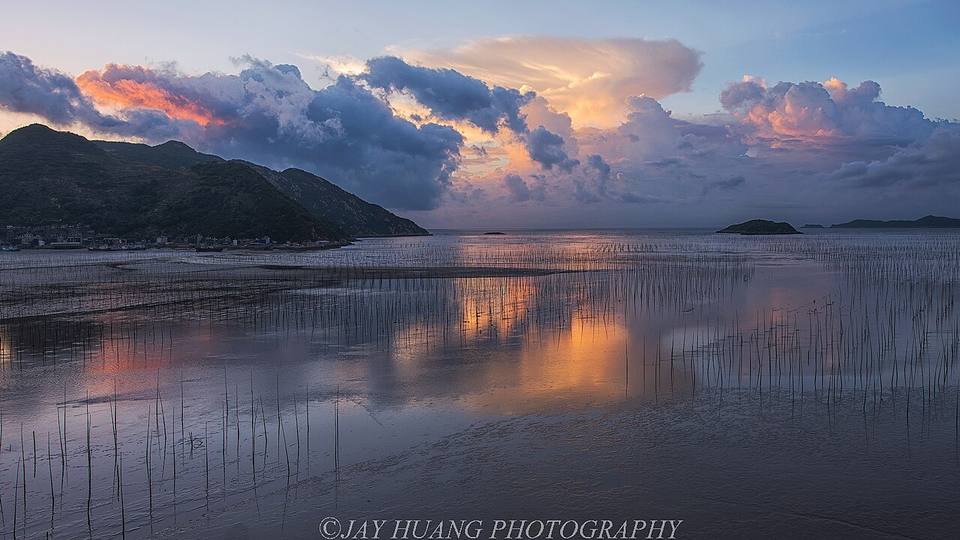
Xiapu County, Ningde, Fujian Province · Mudflats / Photography Destination
Xiapu Mudflats
China's most beautiful mudflats are not in a painting but in the tide tables: nori racks, bamboo-pole arrays and tiger-stripe sand beaches change faces with the light every hour.
Location
Xiapu County, Ningde, Fujian Province
Stories and legends
There is no myth or legend; mudflat place names, salt fields and fishing sayings belong to producers' oral transmission.
History and context
Xiapu has a long coastline and broad mudflats; nori (Porphyra haitanensis) and kelp farming have been century-old industries, and the pole-inserted and suspended aquaculture forms the geometric landscape of the flats. Beiqi mudflat at sunrise, Dongbi at sunset, Xiaohao's "tiger-skin flats," Yangjiaxi and the S-bend at Shajiang are the classic shooting spots. The mudflat scenery changes decisively with the tides — at high tide there are no flats, and ebbing too far leaves the textures parched — so trips must be timed by the tide tables.
Local life
Xiapu's temperament is "labour as scenery": the silhouettes of fishermen heading down to the flats before dawn and shouldering their loads are not a performance but a livelihood; photographers merely borrow the light. In the county town, photography inns, guides and "mudflat weather assessment" have become an industry chain, and old local fishermen have switched to working as models / guides (staged fishing scenes are charged for as a matter of course — clear pricing is best). The freshness of the seafood here has no rival — just-landed yellow croaker and bijia (goose barnacles) are the villagers' daily fare.
Customs
The nori season (autumn-winter harvest) is the mudflats' busiest; fishing villages set their routines by the tides (a tide-chasing culture).
Beliefs
The Mazu faith is shared by the coastal fishing villages; overall, fishing-and-farming production culture dominates.
Local etiquette
The mudflats' silt can swallow you to the knees — never venture deep without a guide (the rising tide can cut off your retreat); talk to fishermen before shooting close-ups of them and agree on prices for staged scenes in advance; never step on the bamboo racks and nori seedlings in the farming areas.
Visiting notes
Check three things before setting out: the tide tables, sunrise/sunset times and cloud cover; staying at a photography-themed inn in Sansha Town / the county town and joining a shared chartered car is most economical; the best season is October to April (the nori season overlaps the light season); non-photographers need only one stop — Dongbi for the sunset.
What to eat nearby
Xiapu seafood (yellow croaker / large yellow croaker, swimming crab, goose barnacles); kelp and nori dishes (nori dumplings / kelp-seedling soup); Xiapu seafood paste soup (hutang, a snack); Mindong sweet-potato cups and other snacks
The seafood-stall area in Xiapu county town, Sansha Town fishing port
Live seafood is weighed fresh — ask the unit price and processing fee first; goose barnacles need tools to pry open, and shops will mostly prepare them for you
A seafood meal 100–200 yuan (for reference only)
Photography groups set out at 3–4 a.m. to take their positions; independent travellers are steadiest on a half-day tour with a local guide; the glare off the flats is strong — sunglasses and sun protection are a must.
Source leads: Xiapu County People's Government / Ningde Municipal Bureau of Culture and Tourism introductions to the mudflats; Fujian marine-fisheries materials on the nori industry.
Image source · Jay Huang from Pleasanton, USA · CC BY 2.0