
Wuyishan City, Fujian Province · Famous Mountain / Tea Culture / Dual World Heritage
Mount Wuyi
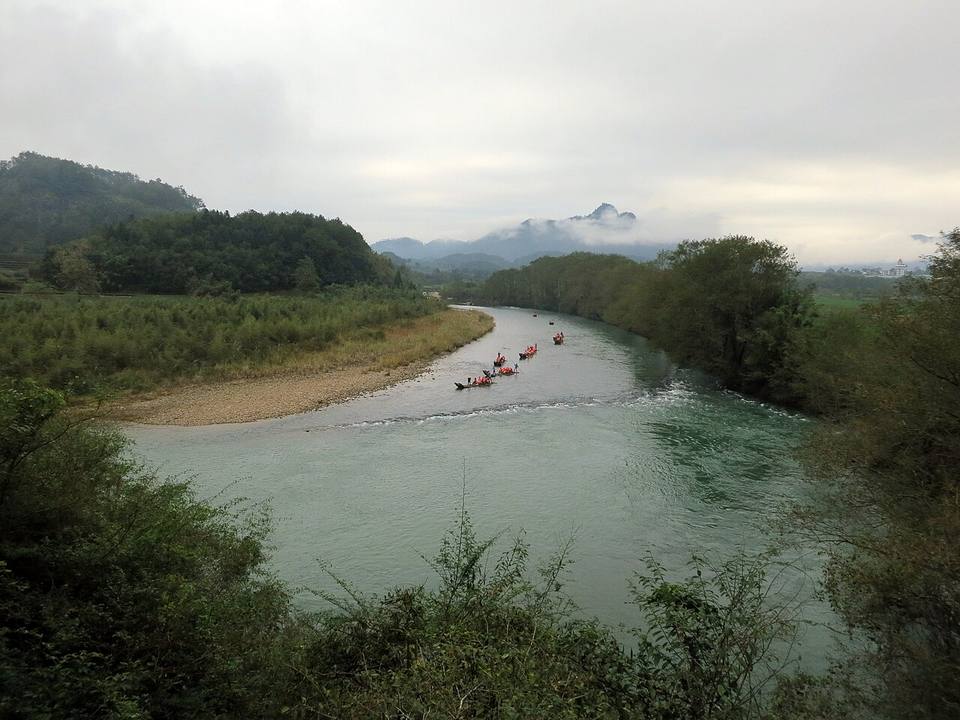
A bamboo raft drifts down Nine-Bend Stream past danxia peaks while, on the banks, Zhu Xi lectured for ten years and rock tea has been fragrant for a millennium — dual cultural and natural World Heritage since 1999, all in one mountain.
Location
Wuyishan City, Fujian Province
Stories and legends
The legends of Pengzu and his sons Pengwu and Pengyi opening the mountain, and the mythic attachments of the Rainbow Bridge planks and the cliff-hung boat coffins, belong to the legendary layer.
History and context
Mount Wuyi preserves Shang-and-Zhou cliff-hung boat coffins and a Han-dynasty city site; Zhu Xi wrote and lectured here (the Wuyi Retreat, built in 1183), making it a famous mountain of Neo-Confucianism. It was listed as dual cultural and natural World Heritage in 1999. The mother bushes of Dahongpao grow on the cliff at Jiulongke (picking is now banned and they are under key protection); rock tea (yancha) is famed for its "rock bone and floral fragrance" (yangu huaxiang), with Rougui, Shuixian and famous cultivars (mingcong) forming the yancha family. Tianyou Peak is the high point for viewing the whole Nine-Bend panorama (some 800-plus steps).
Local life
Wuyi's temperament is a "trio of tea, Neo-Confucianism and danxia": tea-factory hosts talk with you about roast levels and terroir (the zhengyan / banyan / zhoucha distinctions), while raftsmen on the stream hum work songs and tell the nickname of every rock. Mountain people's time is ruled by the tea seasons — in spring-tea season the whole town breathes the scent of roasting tea, and the visitor's tea-tasting experience is only the last link of that industrial chain.
Customs
The bamboo rafts are poled by hand, and a voluntary-tip custom for the raftsman's commentary exists (per the scenic area's published rules — do not let yourself be price-gouged); after tasting tea at a tea factory, buy according to your means.
Beliefs
A historic famous mountain shared by Confucianism (Neo-Confucianism), Buddhism and Taoism, with no single dominant faith.
Local etiquette
Fire is strictly banned in the core scenic area (forest fire prevention in the tea mountains); do not pick from or trample tea gardens and the mother-bush protection zone; do not stand up or change seats on the raft, and during flood season obey raft-suspension arrangements.
Visiting notes
Best in spring and autumn; raft tickets must be reserved for a time slot in advance (official channels), and in peak season they are hard to get; the Impression Dahongpao live-action show is a night-time bonus (per the show's schedule); staying in the Sangu resort area is most convenient for food, lodging and transport.
What to eat nearby
Wuyi rock tea (Dahongpao / Rougui, for tasting); Langu smoked goose; fish from Nine-Bend Stream; Wuyi bamboo shoots and red mushrooms (in season); guangbing and guobian and other northern-Fujian snacks
The dining street of the Sangu resort area, the old street in Wuyishan city, and tea-factory tea spaces
Rock tea stands up to many infusions (the saying goes "fragrance remains after seven infusions") — sip it in small mouthfuls, never gulp it; taste before you buy tea, and given the huge price spread, do not make impulsive large purchases
A full meal 80–150 yuan (for reference only); tea tasting and buying — spend as you please (for reference only)
The raft ends at Wuyi Palace's Song Street, where Zhizhi Hermitage and the museum make a natural half-day continuation.
Source leads: UNESCO World Heritage Mount Wuyi (dual inscription, 1999); Mount Wuyi National Park / Wuyishan Municipal Bureau of Culture and Tourism official site.
Image source · rheins · CC BY 3.0