
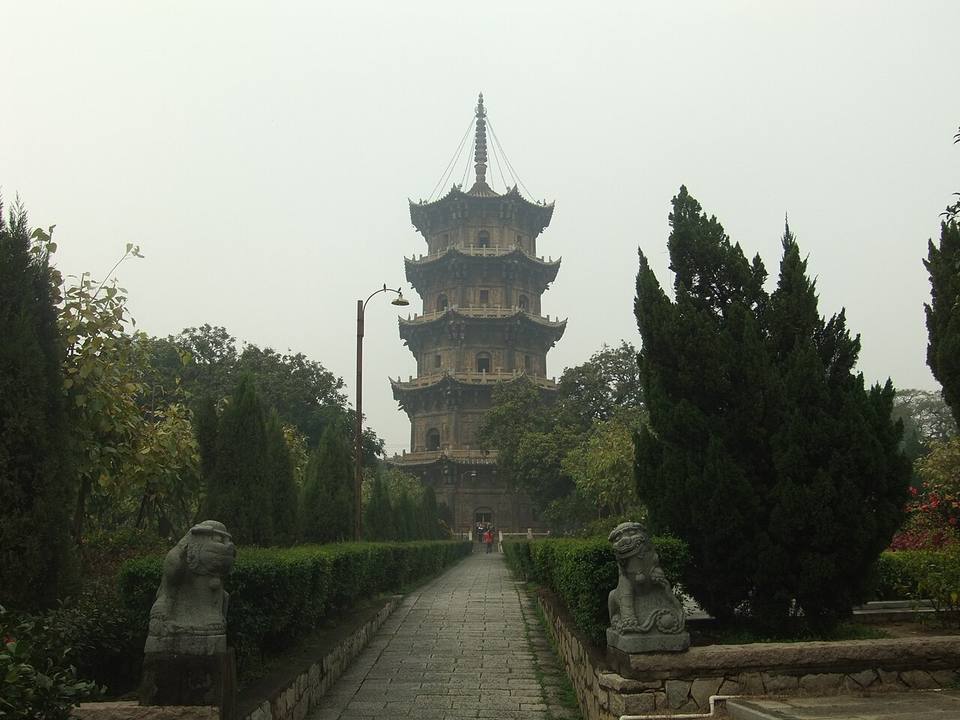
Licheng District, Quanzhou, Fujian Province · Old Capital / Maritime Silk Road Heritage
Quanzhou Old Town (Kaiyuan Temple & Maritime Silk Road Culture)
Inscribed in 2021 as "Quanzhou: Emporium of the World in Song-Yuan China": beneath the twin pagodas of Kaiyuan Temple, Islamic, Hindu and Manichaean carvings share a city with Buddhist pagodas — the Zayton port of Marco Polo's account is still alive.
Location
Licheng District, Quanzhou, Fujian Province
Stories and legends
The name "Cedar City" (Citong) is said to come from the Five Dynasties tale of citong trees planted around the city — a place-name legend layer.
History and context
In the Song and Yuan, Quanzhou was a world-class great port (the record of it standing alongside Alexandria is widely transmitted in historical sources). Kaiyuan Temple was founded in 686 (the second year of Chuigong in the Tang); its east and west twin pagodas are Song-dynasty stone pagodas (the East Pagoda, Zhenguo Pagoda, and the West Pagoda, Renshou Pagoda, both five-storey octagonal stone towers completed in the 13th century). The Qingjing Mosque (built in 1010, among China's oldest surviving Islamic mosques), the Manichaean Buddha statue at Cao'an, Tianhou Temple and Deyimen Gate are among the 22 component sites of the 2021 inscription "Quanzhou: Emporium of the World in Song-Yuan China"; the Luoyang Bridge (completed in 1059 under Cai Xiang's direction) is the model of an ancient cross-sea beam stone bridge.
Local life
Quanzhou's temperament is "half earthly bustle, half immortals": between the West Street clock tower and Kaiyuan Temple's gate, noodle-paste stalls, runbing shops and worshippers at the Qingjing Mosque live on the same street. The Minnan seaport gene of "love to strive and you will win" coexists with the everyday routine of "baibai" (offering worship); the old town has not been made into a specimen — original residents still live in the old houses, and heritage sites are scattered between wet markets and primary schools.
Customs
Walk West Street hunting pagoda shadows; visit Kaiyuan Temple around its morning service; Quanzhou marionette theatre and nanyin music are living intangible heritage (troupe performances per official scheduling).
Beliefs
Multi-religious coexistence is its greatest feature: Buddhism (Kaiyuan Temple), Islam (Qingjing Mosque), the Mazu faith (Tianhou Temple), Manichaean remains and Minnan folk beliefs side by side.
Local etiquette
Dress decently when entering religious sites such as the Qingjing Mosque, and observe the signs marking areas closed to non-Muslims around the prayer areas; no photography inside Kaiyuan Temple's halls; most old residences are private — do not enter uninvited.
Visiting notes
Best in spring and autumn and on weekdays; the "Little White" sightseeing electric carts in the old town stop when hailed and save the most legwork; the heritage sites are scattered — from the 22, pick the four cores: Kaiyuan Temple, Qingjing Mosque, Tianhou Temple and Luoyang Bridge; stay around West Street and everything is walkable.
What to eat nearby
Noodle paste (mianxianhu, with vinegar pork and intestines, served with youtiao); ginger mother duck; Quanzhou runbing cai (spring-roll vegetables); oyster omelette; shihuagao and four-fruit soup (in summer); beef soup (niurou geng)
West Street, the old-shop area around Kaiyuan Temple, and the noodle-paste shop cluster around Shuimen Guozi (go by the shop signs)
Noodle paste is a breakfast staple — eat it hot with pepper; ginger mother duck comes in a clay pot, and slowly gnawing the meat off the bone is the local way
Snacks 30–70 yuan per person (for reference only); a full meal 70–130 yuan (for reference only)
Kaiyuan Temple is free to enter (per temple announcements) and the twin pagodas cannot be climbed; for pagoda-shadow shots, go to high points on West Street such as Youli Rooftop (entry with a purchase).
Source leads: UNESCO World Heritage "Quanzhou: Emporium of the World in Song-Yuan China" (2021); Quanzhou Municipal Bureau of Culture and Tourism / Quanzhou Old Town official site.
Image source · User:Vmenkov · CC BY-SA 3.0