
System Overview · System Overview
Norse Mythology: The Eddas, the Sagas, and the Land of Ice and Fire
The Texts Are Iceland's; the Myths Are All of Scandinavia's.:Norse mythology has a curious fact
The Texts Are Iceland's; the Myths Are All of Scandinavia's.
Norse mythology has a curious fact about it: the centre of the gods' worship lay in Norway, Sweden, and Denmark, yet the texts were preserved almost entirely by Iceland. The manuscripts of the Poetic Edda's poems (the Codex Regius, c. 1270) and Snorri Sturluson's Prose Edda, written around 1220, both come from the hands of Icelanders more than two centuries after Christianisation — Snorri's purpose in writing the Edda was even "to teach young poets to understand the ancient kennings," and mythology was thus rescued in the identity of a literary handbook. The sagas are another line of preservation: the family sagas and kings' sagas write the Vikings' voyages, feuds, and conversion into prose history, and mythic figures often make guest appearances in them (in the Heimskringla, Odin is written as a sorcerer-king migrated from the east — the medieval authors' "historicising" treatment, which the reader must be aware of). The key to understanding the Norse entries is therefore double: of every place one must ask whether it belongs to the Edda's cosmos (the World Tree, Valhalla, Ragnarök) or to the sagas' human world (the assembly at Þingvellir, Egill of Borgarnes, the choice of conversion before Goðafoss).
A Cosmology of Ice and Fire.
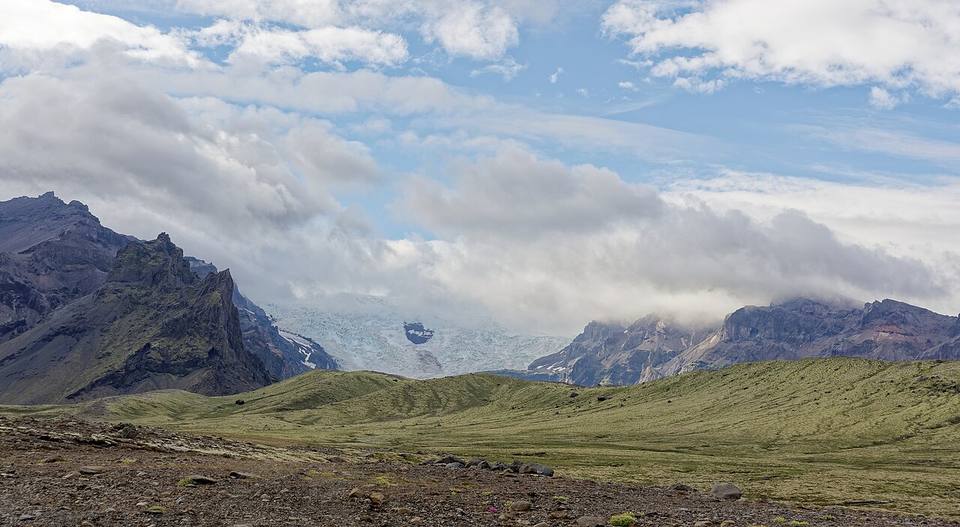
The Norse cosmos was born of a collision: on one side of the void Ginnungagap lay the rime of Niflheim, on the other the fire of Muspelheim, and where ice and fire met they condensed into the primal giant Ymir and the cow Auðumbla. This cosmology is almost a literal translation of Iceland's landforms: volcanoes press beneath the glaciers, black beaches are the debris of lava entering the sea, and hot springs and cold springs run side by side in the same rift valley. Scholars (Davidson and others) have accordingly proposed the volcanic-prototype theory of Ragnarök: Surtr's flames, the blackened sun, and the earth sinking into the sea bear a striking resemblance to eyewitness records of Laki-type eruptions; and the island that newly erupted in 1963 was directly named Surtsey — modern Icelanders personally continuing the mythology into the map. Likewise, Bifröst in the Eddas is a functional fortification, and the Icelanders' identification of it with the resident rainbows of Skógafoss and Gullfoss is a contemporary re-mythologisation — this volume explicitly labels it a modern interpretation, because distinguishing "what the ancients believed" from "what we are willing to believe" is precisely the ethical baseline of mythological travel. The elf faith (Huldufólk) is the living specimen of that ethical line: it is half folklore and half a local language of environmental protection, and when a highway gives way to an elf stone, what operates is community consensus, not theology.
From Rune Stones to Stave Churches.
The material remains of Norse mythology form a clear timeline: from the 2nd century, runic inscriptions were carved on weapons and stone monuments; in the 10th century, on the Great Jelling Stone, runes, a figure of Christ, and the country-name "Denmark" stand juxtaposed on the same stone — paganism and Christianity handing over in a single rock; in the 11th–13th centuries, Norway's stave churches carved interlaced great beasts and dragon-head gables into Christian architecture (Urnes c. 1130, Borgund c. 1180), and the image of the World Tree (by one interpretation) crept thereby into the churches' door frames; in the same period, the royal mounds of Gamla Uppsala and the Law Rock of Þingvellir mark the yielding of sacral kingship to an assembly community. The recommended Norse line: Jelling in Denmark (the handover point) → Gamla Uppsala in Sweden (royal cult) → the Norwegian fjords and stave churches (the wooden archive of folk belief) → Þingvellir, the Golden Circle, and the south-coast waterfalls and black beaches of Iceland (text, assembly, and landform in one). Seasonally, waterfall rainbows are summer's gift, while the polar night and aurora in the manner of Ragnarök belong to winter; the two seasons' Icelands are two translations of the same Edda.
Image source · Jakub Hałun · CC BY 4.0