
System Overview · System Overview
Japanese Mythology: The Kojiki, the Eight Million Gods, and an Introduction to Shrine Pilgrimage
Two Histories, One Mythic Nation.:The textual foundation of Japanese mythology consists of only
Two Histories, One Mythic Nation.
The textual foundation of Japanese mythology consists of only two works: the Kojiki (712, compiled by Ō no Yasumaro at the command of Empress Genmei from the recitation of Hieda no Are) and the Nihon Shoki (720, compiled by imperial order in classical Chinese annals form by Prince Toneri and others). The two books record the same stories side by side and often differ as variants — Izanagi's exploration of Yomi is written more briefly in the Nihon Shoki, and the details of the dance at the Rock Cave of Heaven differ between them — and this format of "main text plus 'one book says'" is exactly the constitution of Japanese mythology: it was never single-voiced from its source. In content it falls into three acts: the Age of the Gods volumes tell of the separate heavenly gods, the five generations of earthly gods, and the creation of the land by the heavenly gods (Izanagi and Izanami establish the land and give birth to the gods; Amaterasu, Tsukuyomi, and Susanoo divide the realms); the Izumo line tells of Ōkuninushi's building of the land and the "land-yielding" (kuniyuzuri) — the Central Land of Reed Plains is yielded to the descendants of the heavenly gods on condition that a grand shrine-palace be raised for Ōkuninushi, which is the origin myth of Izumo Taisha; the Hyūga line tells of the descent of the heavenly grandson and Emperor Jimmu's eastern expedition, stitching mythology into the imperial line. Izumo and Ise thus become the two poles for understanding Japanese mythology: one the shrine of compensation for the one who yielded the land, the other the ancestral shrine of Amaterasu.
The Eight Million Gods and the Logic of the Shrine.
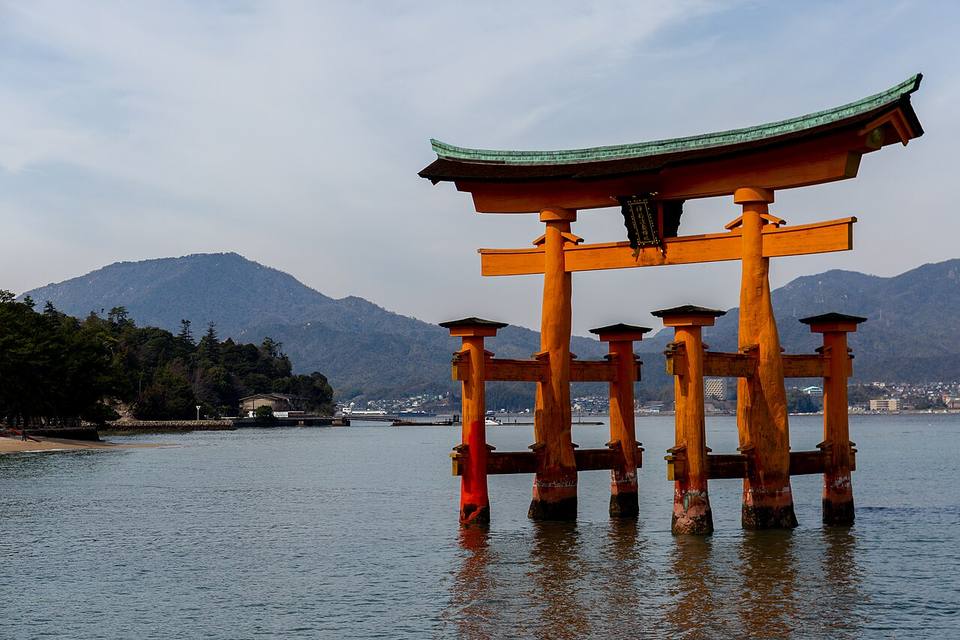
Shinto has no single god: mountains, rivers, rice, the hearth, and even the toilet have their kami, and dead heroes and vengeful spirits (Sugawara no Michizane) can also be raised to godhood — the "eight million gods (yaoyorozu)." A shrine is the kami's "residence and reception room": the torii marks the boundary, the shimenawa rope marks the sacred, the temizuya purifies the body, the worship hall is for paying respects, and in the main sanctuary, deep within, is enshrined the sacred body (a mirror, a sword, a sacred pillar, and the like, never shown to anyone). The standard form of worship is two bows, two claps, one bow; only at Izumo Taisha is it two bows, four claps, one bow; in the old calendar's tenth month, the whole country calls it "the month without gods" (Kannazuki), while Izumo alone calls it "the month with gods" (Kamiarizuki), for legend says the eight million gods gather at Izumo to deliberate — this is exactly an example of turning abstract theology into an executable itinerary: to go to Izumo, catch the Month of the Gods; to go to Takachiho, catch the winter rotation of the night kagura (from mid-November to early February the following year, all 33 dances performed through the night in each village, while Takachiho Shrine presents a selected four dances every night). The yōkai are this system's "folk flank": tsukumogami, kappa, tengu, and oni mostly have no shrine to be worshipped at, yet they live in picture scrolls and tales, and in today's shopping streets (Kyoto's Ichijō Yōkai Street) and museums (Fukuchiyama's Japan Oni Exchange Museum, the Tōno Tales Village).
An Introductory Pilgrimage Route.
First-time visitors can follow a line in textual order: Ise Jingū (Amaterasu and the shikinen sengū, the "ever-young" system of rebuilding once every twenty years; for the current cycle and years, the shrine's official site prevails) → Izumo Taisha and Matsue (the land-yielding myth, the legendary site of Yomotsu Hirasaka, the Mirror Pond of Yaegaki Shrine) → Takachiho in Miyazaki (the Amano-Iwato and Amano Yasugawara, the night kagura) → Kurama and Ichijō-dōri in Kyoto (the town-level layer of tengu and the Night Parade). There are four baselines of etiquette: on entering a shrine, first purify your hands and rinse your mouth at the temizuya (following the ladle rules); photography is prohibited in most main sanctuaries and kagura halls — when you see "no photography" (撮影禁止), put your camera away; omamori and ema are bestowed articles requiring the offering fee (hatsuhoryō) and are not to be bargained over; festivals take precedence over sightseeing — when a divine procession passes, make way, remove your hat, and do not cross through it. Keep these four, and you may count yourself admitted to the world of the eight million gods.
Image source · Balon Greyjoy · CC0