
System Overview · System Overview
A Map of Greek Mythic Sites: The Geography of Oracles, Games, and Epic
Mythology That Can Be Walked to Its End.:Greek mythology differs from most mythologies in that
Mythology That Can Be Walked to Its End.
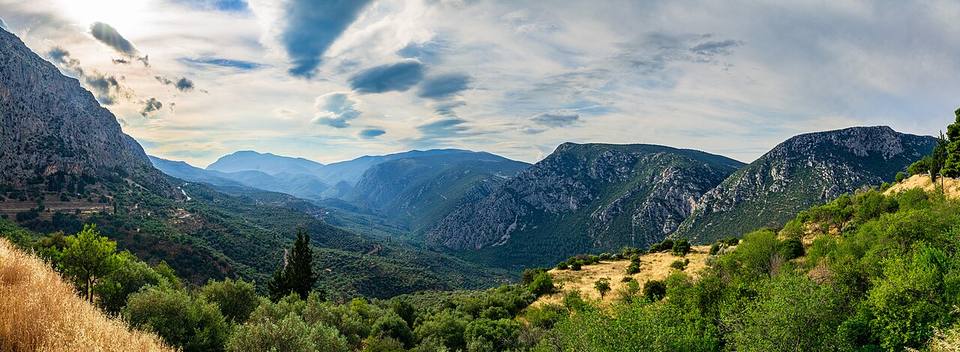
Greek mythology differs from most mythologies in that most of its stages have archaeological coordinates: the mountainside of Delphi, the river flats of Olympia, the palace site of Knossos, the bay of Ithaca can all still be reached on foot. When Pausanias wrote his Description of Greece in the 2nd century, it was itself a mythological geography organised by route — wherever he went, he registered the local temples, statues, and legends one by one. This overview follows his logic and divides the sacred sites by function into three classes. The first class is the oracular sites: Delphi stands first, where Apollo speaks through the mouth of the Pythia; from the 6th century BCE it became the information hub of all Greece, and colonisation, legislation, and war were all put to the god first; its authority came from its deliberate ambiguity and from the cosmological positioning of the Omphalos, the "navel of the world." The Nekromanteion in Epirus is its dark counterpart: Delphi is asked about the future of city-states, while here the dead are asked — Herodotus records Periander questioning his dead wife, and the summoning of the dead in book 11 of the Odyssey provided it with its literary prototype (the site's identification is still academically contested; see entry 21).
Games and Palaces.
The second class is the athletic sanctuaries: Olympia (Zeus), Delphi (the Pythian Games, Apollo), and Nemea and the Isthmus of Corinth each had their Panhellenic games. Athletics is not an appendage of mythology but its mechanism of performance: the east pediment of the Temple of Zeus at Olympia carves the chariot-race origin of Pelops in stone, the athletes swear their oaths before the altar of Zeus, and victory odes by poets such as Pindar write men's victories back into the genealogy of the gods. The third class is the epic and palace sites: Knossos superimposes the Minotaur's Labyrinth onto the plan of a real Minoan palace (Evans's concrete restoration keeps that superimposition full of controversy to this day); Mycenae and Tiryns correspond to Agamemnon's supremacy, and Ithaca to the homecoming of the Odyssey — the geographical authenticity of the Homeric epics has, since Schliemann, been in the state of "partly provable, partly forever unprovable": Troy was dug up; Odysseus's palace was not (the Mycenaean remains at Stavros are only a candidate). The honest traveller should read such places as "literary geography": their value lies not in proving truth or falsehood, but in text and landform glossing each other — stand at Dexa Bay on Ithaca and look at the shape of the harbour of Phorcys, and the description in book 13 of the Odyssey does indeed fit seamlessly.
How to Walk One Map.
The recommended land circuit: the Acropolis of Athens (the city-state guardian myth and the stone-carved version of the contest story on the Parthenon) → the Isthmus of Corinth → Olympia (the origin of the games) → the Nekromanteion in Epirus and the Acheron River (the geography of the underworld) → Delphi (the oracle and the navel of the world); island extensions: Crete (the Labyrinth and the starting point of Icarus's flight route), Ikaria (the island named for the fall into the sea), Ithaca–Kefalonia (the end of the homecoming). Practical reminders: Greek sites in summer operate with timed entry and heat adjustments, and opening times and admission are as published each year by the Greek Ministry of Culture and each site's official page; the three most important originals are not at their original sites but in museums — the Delphi Charioteer is in the Delphi Museum, the Knossos frescoes in Heraklion, the Olympia pediments in the Olympia Museum — so itineraries must pair "site + corresponding museum." The last lesson of mythological geography is at the Acropolis Museum in Athens: the other half of the original Parthenon sculptures is in London — a map of sacred sites has always also been a map of dispersal and return.
Image source · Andrew Parlette from Elkridge,MD, US · CC BY 4.0