
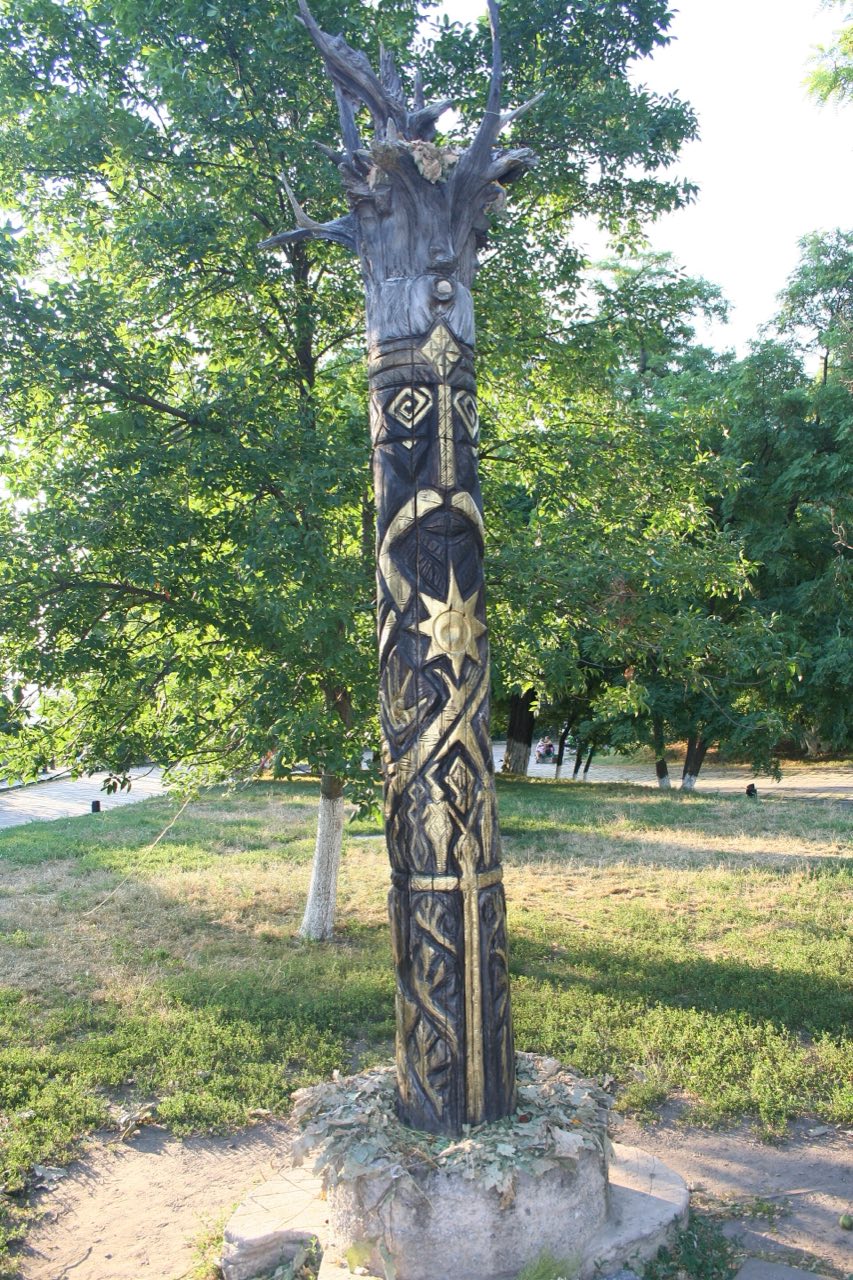
Slavic mythology · Thunder god
Perun
Among the idols Grand Prince Vladimir raised on a hill in Kyiv, his came first.
Stories and legends
Perun is the god of the sky and thunder. He holds a battle axe or hammer and rides his chariot across the heavens, so thunder is the rumble of its wheels and lightning is the bolt he hurls. The oak is his sacred tree, and the eagle stays by his side. He is the witness of oaths. When the people of ancient Rus made treaties with Byzantium, they swore in the name of Perun, and oath-breakers feared being struck by lightning. Legend also says that he battles Veles, god of the underworld, every year. Veles turns into a great serpent, steals the herds or hides away the rain, and Perun drives him back underground with his lightning, so the rain falls back to earth and order is restored.
Origins of the story
What can be verified from written records is as follows. The Primary Chronicle records that in 980, Grand Prince Vladimir set up a group of idols on a hill in Kyiv, with Perun named first, the idol made of wood with a silver head and a golden moustache. After the baptism of 988, the idol was dragged down the hill and thrown into the Dnieper. The name of Perun also appears in the oaths of the treaties between Rus and Byzantium in 945 and 971. In the 6th century, the Byzantine historian Procopius also recorded that the Slavs worshipped a thunder god. These records prove that thunder-god worship truly existed, but the full story of the battle between Perun and Veles has no direct record in ancient texts. It is a reconstruction by later scholars, drawn from folk songs, folk customs, and Indo-European comparative study, and it remains uncertain here. After Christianization, the thunder functions of Perun were largely taken up by the folk image of the prophet Elijah. That is a continuation of folk belief, not the same god under a new name.
Places you can visit
You can walk around Old Kyiv Hill, where most archaeologists place the idols of 980; the neighbouring Volodymyrska Hill park looks out over the Dnieper. Ancient oak groves and hilltop sites still survive across Eastern Europe, and the time around a thunderstorm is a fitting moment to sense the old idea that the thunder god dwells on high. At Slavic cultural festivals you can also see modern reconstructions of Perun idols, though those are modern works of restoration, not ancient originals.
Source leads: https://en.wikipedia.org/wiki/Perun;https://www.encyclopedia.com/environment/encyclopedias-almanacs-transcripts-and-maps/perun
Image source · A modern reconstructed idol of Perun · Ridnovirphoto · CC0