

City guide · 广州 · 古称羊城
Guangzhou
In the thousand-year merchant capital and flower city, morning tea and arcades write the Cantonese centuries together
Guangzhou lies in the heart of the Pearl River Delta, where the Pearl River runs through the city to the South China Sea; it is one of China's longest-standing foreign-trading cities. From the founding of Panyu as capital of the Nanyue kingdom, the city site has not moved for more than two thousand years, earning the name "merchant capital of a thousand years". The arcades of the old city, the Thirteen Hongs and the Shamian concession face the Canton Tower across the river in the Zhujiang New Town; morning tea, Cantonese cuisine and the Cantonese language give the city its distinct Cantonese character. The climate is long summer without winter, and the name "flower city" comes from blossoms in every season. Its living warmth hides in the steamers of the teahouses and the wok fire of the night markets.
History
How the city came to be
Guangzhou's city began in the Qin dynasty: in 214 BC the Qin pacified Lingnan, Ren Xiao built the city of Panyu, and Zhao Tuo founded the Nanyue kingdom with Panyu as capital; Guangzhou has been the political centre of Lingnan for over two thousand years. By the Han dynasty Guangzhou was already one of the starting ports of the Maritime Silk Road, and the Southern Han kingdom made it its capital (named Xingwangfu). In the Ming and Qing, Guangzhou was the sole port open to foreign trade (the "single port" system, 1757–1842), and the Thirteen Hongs trading district made Guangzhou a world-famous trading city. In modern times Guangzhou was a cradle of the Chinese revolution: the Sanyuanli resistance to the British, the Huanghuagang Uprising, the Guangzhou Uprising, the first Kuomintang–Communist cooperation and the Great Revolution all began here. After 1842 the trading ports shifted, but Guangzhou remained the commercial core of South China, and the Canton Fair, founded in 1957, made it China's window for foreign trade.
- 214 BCThe Qin pacified Lingnan; Ren Xiao built the city of Panyu
- 204 BCZhao Tuo founded the Nanyue kingdom, with Panyu as capital
- 1757The Qing court imposed the "single port" system; Guangzhou became the only legal foreign-trade port
- 1841The people of Sanyuanli rose against the British
- 1911The Huanghuagang Uprising broke out
- 1923The Third National Congress of the Chinese Communist Party was held in Guangzhou
- 1927The Guangzhou Uprising broke out and the Guangzhou Soviet Government was established
- 1957The first China Export Commodities Fair (the Canton Fair) was held in Guangzhou

Local life
Food and local daily life
Chen Clan Ancestral Hall, Guangzhou
Must-try
- Dim sum
- Siu mai
- Char siu bao
Morning dim sum (har gow, siu mai, char siu bao, rice-noodle rolls), wonton noodles (bamboo-pole noodles), jidi congee, double-skin milk / ginger milk curd, claypot rice
| Where to eat | Long-established teahouses around Shangxiajiu in Xiguan and Longjin Road / Pantang (Taotaoju / Guangzhou Restaurant branches), Xiguan snack shops around the Chen Clan Ancestral Hall |
|---|---|
| Dining etiquette | Morning tea has a tea charge per seat; pour tea for others before yourself, and tap your fingers on the table to say thanks for tea |
| Typical price per person | Morning dim sum CNY 70–130, snacks CNY 30–60 |
| Tips | Teahouses have long queues at weekends — arrive before 9 a.m.; rice-noodle rolls are best at breakfast time. |
Prices are typical rates as of October 2026, not exact quotes; CNY equivalents are approximate where exchange rates fluctuate.

afterdog · CC0
Regional deep dives
Read deeper into each place
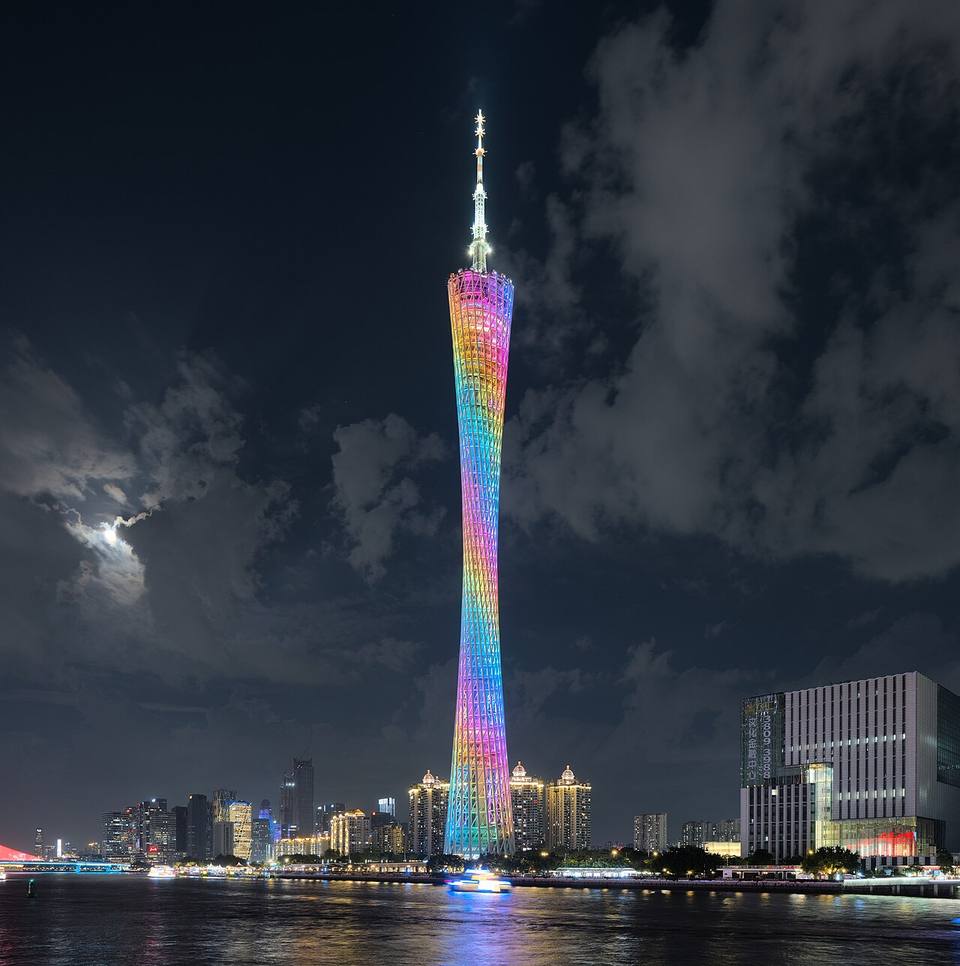
Haizhu District, Guangzhou, Guangdong Province · City Landmark / Night View
Canton Tower
China's tallest tower at 600 metres, its body twisting into a turn at the waist — Guangzhou people call it the "Slim Waist" (Xiaomanyao), and the Pearl River's night scenery bends beneath its feet.
Explore the local guide ↗Source leads: Canton Tower official site; Guangzhou Municipal Bureau of Culture and Tourism.
Image source · Daniel Lu (User:dllu) · CC BY-SA 4.0
Source leads are being checked individually; confirm travel details with local official notices.