
Shizhong District, Leshan, Sichuan Province · Stone Buddha / World Heritage
Leshan Giant Buddha
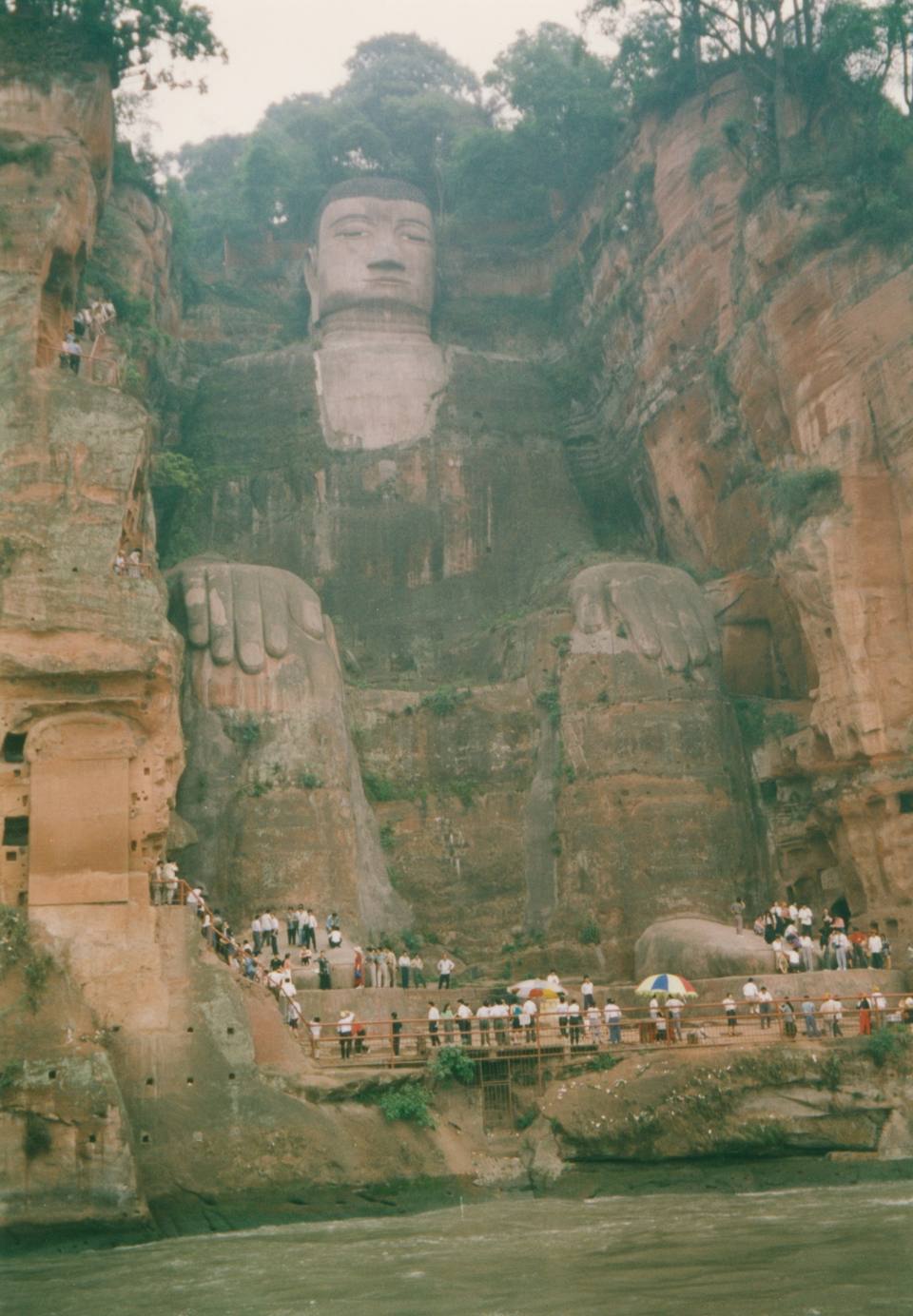
A 71-metre seated Maitreya carved into the cliff where three rivers converge, its instep broad enough for a hundred people to stand on — the Tang monk Haitong used one Buddha to hold down a thousand years of waters.
Location
Shizhong District, Leshan, Sichuan Province
Stories and legends
The tale of the monk Haitong gouging out his own eyes to protect the Buddha-building funds is widely told — the faith-legend layer.
History and context
The Giant Buddha's carving was initiated by the monk Haitong in the first year of Kaiyuan in the Tang (713) and continued through three generations — Haitong, the military governor Zhangqiu Jianqiong and Wei Gao — to completion in the 19th year of Zhenyuan (803), about 90 years in all. The statue stands 71 metres tall overall, with a head 14.7 metres high and ears 7 metres long — one of the world's largest surviving stone seated statues. The Buddha also incorporates a hidden drainage system (drainage channels behind the ears and head, an ancient anti-weathering design). In 1996 it was listed as dual World Cultural and Natural Heritage together with Mount Emei. The touring routes divide into the mountain footpath (down the Nine-Bend Plank Road to the Buddha's feet) and the boat view of the full figure from the river.
Local life
Half of Leshan's temperament is in the Buddha's solemnity and half in its worldly ease: locals feel a family-elder closeness to the Buddha, doing their morning exercises outside Lingyun Temple and taking their late-night snacks at Zhanggong Bridge. Leshan is further crowned by its food (qiaojiao beef originated here), and the full stop of a Buddha trip often falls on a pot of beef soup in Suji Old Town — the sacred and the appetite at zero distance.
Customs
Incense at Lingyun Temple and temple fairs at festivals such as the Spring Festival (per temple arrangements); the boat's homage to the Buddha is a river courtesy (the boat pauses before the statue).
Beliefs
Buddhism (the Maitreya faith); Lingyun Temple is a functioning religious site and the Buddha is its core sacred remain.
Local etiquette
The Nine-Bend Plank Road is steep, narrow and one-way — never go against the flow or lean out; keep quiet before the Buddha and never climb the statue; on the boat deck the wind is strong — watch children and hats.
Visiting notes
Best in spring and autumn; the plank-road queue at peak runs to hours — if time is short, take the boat; from Leshan Station (high-speed rail) the taxi to the scenic area takes about 20 minutes; combined with Mount Emei, allow two days (one for Leshan, one and a half for Emei).
What to eat nearby
Qiaojiao beef (originating in Suji — fresh soup, tender meat, with dipping water); Leshan boboji (chicken in chilli oil); sweet-skin duck; doufunao (Leshan style, thickened and sprinkled with crisp pork); deep-fried skewers (of the folk-famous kind such as Diba Fried)
The Zhanggong Bridge food street, Suji Old Town, and the Jiaxiang Road food belt
Qiaojiao beef is ordered by portion / by weight — ask first; extra soup is the custom; for boboji you are charged by the skewer count — do not throw the skewers away before the bill is counted at the end
Snacks 40–80 yuan per person (for reference only); qiaojiao beef 50–90 yuan per person (for reference only)
The Buddha ticket and the boat ticket are bought separately (per official rules); photographing upward from the Buddha's-feet platform needs a wide angle, and the first plank-road slot in the morning has the fewest people.
Source leads: UNESCO World Heritage "Mount Emei Scenic Area, including Leshan Giant Buddha Scenic Area" (1996); Leshan Giant Buddha scenic area official site.
Image source · Arian Zwegers from Brussels, Belgium · CC BY 2.0