
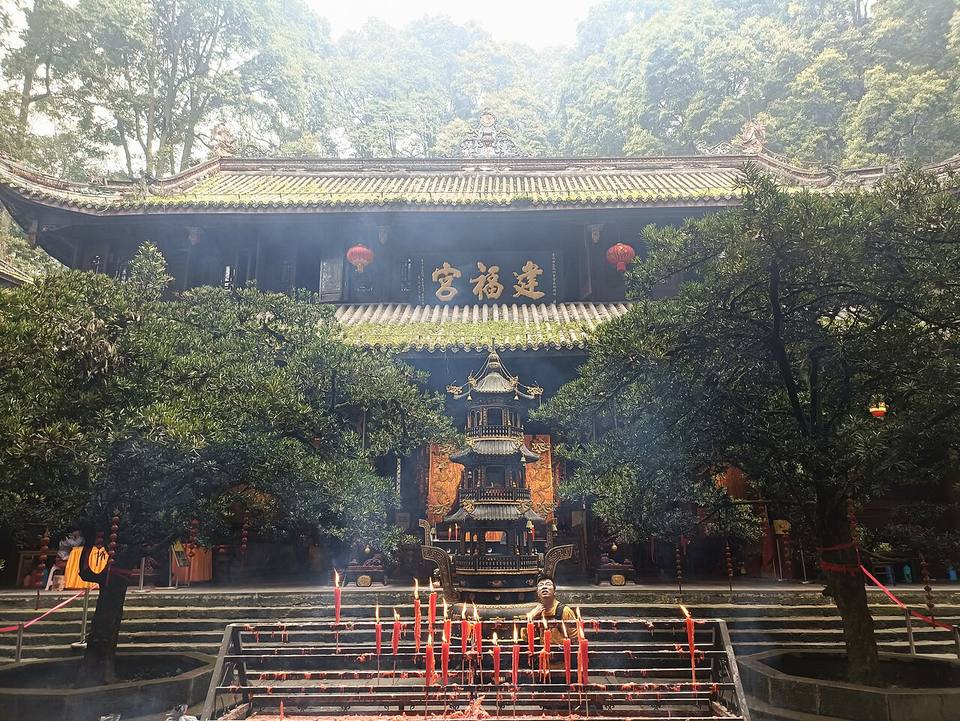
Dujiangyan City, Chengdu, Sichuan Province · Taoist Famous Mountain
Mount Qingcheng
"Qingcheng, most secluded under heaven": in the Eastern Han, Zhang Daoling made his hut here and spread the Way of the Heavenly Masters; mountains of green hide the Taoist temples in cloud and mist — one of the birthplaces of Chinese Taoism, quiet to nothing but birdsong and water.
Location
Dujiangyan City, Chengdu, Sichuan Province
Stories and legends
The tales of Zhang Daoling subduing demons on Mount Qingcheng and of Laozi granting him the Way belong to the Taoist mythic layer.
History and context
In the Shundi years of the Eastern Han (about 142), Zhang Daoling founded the Way of the Five Pecks of Rice (the Way of the Heavenly Masters) at Mount Heming and spread the teaching through the Qingcheng mountains; Mount Qingcheng is the Fifth Grotto-Heaven of Taoism's "Ten Great Grotto-Heavens" (the Heaven of Baoxian Jiushi). Its surviving temples include Tianshi Cave (said to be Zhang Daoling's cultivation place), Shangqing Palace, Laojun Pavilion (at the summit, a multi-storey pavilion, a landmark rebuilt in the 1990s) and Jianfu Palace. In 2000 it was listed as World Cultural Heritage together with Dujiangyan. The front mountain concentrates the cultural temples and the back mountain is mainly natural streams and waterfalls; the two zones are ticketed separately (per official rules).
Local life
Qingcheng's seclusion is a seclusion cultivated for a thousand years: the temples seek not grandeur but hiddenness, teahouses hide beneath ancient ginkgo trees, and the Taoist priests' daily lessons run parallel to the visitors' climbing streams. Chengdu people treat a trip up Qingcheng as a weekend recharge — the cured pork of the farmhouses at the mountain's foot and the cloud sea at Laojun Pavilion are the westernmost end of the "slow Chengdu" map.
Customs
Temple worship (the Taoist three courtesies), tasting Qingcheng tea (lidded-bowl tea) at the mountain teahouses; playing in the water and escaping the heat at the back mountain's Wulong Gorge / Feiquan Gorge is a summer custom.
Beliefs
A core Taoist sacred site (of the Heavenly Masters' founding system); its temples are functioning religious venues.
Local etiquette
Photography of the statues inside the temples follows signage, and do not photograph or disturb the priests at their practice; the mountain paths are wet and slippery (rain is frequent all year) — wear anti-slip shoes; never pick and eat wild fruit or fungi on the mountain.
Visiting notes
Best in spring and autumn and for summer heat-escape; the front-mountain essence route — Jianfu Palace → Yuecheng Lake (choose boat / cable car) → Shangqing Palace → Laojun Pavilion → down by Tianshi Cave — takes about 4–5 hours; those of average fitness should take the cable car up and walk down; visit on a separate day from Dujiangyan.
What to eat nearby
Qingcheng cured pork; chicken stewed with ginkgo nuts; Qingcheng pickles (of the old-vat pickle line); Taoist vegetarian meals (around the temples); Dujiangyan snacks such as Zhang laozao (on the way)
The farmhouse belt in Qingchengshan Town (outside the mountain gate), and Tai'an Old Town (at the back mountain)
At farmhouses, ask the per-kilo price of cured pork and the like before ordering; at vegetarian tables, do not bring meat dishes in to share the table
A full meal 60–110 yuan (for reference only)
From Qingchengshan Station (intercity rail) to the front mountain, check the taxi / bus connection times first; the mountain is rainy — a raincoat is more practical than an umbrella.
Source leads: UNESCO World Heritage "Mount Qingcheng and the Dujiangyan Irrigation System" (2000); Mount Qingcheng scenic area official site / Chinese Taoist Association materials.
Image source · Kcx36 · CC BY-SA 4.0