
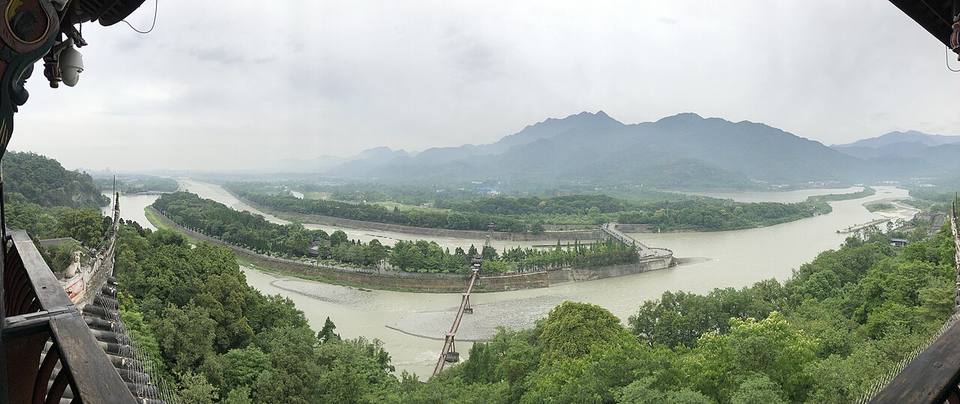
Dujiangyan City, Chengdu, Sichuan Province · Hydraulic Engineering / World Heritage
Dujiangyan
The dam-free diversion project cut by Li Bing and his son in 256 BC has run for over 2,280 years and still irrigates the Chengdu Plain — the Fish Mouth divides the water, the Flying Sand Weir discharges the sand and the Bottle-Neck Channel limits the flow: one system explains the highest wisdom of Chinese water control.
Location
Dujiangyan City, Chengdu, Sichuan Province
Stories and legends
The tales of Li Bing turning into an ox to fight the river god and of Erlang splitting the mountain are widely told; the merging of Li Bing's son "Erlang" with the later Erlang Shen faith belongs to the legendary layer.
History and context
In the late years of King Zhaoxiang of Qin in the Warring States period (about 256 BC), the Shu commandery governor Li Bing directed the building of Dujiangyan, composed of the Fish Mouth diversion levee, the Flying Sand Weir spillway and the Bottle-Neck Channel intake as its three main bodies, with auxiliary works such as the herringbone levees. Using the circular flow of the bend, it achieves "four-six water division and two-eight sand discharge." Its irrigated area now reaches the ten-million-mu class (per the water authorities' releases). In 2000 it was listed as World Cultural Heritage together with Mount Qingcheng. The Qingming Water-Releasing Festival is Dujiangyan's great annual festival (per the city's announcements).
Local life
Dujiangyan's temperament is "engineering as the city's faith": locals watch the water release at Qingming, touch Li Bing's statue at Fulong Temple and drink tea at Erwang Temple listening to the river. This city is named for water and enriched by it, and the Chengdu saying "worship the waters at Dujiangyan" is not a tourism slogan but the plain-dwellers' real gratitude to their water source. The legend of the couple's bridge on the Anlan Cable Bridge and the river wind add tenderness to the hardcore engineering.
Customs
The Qingming Water-Releasing Festival (a re-enacted water-opening ceremony) and the Erwang Temple fair (related to Li Bing's birthday in the sixth lunar month, per temple arrangements).
Beliefs
The cult of Li Bing and his son (worship at Erwang Temple) is interwoven with Taoism (neighbouring Mount Qingcheng); overall it is characterised by a hydraulic civilisation turned into faith.
Local etiquette
The weir area's currents are swift — wild swimming and rafting are strictly forbidden; never shake or run on the cable bridge; visit Erwang Temple and similar sites in quiet respect.
Visiting notes
Best in spring and autumn and at the Water-Releasing Festival; a guide is a must / rent the official audio guide (without commentary the system is incomprehensible); enter by the Lidui Park gate, take in the panorama from the Qinyan Tower high point first, then tour downstream — the optimal route; from Chengdu's Xipu Station the intercity train to Dujiangyan Station takes about half an hour.
What to eat nearby
Chicken stewed with ginkgo nuts (one of Qingcheng's four jewels, in the Dujiangyan / Qingcheng area); You rabbit heads; scallion rolls (congcong juan); Sichuan small restaurants of the Xin Fan beef-douban line; Qingcheng cured pork
The old-town dining belt around South Bridge / West Street, and Yangliuhe Street in Dujiangyan city
Rabbit heads are properly eaten by hand — the shops provide gloves; ginkgo nuts are mildly toxic and must be cooked and eaten in moderation — go by proper restaurants' products and never pick and eat them raw yourself
A full meal 60–120 yuan (for reference only)
Dujiangyan + Mount Qingcheng in one day is too rushed — split them over two days, or in one day take Dujiangyan + the old-town night view; the scenic area's audio-guide works on a deposit — bring ID.
Source leads: UNESCO World Heritage "Mount Qingcheng and the Dujiangyan Irrigation System" (2000); Dujiangyan irrigation-system official site / Sichuan water-history materials.
Image source · 星星 · CC BY-SA 4.0