
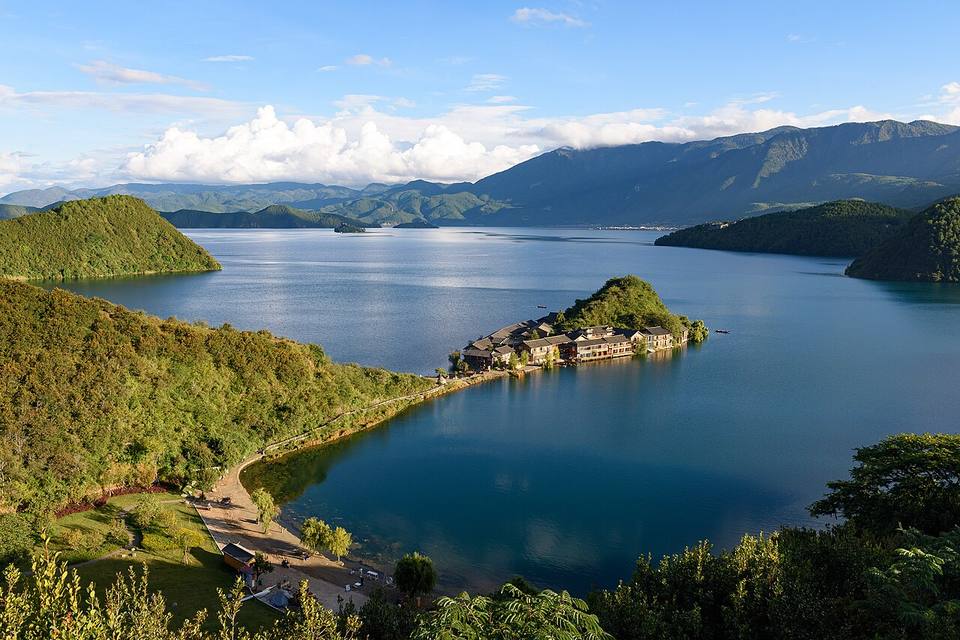
The border of Ninglang County, Lijiang, Yunnan Province and Yanyuan County, Sichuan Province · Highland Lake / Mosuo Culture
Lugu Lake
Mount Gemu, the goddess mountain, guards a pool of highland blue while Mosuo pig-trough boats row through the blooms of the water plants — beyond the walking-marriage culture, remember first that this is a living community of matrilineal culture.
Location
The border of Ninglang County, Lijiang, Yunnan Province and Yanyuan County, Sichuan Province
Stories and legends
The love myth of the Goddess Gemu and the dragon god Houlong, and the legend of the lake's formation, are the core of Mosuo mythology — the legendary layer.
History and context
Lugu Lake is a highland freshwater lake jointly administered by Sichuan and Yunnan at about 2,690 metres, with high water visibility (said to reach the 10-metre class). The Mosuo people along its shores preserve matrilineal extended families and the "walking marriage" (Axia marriage) custom — an important anthropological sample. The lake's islands and villages such as Lige, Daluoshui and Zhaojiawan form the round-lake touring line, and pig-trough boats (dugout / plank boats) are the traditional water transport. The scenic area runs tickets and environmental management, and entry is possible from both the Yunnan and Sichuan sides (ticketing per each gate's officials).
Local life
Lugu Lake's temperament is "the women's lake": the hearth of the grandmother's house, the family structure of uncles and mothers, and Mosuo song and dance at the bonfire parties all remind visitors that the walking marriage is not an exotic label but a complete kinship system. The lake's early mornings belong to fishermen and the water-blooming plants (Ottelia, which demands extremely high water quality), while the commercial inns' lights come on only at night — the boundary between the two is the focus of recent protection-and-development debate.
Customs
Bonfire parties (jiacuo dance) are the villages' way of receiving guests; hearth culture (the grandmother's house hearth never dies) is the core of the Mosuo family.
Beliefs
The Mosuo Daba religion (a primitive religion) coexists with Tibetan Buddhism; Mount Gemu is the centre of the sacred-mountain faith (the Mountain-Circling Festival is a great Mosuo festival, on the 25th day of the seventh lunar month, per local announcement).
Local etiquette
Do not pry into walking-marriage privacy in an exoticising tone, and never photograph family interiors or Daba rituals without consent; never step over or trample the grandmother's house hearth; the lake water is a drinking-water source — no swimming in the lake and no littering.
Visiting notes
Best from March to October (flowers and lake conditions at their best; in the rainy season check road conditions for landslide risk); the bus from Lijiang takes about 4 hours of winding mountain road — prepare motion-sickness medicine; stay at Daluoshui (convenient) or Lige (scenery) as you prefer; a one-day chartered round-lake tour covers everything, and the sunset at Liwubi Bay (the Walking Marriage Bridge) is the most photogenic.
What to eat nearby
Cured pork fat (zhubiaorou — traditional Mosuo cured pork with a strong flavour); Sulima wine (a low-alcohol Mosuo wine); tuotuo meat and grilled fish; dried apples, huahua candy and other local products; lakeside stone-pot fish
The dining street in Daluoshui Village, small restaurants in Lige Village
Sulima wine is offered in hospitality — if you cannot manage much, receive the cup with both hands to show respect, taste a little and explain; zhubiaorou is a fatty flavour — order a small portion to try
A full meal 60–120 yuan (for reference only)
Lakeside mornings and evenings swing widely in temperature with strong ultraviolet; bonfire-party tickets are clearly priced by the villages — go by the village side and do not buy high-priced resold tickets.
Source leads: Lugu Lake scenic area official site (the Sichuan and Yunnan management sides); Lijiang / Liangshan culture-and-tourism materials.
Image source · N509FZ · CC BY-SA 4.0