
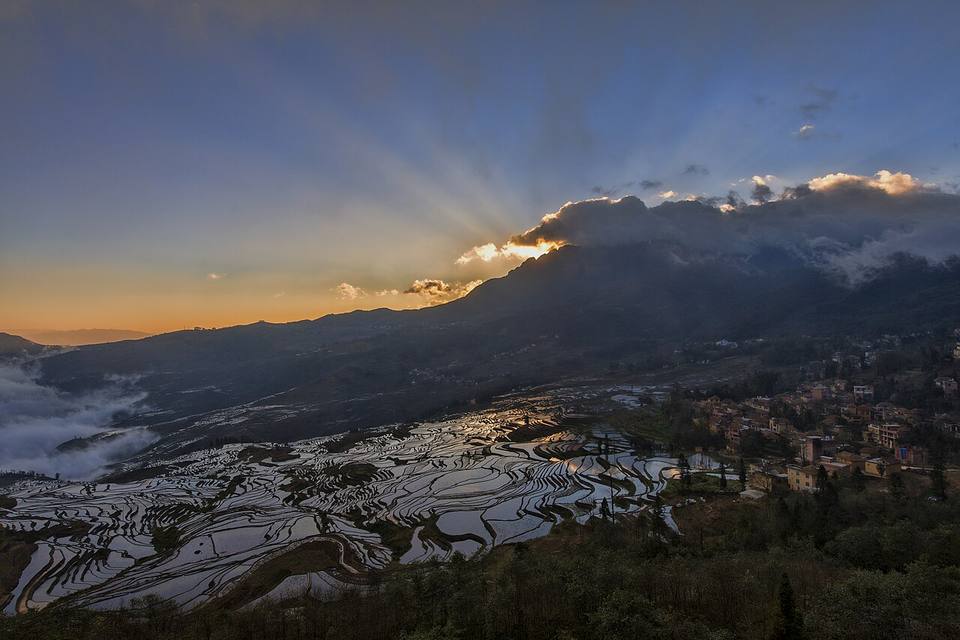
Yuanyang County, Honghe Hani and Yi Autonomous Prefecture, Yunnan Province · Terraced Fields / World Cultural Heritage
Yuanyang Terraced Fields
The Hani terraces, inscribed as World Heritage in 2013, where in the winter-spring flooding season ten thousand mu of mirror surfaces reflect cloud seas and sunrises — for 1,300 years the Hani have combed the great mountains into a stairway to heaven with their own hands.
Location
Yuanyang County, Honghe Hani and Yi Autonomous Prefecture, Yunnan Province
Stories and legends
The Hani creation epic and terrace-origin myths (the Hani migration epic Hani Apei Congpopo) belong to the people's oral epic tradition.
History and context
The Hani terraces have a cultivation history of over 1,300 years (records from the Tang-dynasty Nanzhao period are inferred); they form the "forest–village–terraces–water system" four-element system: mountaintop forests conserve the water, villages sit in the middle, terraces below and rivers recycle — a world model of farming ecology. In 2013 they were inscribed as the World Heritage "Cultural Landscape of Honghe Hani Rice Terraces." The core areas include Bada, Laohuzui and Duoyishu, and the channels with the "wood-carved water division" system embody traditional water-management wisdom.
Local life
Yuanyang's temperament is "a farming civilisation above the clouds": Hani mushroom-roofed houses and the Long Street Banquet (during the Hani Tenth-Month New Year, every household feasts along the street) coexist with the terraces. Before sunrise at Duoyishu and sunset at Laohuzui the viewing platforms crowd with cameras of every size, yet the old farmer driving his ox in the fields is the picture's true owner. Commercialisation here is relatively restrained — most villages still farm as their main occupation, with inns a sideline.
Customs
The long street banquet of the Hani Tenth-Month Year (the Hani New Year, around the tenth lunar month) is the greatest festival (exact dates per the county's announcements); market days (rotating among villages) are the mountains' social days.
Beliefs
Traditional Hani beliefs (nature and ancestor worship, sacred village forests) are the core, and terrace water management and worship (farming rites such as "opening the seedling gate") are one.
Local etiquette
Outsiders must not enter the sacred village forests (the groves above the villages); never trample field ridges or seedling fields; obtain consent before photographing elders and sacrificial activities; the long street banquet is the villagers' festival — visitors join per the organisers' arrangements and must not help themselves to food.
Visiting notes
The best viewing is the flooding period from November to April (mirror surfaces + the highest chance of cloud seas); the mountain roads twist — take a bus from the Kunming / Gejiu direction to Nansha and transfer; staying at Duoyishu saves the most time for sunrise; in peak season arrive early at the sunrise platforms (official platform charges follow the ticket system).
What to eat nearby
Hani dipping-water chicken / dipping-water dishes; terrace red rice (red rice noodles / red rice); field snails and loaches (products of the terraces' ecological farming, in season); Hani fermented soybean paste; Xinjie Town barbecue
The restaurant area of Xinjie Town (the old county town), farmhouses in Shengcun / Duoyishu villages
The dipping water is fiercely spicy — try a little; terrace fish and snails are ecological ingredients, small in quantity and high in price — ask the price first
A full meal 50–100 yuan (for reference only)
Yuanyang's old town Xinjie is at high altitude with big day-night temperature swings — wear a down jacket for a winter dawn sunrise; the viewing platforms' day-pass system follows scenic-area announcements.
Source leads: UNESCO World Heritage "Cultural Landscape of Honghe Hani Rice Terraces" (2013); Yuanyang County Bureau of Culture and Tourism.
Image source · chensiyuan · CC BY-SA 4.0