
Cherry-blossom sites · Cherry blossoms / Mountain faith
Mount Yoshino
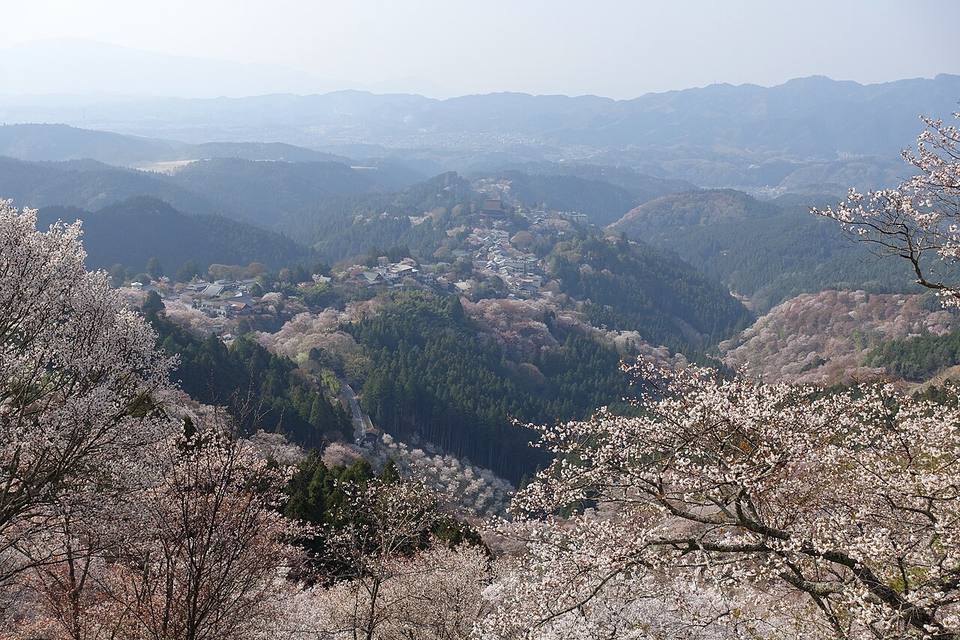
About 30,000 cherry trees bloom in sequence up the ridge from Shimo-Senbon to Oku-Senbon; "a thousand trees at a glance" means watching not one tree but a whole mountain dye itself from white to pink.
Location
Yoshino Town, Nara Prefecture
Stories and legends
The legend of En no Gyōja founding Shugendo is bound up with the Zaō Gongen faith of the Zaōdō hall; the saying that the cherries are sacred trees, planted as offerings into a forest, belongs to faith tradition.
History and context
Mount Yoshino's cherries are mostly yamazakura (シロヤマザクラ, wild mountain cherries); from the middle ages, believers planted them as offerings and generations protected them, reaching today's scale of about 30,000 trees. The four "thousand-tree" zones — lower, middle, upper, and inner — bloom in sequence by altitude, so the season, usually late March to mid-April, is longer than on the plains. Mount Yoshino and Kinpusen-ji were inscribed in 2004 as part of the World Heritage "Sacred Sites and Pilgrimage Routes in the Kii Mountain Range." Toyotomi Hideyoshi's grand flower-viewing party here in 1594 is a famous historical event.
Local life
Yoshino's ethos is "cherries are faith": the cherry is the sacred tree of Zaō Gongen, and blossom viewing and pilgrimage to the Shugendo holy site are one and the same act. The mountain is a narrow ridge town; ryokan, tofu shops, and kuzu (kudzu starch) shops line the slopes, and outside blossom season it returns to a quiet mountain village. In the Nanbokuchō period the Southern Court's Emperor Go-Daigo held his palace here, giving Yoshino an extra layer of dynastic pathos that mirrors the cherries' brief beauty.
Customs
In blossom season there is a tradition of offering and protecting cherry trees; the old rule for climbing pilgrims was to worship at the main hall of Kinpusen-ji before viewing the blossoms.
Beliefs
A core holy site of Shugendo, the syncretic mountain faith (Zaō Gongen belief), with an extremely strong religious character; Kinpusen-ji is one of Shugendo's head temples.
Local etiquette
Observe no-photo areas inside temples and do not disturb services with blossom-viewing noise; mountain cherries are sacred trees — breaking branches is strictly forbidden; the mountain roads are narrow with one-way traffic controls, and driving in blossom season jams very easily.
Visiting notes
Best at the full bloom of Naka-Senbon (usually early April); from Kintetsu Yoshino Station take the cable car or bus up — in blossom season walking up can actually be faster; to avoid crowds take the first train on a weekday or stay on the mountain for the early morning; Oku-Senbon blooms latest and has the fewest visitors.
What to eat nearby
Persimmon-leaf sushi (柿の葉寿司, mackerel / salmon sushi wrapped in persimmon leaves, a Yoshino specialty); kuzu starch and kuzukiri noodles (葛きり, Yoshino hon-kuzu); kusamochi (草餅, mugwort rice cakes); mountain-vegetable tofu dishes; cherry-season limited wagashi
Old shops along the Naka-Senbon road, the approach shops at Shimo-Senbon, in front of Yoshino Station
The persimmon leaf on the sushi is packaging and aroma — do not eat it; peel it off and eat the sushi; kuzukiri is dipped in kuromitsu syrup and should be eaten while still cold and slippery
Persimmon-leaf sushi sets 1,500–2,500 yen (about 70–118 yuan, for reference only); shōjin / tofu kaiseki from 3,500 yen (from about 165 yuan, for reference only)
Mountain restaurants fill by 11:00 in blossom season — eat first or bring your own onigiri; for kuzu souvenirs, note the price difference between pure "Yoshino hon-kuzu" and starch-blended products.
Source leads: Yoshino Town official tourism, Mount Yoshino Tourism Association, UNESCO materials on the Kii Mountain Range sacred sites World Heritage.
Image source · Luka Peternel · CC BY-SA 4.0