
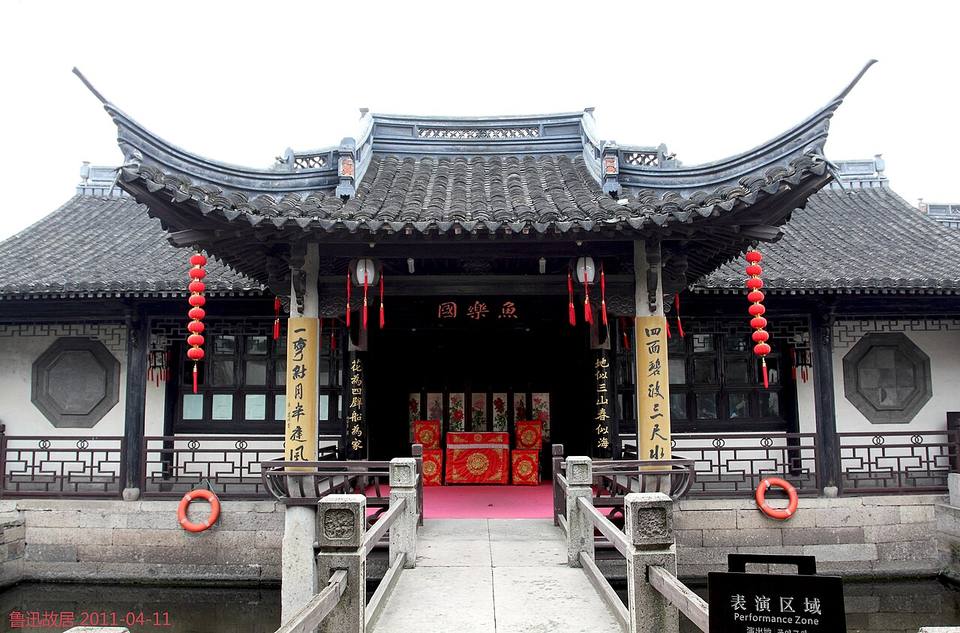
Yuecheng District, Shaoxing, Zhejiang Province · Old Capital / Water-Town Culture
Shaoxing Old Town (Lu Xun's Hometown & Yellow Rice Wine Culture)
A museum-city without walls: the Three-Flavor Study and the Xianheng Tavern of Lu Xun's writings still stand where they always stood, and the aroma of yellow rice wine has been brewing from the days of Goujian, King of Yue, down to today.
Location
Yuecheng District, Shaoxing, Zhejiang Province
Stories and legends
The narratives of Yu the Great summoning the lords at Kuaiji and of Goujian sleeping on brushwood and tasting gall combine history and transmission; their details belong to the legendary layer.
History and context
Shaoxing's city history runs over 2,500 years (it was the capital of the Yue state). Lu Xun (1881–1936) was born in Shaoxing, and his hometown scenic area includes his former residence, the Three-Flavor Study and Hundred-Herb Garden (the garden inside the residence). Shaoxing yellow rice wine (huangjiu) is the representative of Chinese huangjiu; in 2006 the traditional brewing craft of Shaoxing wine was listed as national intangible cultural heritage, and its winter-brewing tradition (starting brewing at the Beginning of Winter and pressing at the Beginning of Spring) is still followed. The Xianheng Tavern became famous through Lu Xun's story "Kong Yiji" and is now a genuinely operating, time-honoured restaurant landmark.
Local life
Shaoxing's temperament is "legal secretaries and literati": a web of waterways, the creak of black-awning boats, and its many ancient bridges and river landings form the texture of life. Shaoxing people are shrewd and nostalgic at once: fennel beans must come with warmed huangjiu, Yue opera warbles from the stage, and queues form at the stinky-tofu stalls on Cangqiao Zhijie Street. This state of "a Lu Xun IP coexisting naturally with a living old town" is rare among China's literary hometowns.
Customs
Black-awning boats rowed by foot are a Shaoxing speciality; huangjiu is properly drunk warm (warmed to about 40°C), and during the winter-brewing season wineries open for tours (per winery arrangements).
Beliefs
No specific religious association; its main cultural attributes are Yue culture, huangjiu culture and the Lu Xun literary landscape (the city also has sacrificial sites such as the Yu the Great Mausoleum).
Local etiquette
Much of Lu Xun's hometown consists of protected buildings — do not make noise or touch exhibits in the residences; black-awning boats are charged per boat, so agree on route and duration first; huangjiu has a strong after-kick, so do not overindulge when tasting (and the general rule holds: no drink-driving).
Visiting notes
Best in spring and autumn; the Lu Xun Hometown scenic area requires reservations (per official rules), and the walk from Hundred-Herb Garden to the Three-Flavor Study links the sights; the Calligraphy Sage's Hometown is quieter and of high quality — a good crowd-avoiding alternative; staying a night for the old town's night river is even better value.
What to eat nearby
Shaoxing huangjiu (jiafanjiu / huadiao, drunk warm); fennel beans; stinky tofu (around Cangqiao Zhijie / Lu Xun's Hometown); braised pork with preserved mustard greens; cream puffs (na you xiao pan, a legacy of Shaoxing's Western-style pastry); huangjiu ice pops / huangjiu milk tea (recent cultural-creative ways of eating it)
Xianheng Tavern (Lu Xun Middle Road), Cangqiao Zhijie Street, the Lu Xun Hometown pedestrian street
Warm huangjiu but do not overheat it (above 60°C the aroma dissipates); slowly chewing fennel beans with wine is the modern use of Kong Yiji's style of eating — smile and move on, do not mimic any exclusion of others
A full meal 60–120 yuan (for reference only); huangjiu tasting 30–80 yuan (for reference only)
The China Huangjiu Museum in the north of the old town gives systematic background; when buying huangjiu, look for the vintage labels of proper wineries such as Guyue Longshan, and do not trust roadside "aged cellar-stored" goods.
Source leads: Shaoxing Municipal Bureau of Culture and Tourism; Lu Xun Hometown scenic area official site; China Huangjiu Museum materials.
Image source · wanghongliu · CC BY-SA 3.0