
Xihu District, Hangzhou, Zhejiang Province · Ancient Temple / Old Capital
Lingyin Temple
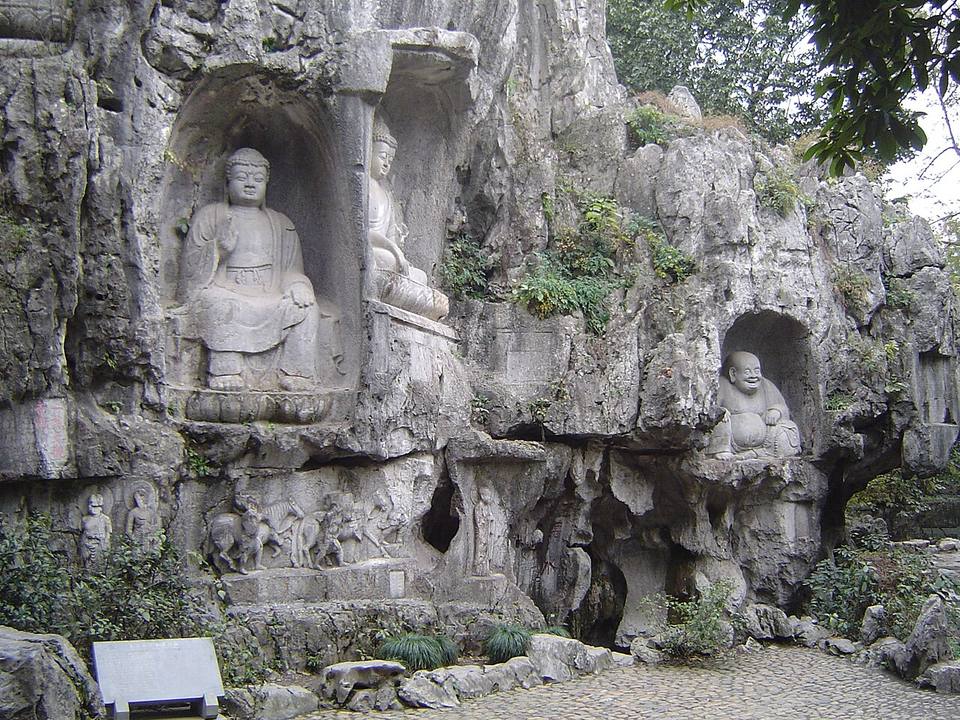
A great Chan (Zen) monastery of Jiangnan founded in the Eastern Jin; before you even pass the mountain gate, the grotto carvings on Feilai Peak — cut from the Five Dynasties to the Ming — let you read half a history of stone sculpture.
Location
Xihu District, Hangzhou, Zhejiang Province
Stories and legends
The legend that Feilai Peak "flew here from India" and the tales of Jigong, the Living Buddha (the Southern Song monk Daoji, buried at Hupao, with many tales attached to Lingyin), are widely told and belong to legend.
History and context
Lingyin Temple is said to have been founded around 326 (the Xianhe years of the Eastern Jin) by the Indian monk Huili. Feilai Peak preserves some 300-plus statues, flourishing from the Five Dynasties through the Song and Yuan, including treasures such as the Song-dynasty Budai (Cloth Sack Monk) figure; they are listed as nationally protected cultural heritage. The temple has been destroyed and rebuilt many times through the dynasties; the present layout is mostly a reconstruction from the late Qing onward, with the Hall of the Heavenly Kings' inscribed plaque and the Mahavira Hall as its landmarks.
Local life
Lingyin's temperament is "the inner chamber of West Lake": more secluded than the lakeshore, quieter than the downtown bustle, with incense and scholarship (a Buddhist academy) thriving side by side. Hangzhou people burning incense on the first and fifteenth days of the lunar month and vying for the first incense of the New Year (subject to the temple's arrangements) are part of the city's annual customs; Feilai Peak's cold-spring stream and ancient trees turn a religious site into woodland.
Customs
Offering three sticks of plain incense is the respectful norm (the temple's incense policy follows on-site rules); a vegetarian meal is a set part of any visit.
Beliefs
A famous monastery of Chan Buddhism (of the Linji lineage), one of Hangzhou's Buddhist centres.
Local etiquette
No photography inside the halls, no loud noise, and do not point or gesture at the Buddha statues; do not bring in large quantities of your own incense and candles to burn (follow the temple's eco-friendly incense rules); the grotto statues must never be touched or climbed on.
Visiting notes
Best in spring and autumn and in the early morning; you must first buy a Feilai Peak scenic-area ticket and then a Lingyin Temple incense voucher (the two-ticket system follows official rules); on holidays Lingyin Road jams solid — take a bus / cycle to Lingyin station and walk; allow half a day to include the Feilai Peak carvings.
What to eat nearby
Lingyin vegetarian noodles / vegetarian meals (the Shifangyuan vegetarian noodle window inside the temple — a real temple vegetarian food counter); West Lake vinegar fish (at time-honoured restaurants downtown); Longjing shrimp; Zhiweiguan snacks (pian'erchuan noodles / "cat's ear" pasta); farmhouse food around Faxi Temple (on the way)
The vegetarian food windows inside Lingyin Temple, Tianwaitian (a time-honoured vegetarian / Hangzhou-cuisine restaurant area near Lingyin), Meijiawu farmhouse restaurants
Do not bring meat or fish into the hall areas when eating vegetarian food in the temple; for vegetarian noodles, queue to collect your meal and finish everything without waste, in keeping with "cherishing good fortune"
Vegetarian noodles 20–40 yuan (for reference only); a Hangzhou-cuisine meal 80–150 yuan (for reference only)
Faxi Lecture Temple (Upper Tianzhu) is on the same route as Lingyin; for the much-photographed amulets, buy at the temple's own windows and avoid counterfeits.
Source leads: Lingyin Temple official site; Hangzhou Municipal Bureau of Gardens and Cultural Relics materials on the Feilai Peak carvings.
Image source · No machine-readable author provided. Sumple~commonswiki assumed (based on copyright claims). · CC BY-SA 3.0