
Roman mythology · Chief god
Jupiter
Treaties, oaths and triumphs all led Romans up the Capitoline Hill to answer to this god of thunder.
Stories and legends
Jupiter is the king of the Roman gods and the god of the sky and thunder, wielding lightning bolts, with an eagle often at his side and the oak as his sacred tree. He dwelt on the Capitoline Hill and, together with Juno and Minerva, formed the Capitoline Triad that guarded the Roman state; he was the witness of oaths, so Romans making treaties, swearing vows, or returning in triumph passed through his temple, and a victorious general laid his spoils before his altar. Romans also said that Jupiter once spoke with the second king, Numa Pompilius, and laid down the rules of sacrifice; in times of drought people prayed to him for rain, and any place struck by lightning belonged to him and had to be fenced off from common use.
Origins of the story
What can be verified is the religious and architectural record: Jupiter was the chief god of Roman state religion throughout the Republic and the Empire, until Christianity became the dominant religion of the Empire; the temple of Jupiter on the Capitoline was begun by Tarquinius Priscus and completed by the last king, Tarquinius Superbus, and dedicated in 509 BC at the start of the Republic, then rebuilt after great fires in 83 BC, AD 69, and AD 80, with most of the surviving foundations and podium lying beneath the Palazzo Caffarelli, and the podium measuring about 55 by 60 metres (one view gives about 50 by 60 metres, and scholars have no consensus on the exact figure, so this remains open). The identification of Jupiter with the Greek Zeus belongs to the Romans' own practice of Greek-style assimilation: Latin literature and Roman art borrowed heavily from the myths and imagery of Zeus, but Jupiter was originally a native Italian sky god, and the two cannot simply be equated. The story of Jupiter speaking with Numa and laying down the rules of sacrifice belongs to mythical narrative, not to verifiable history.
Places you can visit
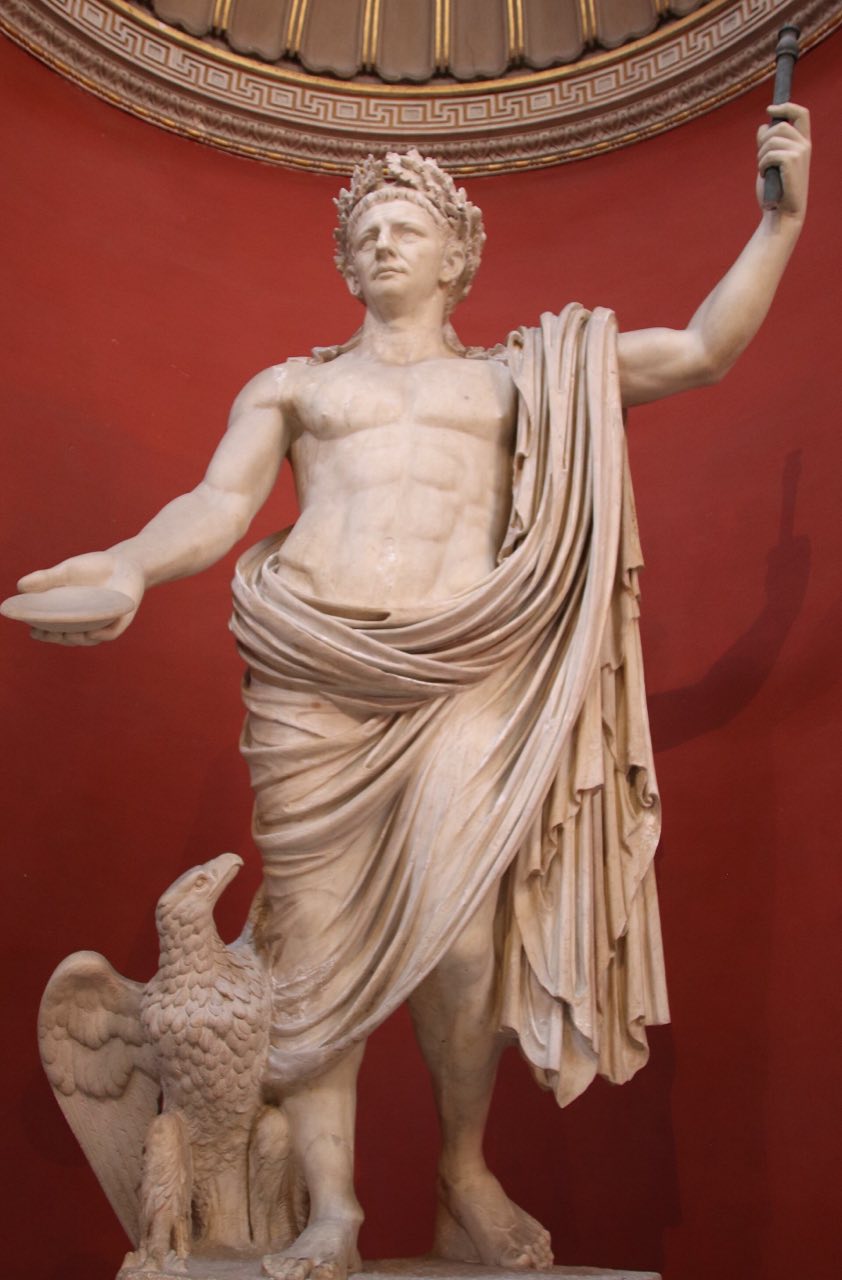
You can see the remains of the temple of Jupiter and a reconstruction model in the Capitoline Museums area, which convey the scale and the three-cella layout of Rome's chief state temple; the Round Hall of the Vatican Museums holds a statue of the emperor Claudius portrayed as Jupiter, which shows how Jupiter's attributes, the lightning bolt and the eagle, were used in imperial portraiture, though this statue is a portrait of an emperor in the guise of a god, not a cult image of Jupiter himself; and the Capitoline Hill itself is the hill on which the temple and the Roman citadel once stood.
Image source · Vatican Museums, Round Hall: Claudius portrayed as Jupiter · Gary Todd · Public domain
