

City guide · 重庆 · 古称渝州
Chongqing
A mountain city and river city where the two rivers meet — half everyday smoke and fire, half immortals
Chongqing stands where the Yangtze and the Jialing River meet, its urban area built on the mountains and hills between the Zhongliang and Tongluo ranges — the most three-dimensional of China's big cities. The stilt-house cluster of Hongyadong, the monorail passing through the building at Liziba, the spiralling interchanges and the cross-river cableway make up its multiple titles: "mountain city", "river city" and "bridge capital". This is the centre of Bayu culture: the beef-tallow fragrance of hot pot, the echoes of the Chuanjiang boatmen's chants and the teahouses inside air-raid shelters together write the straightforward, hearty character of Chongqing people. The main urban districts hold more than ten million people; it is the economic and transport hub of the west.
History
How the city came to be
Chongqing was in ancient times the land of the Ba state; after the Qin destroyed Ba it set up Ba Commandery. In 316 BC Zhang Yi built Jiangzhou City, and Chongqing's city history runs over three thousand years. In the sixteenth year of Chunxi of the Southern Song (1189), Zhao Dun was first enfeoffed as Prince Gong and then ascended the throne, and taking the meaning of "double celebration" (shuangchong xiqing) he raised Gongzhou to Chongqing Prefecture — the origin of the name "Chongqing". After the Ming and Qing migrations into Sichuan, Chongqing, on the water transport of the Jialing and Yangtze rivers, became the commercial centre of the southwest, and opened as a treaty port in 1891. During the War of Resistance (1937–1946) Chongqing was the National Government's wartime capital (peidu), becoming the Far East command centre of the world anti-fascist war, enduring the great bombing without yielding. In 1997 Chongqing was established as a municipality directly under the central government, China's fourth, and the leader of western development; the mountainous terrain at the meeting of the Yangtze and Jialing rivers created its three-dimensional, magical cityscape.
- 316 BCThe Qin destroyed the Ba state, set up Ba Commandery and built Jiangzhou City
- 1189Emperor Guangzong of Song raised Gongzhou to Chongqing Prefecture for the "double celebration"
- 1891Chongqing formally opened as a port for foreign trade
- 1929Chongqing was formally established as a city
- 1937The National Government moved to Chongqing, which became the wartime capital of the War of Resistance
- 1949Chongqing was liberated on 30 November
- 1983Chongqing became the country's first pilot city for comprehensive economic-system reform
- 1997The Chongqing Municipality was established

Local life
Food and local daily life
Hongya Cave, Chongqing
Must-try
- Chongqing hotpot
- Chongqing xiaomian (spicy noodles)
- Hot-and-sour sweet-potato noodles
Chongqing hotpot (nine-grid pot), Chongqing xiaomian (numbing-spicy noodles), hot-and-sour sweet-potato noodles, maoxuewang (spicy blood-and-offal stew), Shancheng mini tangyuan
| Where to eat | Hongyadong's Bayu-style street, Bayi food street at Jiefangbei, old hotpot restaurants in residential areas (Guanyinqiao / Lianglukou) |
|---|---|
| Typical price per person | CNY 60–120 |
| Tips | Hongyadong is mainly for photo-op snacks — go to neighbourhood places for proper hotpot; the split 'yuanyang' pot is the visitor-friendly option. |
Prices are typical rates as of October 2026, not exact quotes; CNY equivalents are approximate where exchange rates fluctuate.

N509FZ · CC BY-SA 4.0
Trips beyond the city
These places can be explored from this city but lie outside it. See each place for transport and visiting guidance.

Regional deep dives
Read deeper into each place
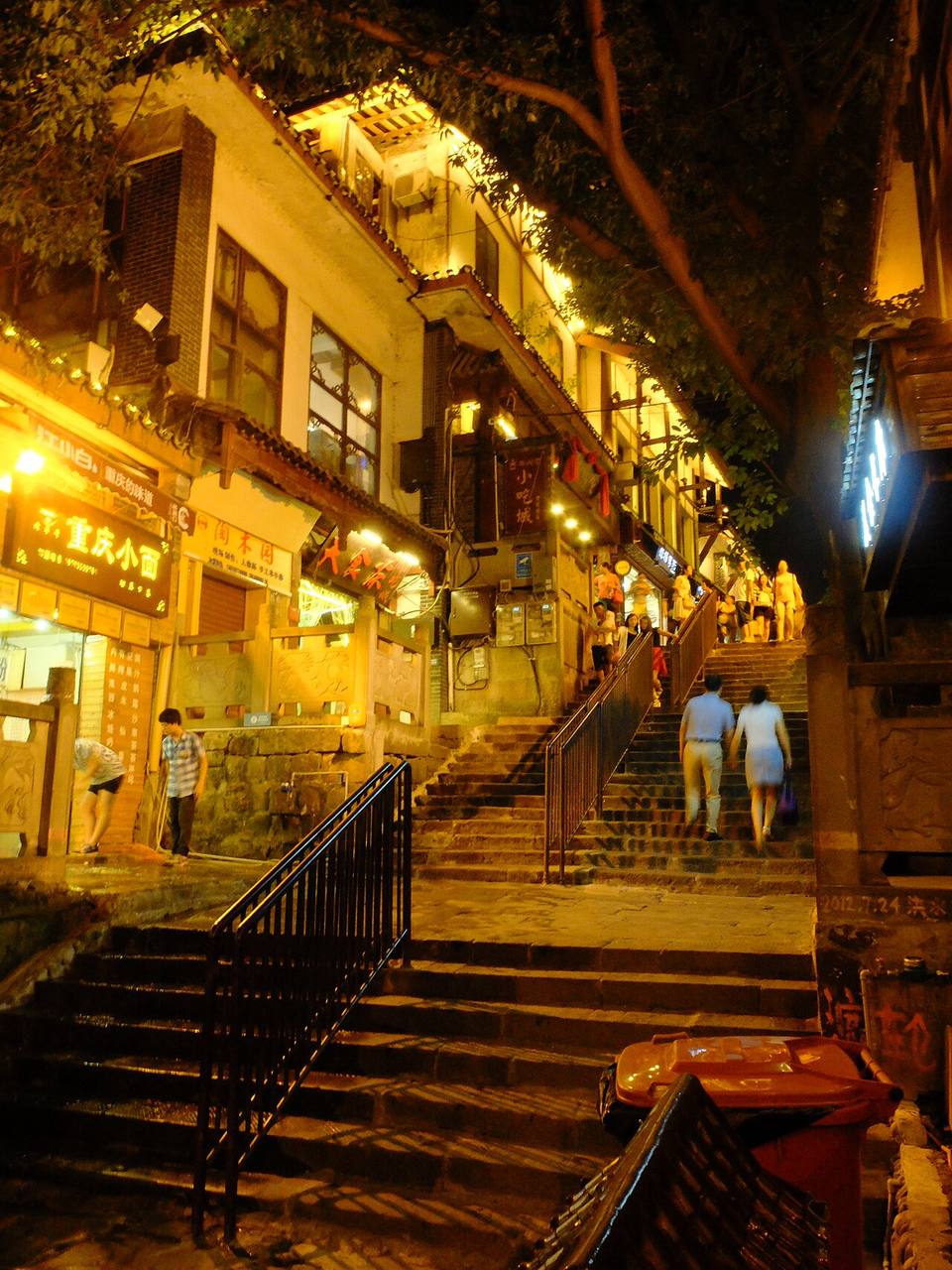
Shapingba District, Chongqing · Old Town / Bayu Folk Customs
Ciqikou Old Town
A thousand-year-old wharf town on the Jialing River, its bluestone main street sliding down from the mountain shadows toward the riverbank on the Baigongguan side — the length of the Chen Mahua queue is the gauge of its popularity.
Explore the local guide ↗Source leads: Shapingba District Bureau of Culture and Tourism / Ciqikou Old Town official introduction.
Image source · Franco Pecchio from Milano, Italy · CC BY 2.0
Source leads are being checked individually; confirm travel details with local official notices.