
Emeishan City, Leshan, Sichuan Province · Buddhist Famous Mountain / Natural Heritage
Mount Emei
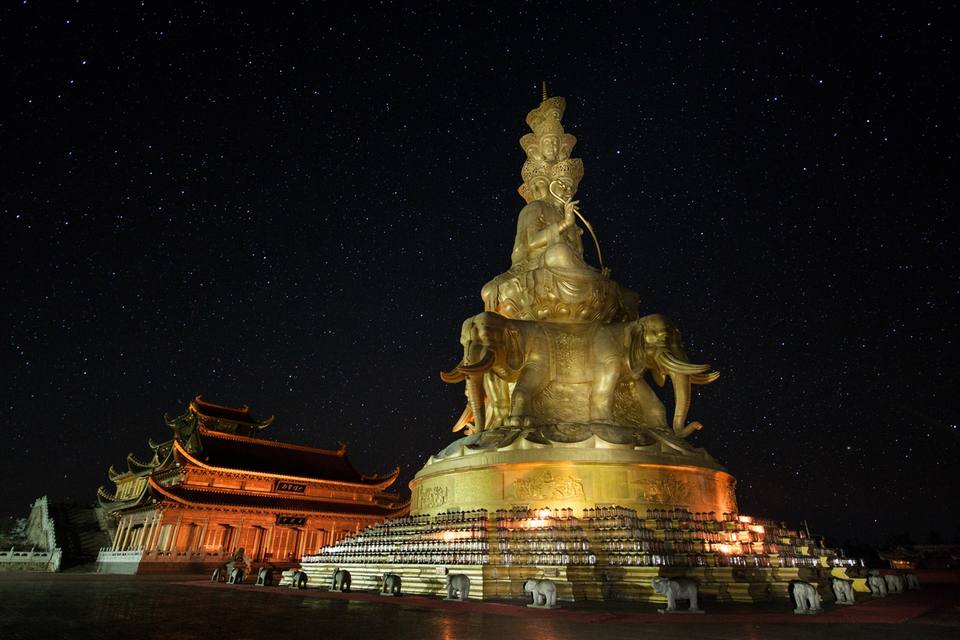
The 48-metre golden statue of Samantabhadra with ten faces in four directions stands on the Golden Summit above a 3,079-metre sea of clouds, with sunrise, Buddha's halo and the sacred lamps — three wonders on one mountain: the Samantabhadra sanctuary gives a Buddhist famous mountain its full pageantry.
Location
Emeishan City, Leshan, Sichuan Province
Stories and legends
The narratives of Samantabhadra's manifestations and of the Buddha's halo (treasure light) and sacred lamps belong to the faith-legend layer.
History and context
Mount Emei is one of the Four Sacred Buddhist Mountains of China (the Samantabhadra sanctuary); Buddhism's arrival can be traced to the Eastern Han (as transmitted), and its temples flourished from the Jin and Tang onward. The Golden Summit's Huazang Temple has a long history, and the present four-direction, ten-face Samantabhadra statue was completed in 2006 at 48 metres tall. The main peak, the Golden Summit, stands 3,079 metres, with Wanfo Peak at 3,099 metres the highest point. In 1996 it was listed as dual World Heritage together with the Leshan Giant Buddha. The wild Tibetan macaques of the monkey zone (the Ecological Monkey Zone) are a famous and risky interaction point. The scenic area runs staged ticketing for entrance + sightseeing buses + cable cars with reservations (per official rules).
Local life
Emei's temperament is "a sacred mountain's two faces": from Baoguo Temple to Qingyin Pavilion runs the seclusion of teahouses and ancient temples; above Xixiang Pool lies the wildness of cloud seas and monkey troops; and the Golden Summit is the ceremony of ten thousand people waiting for sunrise. Emei martial arts (the Emei school) and Emei teas (Zhuyeqing, Emei Xueya) add jianghu and tea fragrance to this Buddhist mountain, while Emeishan city's nightlife at the foot (hot springs, night markets) does the finishing.
Customs
Mountain pilgrimage with incense (the full ancient footpath is a pilgrimage of ascetic grade), keeping vigil for the Golden Summit sunrise, and civilised monkey-watching in the monkey zone (the scenic area posts dedicated managers).
Beliefs
The core sacred site of the Buddhist Samantabhadra sanctuary; Wannian Temple, Huazang Temple and others are functioning religious venues.
Local etiquette
The monkeys will snatch food and bags: keep food inside a zipped backpack, never carry plastic bags in your hand, never tease the monkeys or stare them down, and if something is snatched do not fight to retrieve it (personal safety first); the Golden Summit is at high altitude — the elderly and children should go by their strength and guard against altitude sickness; no photography inside the temple halls.
Visiting notes
Best on clear spring and autumn days and for winter snow scenes; two days for the whole mountain is right (one day from the foot to Qingyin Pavilion, one day for the Golden Summit); between Leidongping and Jieyin Hall, walking vs. the cable car depends on the queue; Emeishan Station (high-speed rail) reaches the Baoguo Temple visitor centre directly; for sunrise, stay at the Golden Summit / Leidongping and check that day's first-cable-car time.
What to eat nearby
Emei doufunao and ye'erba; Emei Xueya / Zhuyeqing tea; mountain cured pork and wild vegetables; Emei braised shredded eel (a local signature); vegetarian food around Baoguo Temple
The Baoguo Temple food street, the Maluqiao dining belt in Emeishan city, and Haochi Street
At vegetarian tables keep purity; eating around the monkey zone is the greatest taboo (the monkeys will smell food and snatch it) — dine inside the restaurants
A full meal 60–110 yuan (for reference only)
The sightseeing bus + cable cars are unavoidable major expenses — budget them first; summit lodging is expensive with limited heating, so in winter bring ample warm clothing.
Source leads: UNESCO World Heritage "Mount Emei Scenic Area, including Leshan Giant Buddha Scenic Area" (1996); Mount Emei scenic area official site.
Image source · Jeffdai1988 · CC BY-SA 3.0