
Celtic mythology · Irish mythology, the Ulster Cycle
Cú Chulainn
The "Hound of Culann" held back an invading army alone, and died standing, tied to a pillar stone.
Stories and legends
Cú Chulainn was born Sétanta, the son of the god Lug and the mortal woman Deichtine. As a boy on his way to a feast at the smith Culann's house, he killed Culann's fierce hound in self-defence, and then volunteered to guard the gate himself until a new hound grew up, which is how he earned the name "Hound of Culann". He became the pupil of the woman warrior Scáthach and received the magic spear Gáe Bulg. At seventeen, when Queen Medb of Connacht led an army into Ulster to seize the famous bull known as the Brown Bull of Cooley, the warriors of Ulster were struck by a spell and could not move, and only Cú Chulainn stood before the army, fighting single combats day after day. In anger he would enter a battle frenzy in which his face became wholly unrecognisable, and he could no longer tell friend from foe. At last, gravely wounded, he tied himself to a standing stone and died on his feet, and people only knew he was dead when a crow landed on his shoulder.
Origins of the story
Cú Chulainn is the central figure of the medieval Irish text Táin Bó Cúailnge and the Ulster Cycle. The earliest surviving texts were written in Old Irish and Middle Irish and date roughly to the twelfth century. His half-divine parentage, his battle frenzy and his single-handed defence against an army are legendary elements. The legendary palace of Emain Macha in the tales corresponds to the Navan Fort site near Armagh today, but matching the figures of legend one by one to specific historical kings has no firm evidence, and the point remains open. The bronze statue of The Death of Cú Chulainn in the hall of the Dublin General Post Office is real. Oliver Sheppard's original plaster model was completed in 1911 and exhibited in 1914, the bronze was unveiled in 1935, and it was later adopted as the official memorial of the 1916 Easter Rising, although it was not made for the Rising.
Places you can visit
When you are in Dublin, you can see Sheppard's bronze of The Death of Cú Chulainn in the hall of the General Post Office, and visit the Witness History museum in the same building. Near Armagh in Northern Ireland you can visit the Navan Fort site and visitor centre, where the story is told as the legendary palace of Emain Macha. The Cooley Peninsula is the legendary route of Medb's army in Táin Bó Cúailnge.
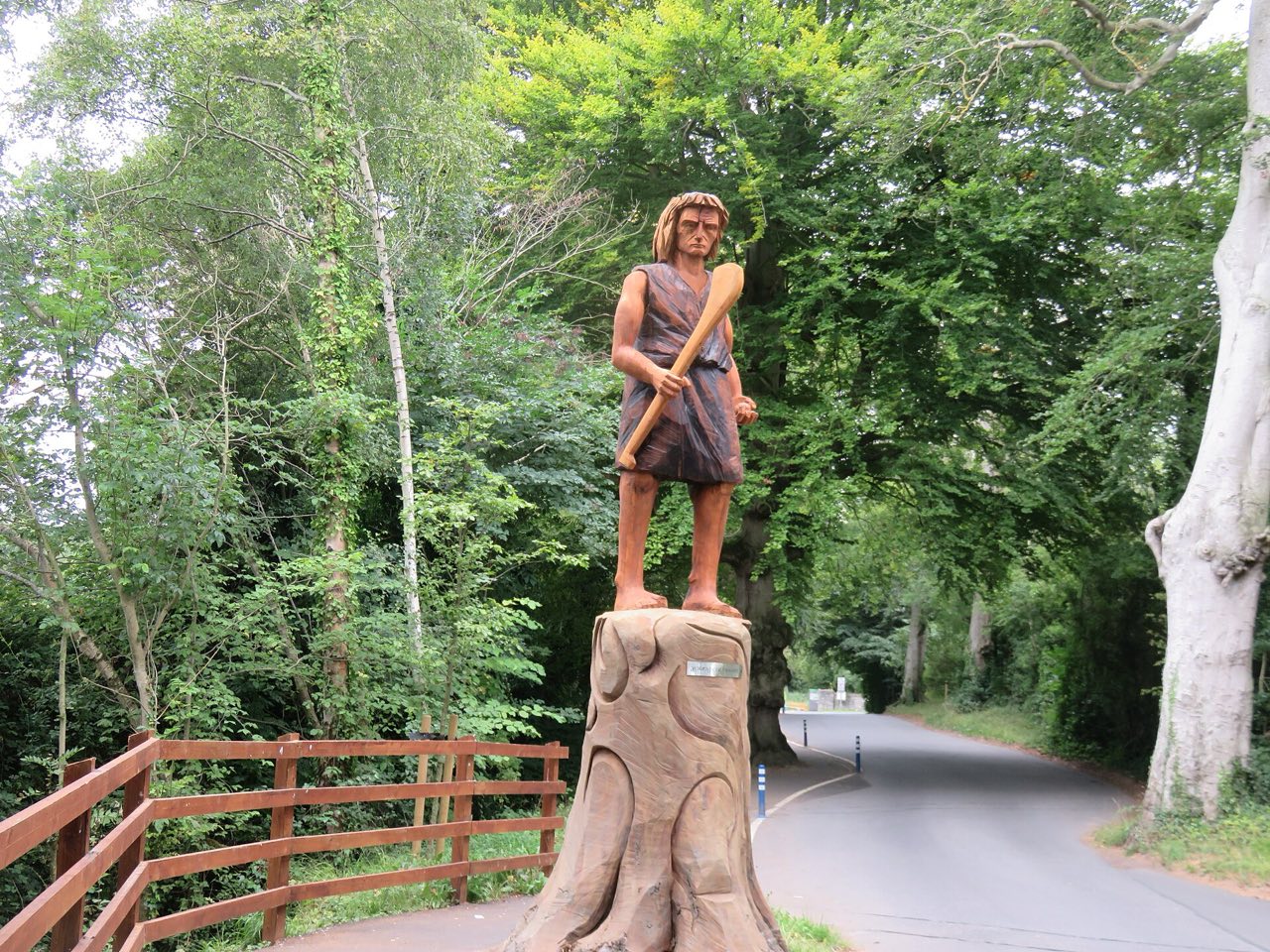
Image source · Wooden sculpture of Cú Chulainn (a modern work, not the GPO bronze in Dublin) · Leimanbhradain · CC BY-SA 4.0