
Norse Mythology · Cosmological myth / natural association
Bifröst, the Rainbow Bridge, and Iceland's Waterfalls
The rainbow is the gods' commuting bridge — and its keeper, Heimdall, watches it day and night, until the day of doom, when the giants come treading across it.
Stories and legends
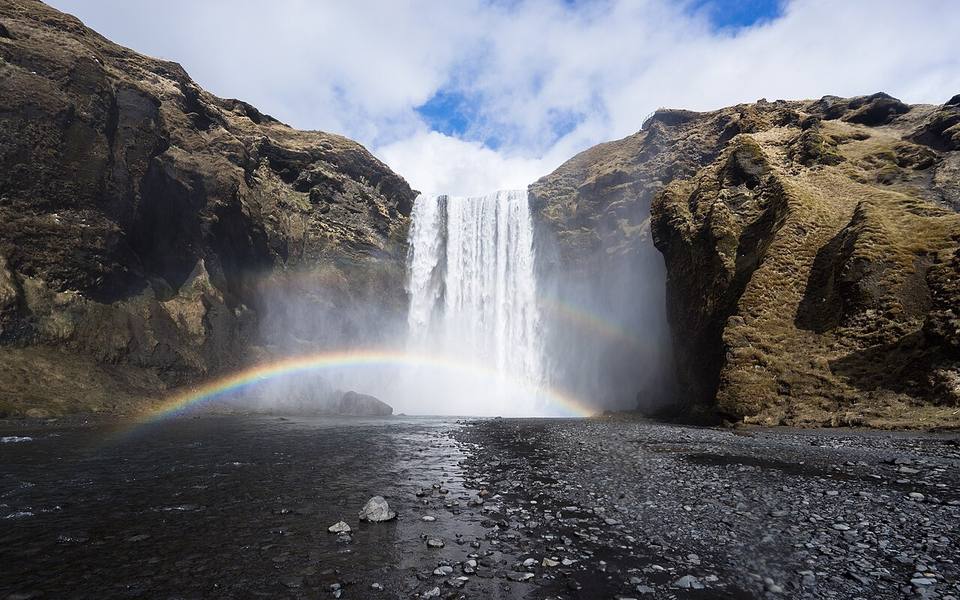
One end of the rainbow bridge Bifröst rests on Himinbjörg in Asgard, the realm of heaven (the palace of Heimdall), and the other end falls upon the human world. The bridge has three colours, and the red band is burning flame — the Prose Edda explains that this is to stop the frost giants and mountain giants from seizing the bridge and storming heaven: if they set foot on it, they will surely be barred by the flames and by the river rushing beneath the bridge. The bridge's keeper, Heimdall, is the most vigilant of the gods: he sleeps less than a bird, can see a hundred miles off, and can hear the grass grow and the wool sprout on sheep; beside his pillow lies the Gjallarhorn — the day it sounds is the day Ragnarök begins. Ordinarily only the gods cross the bridge: every day they ride down along it to the judgement court beside the Well of Urðr; Thor alone is the exception — he is required to wade through the water, because his thunder and his weight would break and scorch the bridge's surface (the Song of Grímnir names the two rivers he fords). Prophecy has written the bridge's ending: the sons of Muspell (the fire-giant host), led by Surtr, charge across the bridge, and Bifröst shatters beneath their hooves — the gods' most beautiful creation, destroyed in the very battle it was made to defend against. Iceland's waterfalls have no direct binding to this bridge in the ancient texts (see History and Origins), but when you stand in the spray of Skógafoss and watch a double rainbow span the black rock and the green meadow, you understand at once why modern Icelanders are willing to "lend" this bridge to the waterfall.
Origins of the story
Bifröst is found in the Prose Edda · Gylfaginning chapters 13, 15, and 51 and in the Poetic Edda · Grímnismál stanza 29 and the Lay of Fáfnir. It must be made explicit: the Eddas never mention Skógafoss or Gullfoss, and the association of the two waterfalls with Bifröst is an interpretive association of contemporary Icelandic guiding and travel literature; this entry presents it as a "modern mythic interpretation" and does not dress it up as an ancient source. Skógafoss's own local legend is that the settler Þrasi hid a chest of gold behind the falls (the chest's ring is now kept in the Skógar Museum), and Gullfoss's own local narrative is the true history of Sigríður's early-20th-century fight to protect the falls from hydroelectric development — each of the two waterfalls has a real story of its own and needs no borrowed rainbow bridge to add lustre.
Customs
The rocks at the falls' edges are wet and slippery in the spray all year round — walk only on the trails inside the fences, and do not cross the ropes to photograph a rainbow; drones are prohibited or permit-controlled at many national parks and popular waterfalls — check the on-site signs first; do not swim, draw water, or play in the plunge pools; the door ring at the Skógar Museum is an artefact — do not touch it.
Places you can visit
Skógafoss (25 m wide, a drop of 60 m, with single/double rainbows common on fine days, and steps climbing to the top of the falls) and the Skógar Folk Museum (the chest's door ring); Gullfoss (on the Golden Circle, falling in two tiers, with a high probability of rainbows in the afternoon, a memorial, and the Sigríður narrative); Seljalandsfoss can serve as a comparison on the same line. The waterfalls are all open natural sites; parking and trail rules are as officially announced each year.
Image source · Jeremy Goldberg jeremy · CC0

