
Norse Mythology · Eschatological myth
Ragnarök — The Twilight of the Gods
The ending of Norse mythology is not victory, but rebirth after mutual destruction — the earth sinks into the sea, and rises from the sea again.
Stories and legends
The omens had long been lined up in sequence: the death of Baldr, the collapse of kinship morality, and Fimbulvetr, the mighty winter of three winters in a row with no summer between. The hound Garm bays before the underworld, and three roosters crow in the land of the giants, in Asgard, and in Hel. Fenrir breaks the gods' chain, Heimdall blows the Gjallarhorn, and the einherjar march out of the hall in ranks. The battlefield is the plain of Vígríðr: Odin faces Fenrir and is swallowed by the great wolf; his son Víðarr sets his foot in the wolf's jaw and tears its mouth apart in vengeance; Thor kills Jörmungandr, then retreats nine steps and dies of the venom; Frey, who long ago gave his self-seeking sword to his servant Skírnir, meets the fire giant Surtr weaponless and falls; Loki and Heimdall destroy each other; Týr and the hellhound Garm go down together. Then Surtr hurls fire across the world, the World Tree burns, the sun turns black, the earth sinks into the sea, and the stars fall. Yet the Seeress's Prophecy does not stop its pen at the destruction: the seeress sees the earth rise again from the sea, green as before, waterfalls plunging and eagles striking the sky; Baldr and Höðr return from the underworld, the surviving gods gather again on the plain of Iða and talk of old times; and a pair of humans, Líf and Lífþrasir, hidden in Hoddmímir's wood and feeding on the morning dew, walk out of the forest and become the ancestors of humankind anew. Doomsday is not the end — it is clearing and sowing.
Origins of the story
The Poetic Edda · Völuspá (女先知预言) forms the skeleton, and the Prose Edda · Gylfaginning from chapter 51 onward gives the systematised retelling; the two differ in details (such as the list of survivors). The hypothesis that "the mythology derives from firsthand experience of Icelandic volcanoes," advanced by Hilda Ellis Davidson and others (the correspondence between the 1783 Laki eruption and the poem's "the sun turns black, the earth sinks, the flames reach high to heaven"), is an influential academic hypothesis, not a settled conclusion. The island of Surtsey rose from a submarine eruption in 1963 and was named after the fire giant Surtr — modern toponymy's return salute to mythology; the island is a strict scientific reserve, closed to the public, who can only view it from afar or through exhibitions.
Customs
The rip currents and sneaker waves at the black beach are lethal, and visitors have been swept away over the years — you must stay behind the warning signs and never turn your back on the sea; landing on Surtsey, and disturbing birds with drones, are strictly forbidden; on volcano hikes, walk only on the open trails and never enter areas where the lava has not fully cooled; do not take sand and stones from the black beach as souvenirs (reserve regulations).
Places you can visit
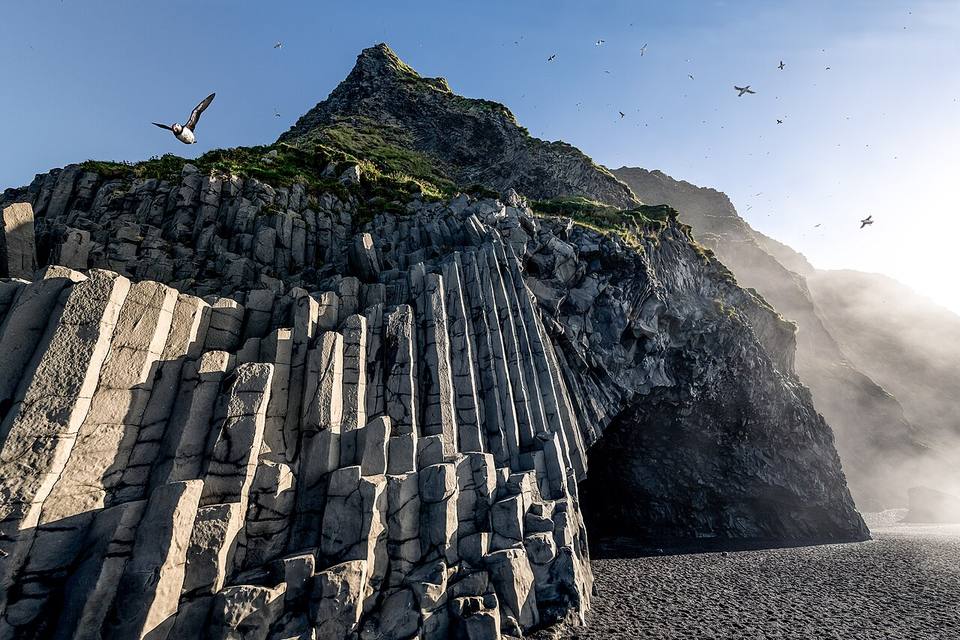
Reynisfjara black beach and the Reynisfjara/Reynisdrangar basalt sea stacks on Iceland's south coast (viewed from afar like the fossils of giants — a modern landform association); viewing points for the Westman Islands and Surtsey, and the Eldfell volcano (the 1973 eruption site and the Eldheimar volcano museum); distant views of the Hekla volcano (called the "Mouth of Hell" in the Middle Ages — a narrative of medieval monks); the Edda manuscript exhibitions at the National Museum of Iceland (the originals are held at the Árni Magnússon Institute at the University of Iceland and are usually presented in copies or special exhibitions). Opening times and exhibition periods are as officially announced each year.
Image source · Bernd Thaller from Graz, Austria · CC BY 2.0
