
Norse Mythology · Creation myth / chief-god belief
Odin and Valhalla
He traded one eye for wisdom, and drills the dead heroes day after day — all to gain one more chance in a final battle he is fated to lose.
Stories and legends
Odin is the son of Borr and a descendant of the primordial Búri; with his brothers Vili and Vé he slew the frost giant Ymir and made heaven and earth from his corpse: the skull became the sky, the blood the sea, the bones the mountains, and the brain the clouds. He offered one eye at the Well of Mímir in exchange for a drink of the wisdom that sees all things clearly; and he hung himself on the World Tree for nine nights, without food offered by anyone, pierced by a spear, in exchange for the runes. His two ravens, Huginn (thought) and Muninn (memory), fly over the world every day and return to report at his ear. Odin has another identity: father of war and of the dead. He sends the valkyries to choose the bravest of the fallen on the battlefield — half go to the goddess Freyja's Fólkvangr, and half enter the hall of the slain, Valhalla: the hall has five hundred and forty doors, its roof is covered with golden shields, and its beams and pillars are all spear-shafts. The einherjar hack each other to death on the plain by day; at dusk their wounds heal of themselves and they are all restored to life, sitting together to drink deep of goat's milk and mead (one account says they are fed by the milk of the ever-living goat Heiðrún and the flesh of the boar Sæhrímnir, the boar being reborn each night). All this enjoyment is military training: on the day the wolf Fenrir breaks his chain, the einherjar will march out of the hall with Odin to the decisive battle — and prophecy has long since written that Odin will be swallowed by Fenrir. To prepare for war in full knowledge of the outcome is the coldest undertone of the Odin myths.
Origins of the story
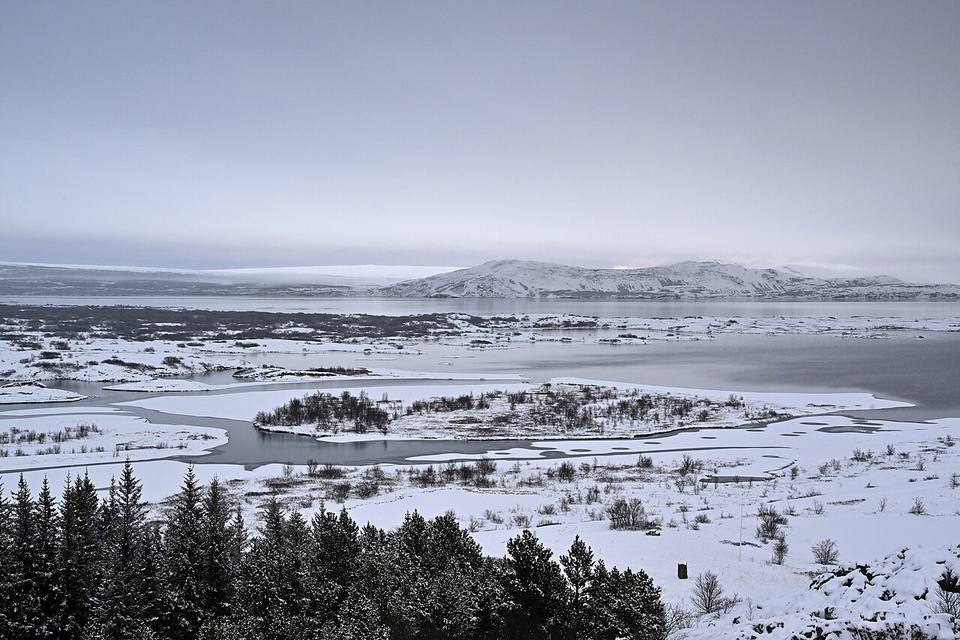
The core texts are the Poetic Edda · Völuspá (女先知预言), the Prose Edda · Gylfaginning, and the saga tradition of the Heimskringla; the details of Valhalla come mainly from the Grímnismál (格里姆尼尔之歌). Gamla Uppsala was the centre of royal power and sacrifice in ancient Sweden; Adam of Bremen's 11th-century History of the Archbishops of Hamburg records that the temple of Uppsala housed statues of Odin, Thor, and Frey — but this record is of the nature of second-hand report, and scholars debate its reliability, so it must be labelled when cited. Þingvellir has no direct sacrificial connection with Odin; its point of binding is the assembly tradition of the Viking commonwealth and the historical stage on which the sagas happened, and this entry positions it truthfully as a "cultural-context site," not an Odin sanctuary.
Customs
The mound bodies at Gamla Uppsala are protected cultural relics — climbing to the top of the mounds is forbidden; the vegetation at Þingvellir is fragile — walk only on the trails and do not throw "wish coins" into the rift-valley waters (the rules of Almannagjá); if you encounter a gathering at a modern Ásatrú ritual site, ask consent before watching, and do not mimic sacrificial gestures in jest.
Places you can visit
Gamla Uppsala in Sweden (the group of great royal mounds, the Gamla Uppsala Museum, interpretation at the church site); Þingvellir National Park in Iceland (the Alþing assembly site from 930, the Law Rock, the rift-valley landforms, a UNESCO site); saga place-name points in the Norwegian fjord region (such as modern experience facilities like the Viking village at Gudvangen — contemporary culture-and-tourism facilities, not antiquities); the National Museum of Denmark (permanent rune and Viking exhibitions). Activities at each museum are as officially announced each year.
Image source · G. Edward Johnson · CC BY 4.0
